


Optimized inorganic carbon regime for enhanced growth and lipid accumulation in Chlorella vulgaris
- PMID: 26101545
- PMCID: PMC4476231
- DOI: 10.1186/s13068-015-0265-4
Optimized inorganic carbon regime for enhanced growth and lipid accumulation in Chlorella vulgaris
Abstract
Background: Large-scale algal biofuel production has been limited, among other factors, by the availability of inorganic carbon in the culture medium at concentrations higher than achievable with atmospheric CO2. Life cycle analyses have concluded that costs associated with supplying CO2 to algal cultures are significant contributors to the overall energy consumption.
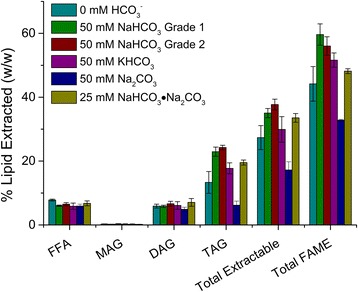
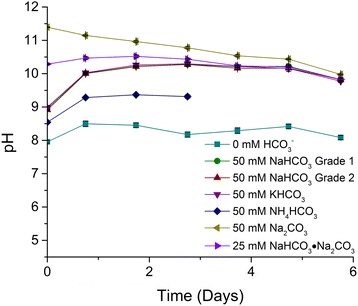
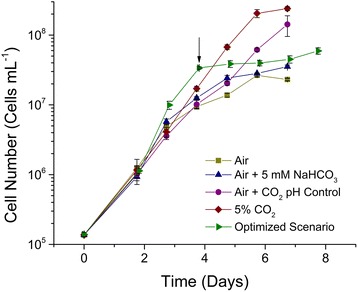
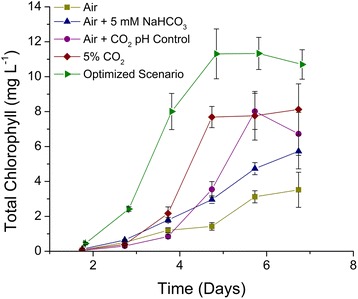
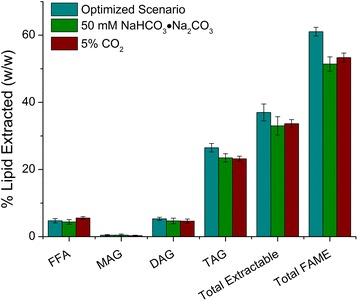
Results: A two-phase optimal growth and lipid accumulation scenario is presented, which (1) enhances the growth rate and (2) the triacylglyceride (TAG) accumulation rate in the oleaginous Chlorophyte Chlorella vulgaris strain UTEX 395, by growing the organism in the presence of low concentrations of NaHCO3 (5 mM) and controlling the pH of the system with a periodic gas sparge of 5 % CO2 (v/v). Once cultures reached the desired cell densities, which can be "fine-tuned" based on initial nutrient concentrations, cultures were switched to a lipid accumulation metabolism through the addition of 50 mM NaHCO3. This two-phase approach increased the specific growth rate of C. vulgaris by 69 % compared to cultures sparged continuously with 5 % CO2 (v/v); further, biomass productivity (g L(-1) day(-1)) was increased by 27 %. Total biodiesel potential [assessed as total fatty acid methyl ester (FAME) produced] was increased from 53.3 to 61 % (FAME biomass(-1)) under the optimized conditions; biodiesel productivity (g FAME L(-1) day(-1)) was increased by 7.7 %. A bicarbonate salt screen revealed that American Chemical Society (ACS) and industrial grade NaHCO3 induced the highest TAG accumulation (% w/w), whereas Na2CO3 did not induce significant TAG accumulation. NH4HCO3 had a negative effect on cell health presumably due to ammonia toxicity. The raw, unrefined form of trona, NaHCO3∙Na2CO3 (sodium sesquicarbonate) induced TAG accumulation, albeit to a slightly lower extent than the more refined forms of sodium bicarbonate.
Conclusions: The strategic addition of sodium bicarbonate was found to enhance growth and lipid accumulation rates in cultures of C. vulgaris, when compared to traditional culturing strategies, which rely on continuously sparging algal cultures with elevated concentrations of CO2(g). This work presents a two-phased, improved photoautotrophic growth and lipid accumulation approach, which may result in an overall increase in algal biofuel productivity.
Keywords: Bicarbonate; Biodiesel; CO2; Chlorella vulgaris; Fatty acid methyl ester (FAME); Microalgae; Nitrogen limitation; Triacylglycerol (TAG).
Figures
References
-
- How dependent are we on foreign oil? [http://www.eia.gov/energy_in_brief/foreign_oil_dependence.cfm]
-
- National Research Council: Advancing the Science of Climate Change. Washington, DC, USA; 2010.
-
- Stocker TFD, Qin G-K, Plattner M, Tignor SK, Allen J, Boschung A, Nauels Y, Xia V, Midgley B, Midgley PM. Climate Change 2013: The Physical Science Basis. Cambridge: Contribution of Working Group I to the Fifth Assessment Report of the Intergovernmental Panel on Climate Change; 2013.
-
- Dukes JS. Burning buried sunshine: Human consumption of ancient solar energy. Clim Chang. 2003;61:31–44. doi: 10.1023/A:1026391317686. - DOI
LinkOut - more resources
Full Text Sources
Other Literature Sources
Molecular Biology Databases
