. 2015 May;7(5):810-21.
doi: 10.3978/j.issn.2072-1439.2015.04.51.

Initial thrombolysis treatment compared with anticoagulation for acute intermediate-risk pulmonary embolism: a meta-analysis

Affiliations

Initial thrombolysis treatment compared with anticoagulation for acute intermediate-risk pulmonary embolism: a meta-analysis

Qixia Xu et al. J Thorac Dis. 2015 May.

Abstract

Background: The use of thrombolysis in patients with acute, intermediate-risk pulmonary embolism (PE) remains controversial. This meta-analysis compared the efficacy and safety of thrombolysis and anticoagulation treatments for intermediate-risk PE patients.

Methods: Two investigators independently reviewed the literature and collected data from randomized controlled trials (RCTs) of thrombolysis for intermediate-risk PE in the PubMed, MEDLINE, EMBASE, the Cochrane Library, and Chinese Biomedical Literature Databases (CBM).

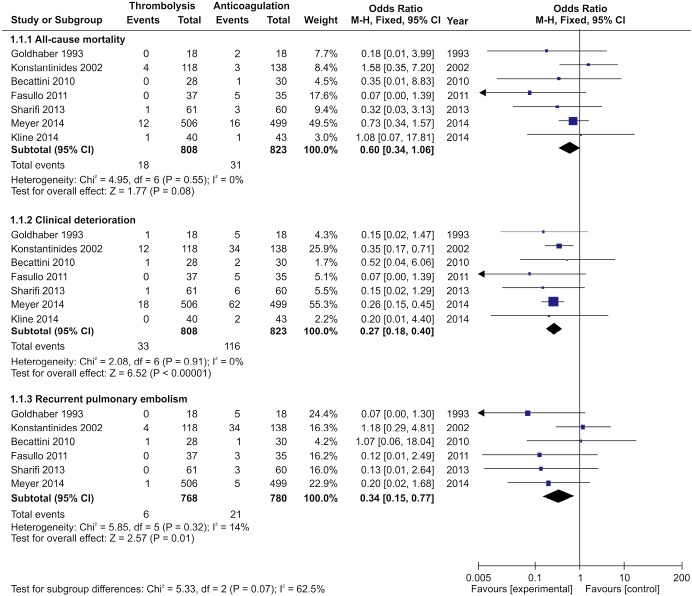
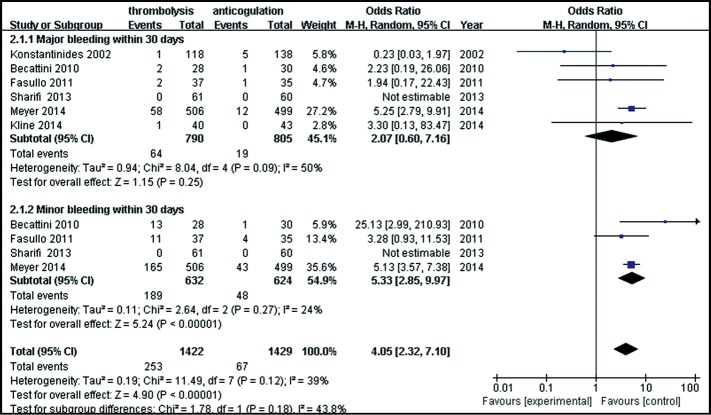
Results: A total of 1,631 intermediate-risk PE patients from seven studies were included. Significant differences were not found regarding the 30-day, all-cause mortality rates between the thrombolytic and anticoagulant groups [odds ratio (OR), 0.60; 95% confident interval (CI), 0.34-1.06; P=0.08]. The rate of clinical deterioration in the thrombolytic group was lower than that in the anticoagulant group (OR, 0.27; 95% CI, 0.18-0.41; P<0.01). Recurrent PE in the thrombolytic group was also significantly lower than that in the anticoagulant group (OR, 0.34; 95% CI, 0.15-0.77; P=0.01). Comparing the thrombolytic and anticoagulation groups, the incidence of minor bleeding was significantly higher in the thrombolytic group (OR, 5.33; 95% CI, 2.85-9.97; P<0.00001), but there were no difference in the incidences of major bleeding events (OR, 2.07; 95% CI, 0.60-7.16; P=0.25).

Conclusions: Thrombolytic treatment for intermediate-risk PE patients, if not contraindicated, could reduce clinical deterioration and recurrence of PE, and trends towards a decrease in all-cause, 30-day mortality. Despite thrombolytic treatment having an increased total bleeding risk, there was no difference in the incidence of major bleeding events, compared with patients receiving anticoagulation treatment.

Keywords: Thrombolytic therapy; anticoagulation treatment; efficacy; pulmonary embolism (PE); safety.


Figures
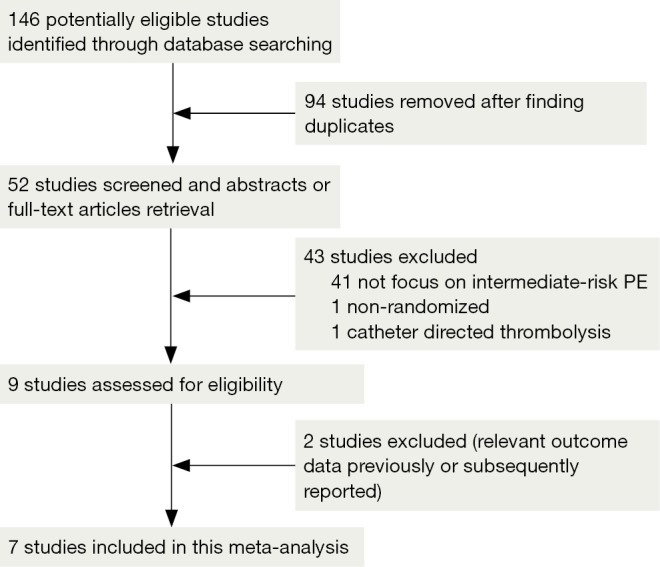
Figure 1
Figure 1
Flow chart of study selection. Potentially eligible studies [146] were identified from PubMed, EMBASE, MEDLINE, the Cochrane library, and the Chinese BioMedical Literature Database. After removing duplicates, 52 studies were selected and their full-texts or abstracts were screened. Finally, seven randomized-control trial studies were included in the meta-analysis.
Figure 2
Figure 2
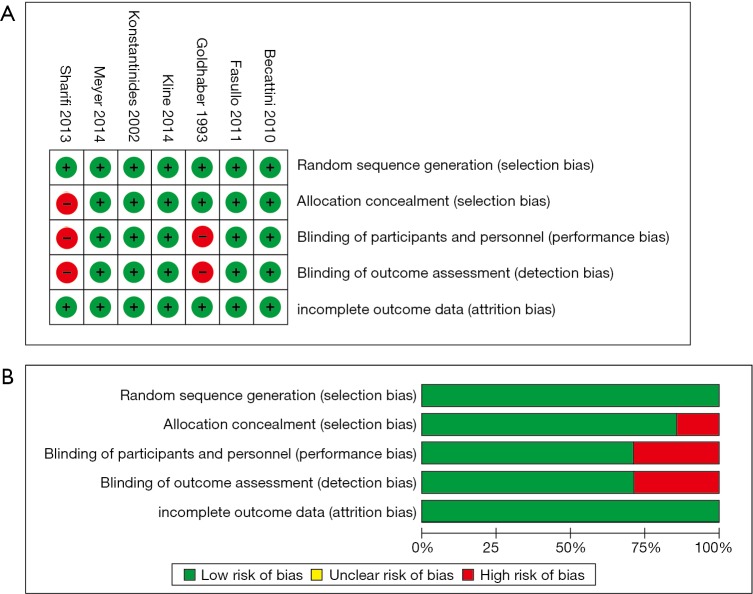
Risk of bias summary. (A) The risk of bias judgment for each included study; (B) the risk of bias judgment is presented as percentages across all included studies.
Figure 3
Figure 3
Comparison of clinical outcomes: thrombolysis vs. anticoagulation. Compared with anticoagulant treatment, thrombolytic therapy reduced all-cause mortality, but the difference was not statistically different (P=0.08). However, thrombolytic therapy significantly lowered the incidence of clinical deterioration events (P<0.00001) and recurrent pulmonary embolism (PE) (P=0.01). M-H, Mantel-Haenszel; CI, confident interval; df, degrees of freedom.
Figure 4
Figure 4
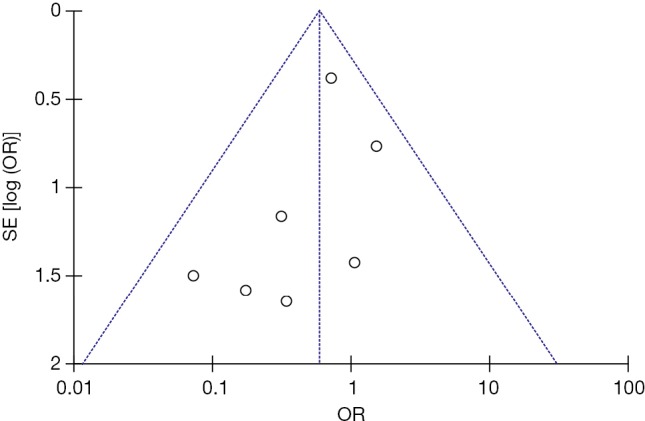
Publication bias of comparison of all-cause mortality. A funnel plot shows no obvious publication bias regarding all-cause mortality. SE, standard error; OR, odds ratio.
Figure 5
Figure 5
Comparison of bleeding events: thrombolysis vs. anticoagulation. Compared with the anticoagulation group, the thrombolytic treatment group demonstrated a significantly higher incidence of minor bleeding events (P<0.00001), but the incidence of major bleeding events was not statistically different (P=0.27). M-H, Mantel-Haenszel; CI, confident interval; df, degrees of freedom.
Figure 6
Figure 6
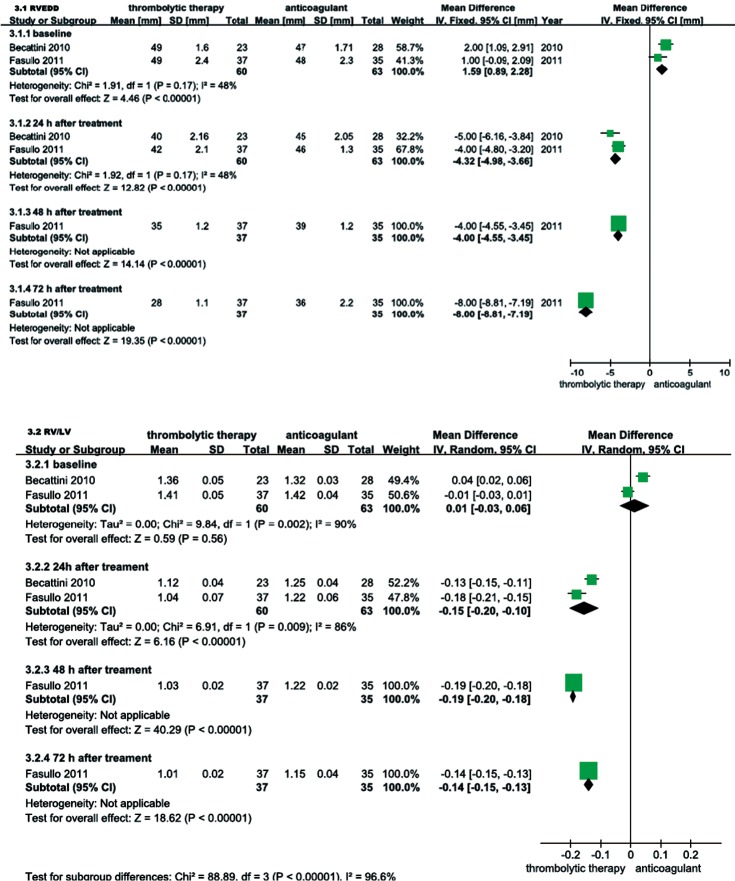
Comparison of Right ventricular (RV) function within the first three days: thrombolysis vs. anticoagulation therapy. Compared with anticoagulant group, RV function was improved within the first 3 days in thrombolytic group (P<0.05, all). RVEDD, right ventricular end-diastolic dimension; RV/LV EDD, right ventricular end-diastolic dimension/left ventricular end-diastolic diameter; IV, inverse variance; CI, confident interval.
Figure 7
Figure 7
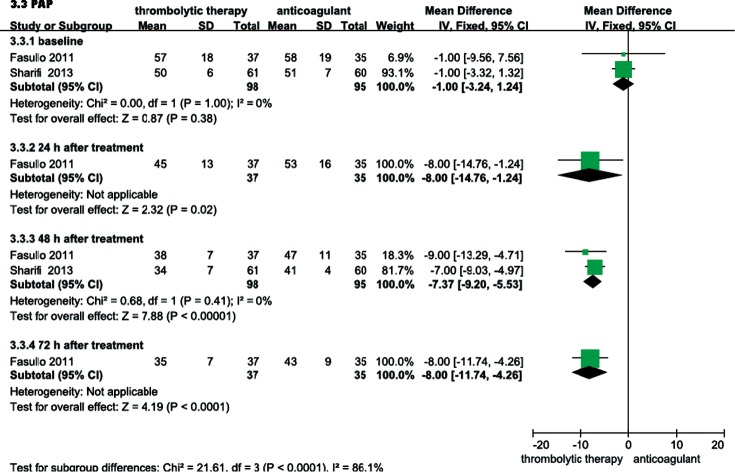
Comparison of PAP within the first 3 days: thrombolysis vs. anticoagulation therapy. Compared with anticoagulant group, PAP was lower within the first three days in thrombolytic group (P<0.05, all). PAP, pulmonary artery pressure; IV, inverse variance; CI, confident interval.
Figure 8
Figure 8
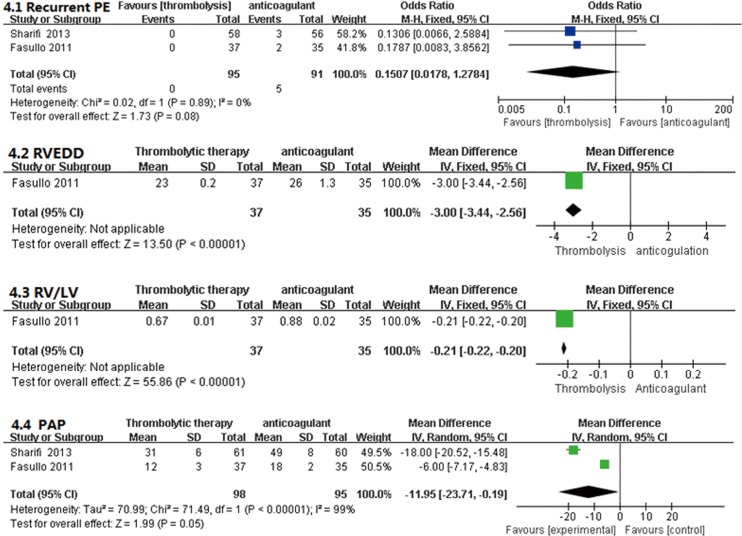
Comparison of Recurrent PE, RV function and mean pulmonary artery pressure (mPAP) after a 6-month follow-up: thrombolysis vs. anticoagulation. Compared with the anticoagulant group, recurrent PE was not significant difference (P=0.08), but RV function and mPAP was significantly improved in the thrombolysis group after a 6-month follow-up (P<0.05, all). RV, right ventricular; PE, pulmonary embolism; RV EDD, right ventricular end-diastolic dimension; RV/LV EDD, right ventricular end-diastolic dimension/left ventricular end-diastolic diameter; M-H, Mantel-Haenszel; IV, inverse variance; CI, confident interval.

References

    1. Vázquez FJ, Posadas-Martínez ML, Vicens J, et al. Incidence rate of symptomatic venous thromboembolic disease in patients from a medical care program in Buenos Aires, Argentina: a prospective cohort. Thromb J 2013;11:16. - PMC - PubMed
    1. Naess IA, Christiansen SC, Romundstad P, et al. Incidence and mortality of venous thrombosis: a population-based study. J Thromb Haemost 2007;5:692-9. - PubMed
    1. Goldhaber SZ. Venous thromboembolism: epidemiology and magnitude of the problem. Best Pract Res Clin Haematol 2012;25:235-42. - PubMed
    1. Cohen AT, Agnelli G, Anderson FA, et al. Venous thromboembolism (VTE) in Europe. The number of VTE events and associated morbidity and mortality. Thromb Haemost 2007;98:756-64. - PubMed
    1. Sekhri V, Mehta N, Rawat N, et al. Management of massive and nonmassive pulmonary embolism. Arch Med Sci 2012;8:957-69. - PMC - PubMed