


Treatment of Solitary Painful Osseous Metastases with Radiotherapy, Cryoablation or Combined Therapy: Propensity Matching Analysis in 175 Patients
- PMID: 26103516
- PMCID: PMC4478013
- DOI: 10.1371/journal.pone.0129021
Treatment of Solitary Painful Osseous Metastases with Radiotherapy, Cryoablation or Combined Therapy: Propensity Matching Analysis in 175 Patients
Abstract
Purpose: aim of this study was to identify outcomes in pain relief and quality of life in patients with a solitary painful osseous metastasis treated by radiotherapy, cryoablation or the combination using a propensity score matching study design.
Materials and methods: 175 patients with painful bone metastases were included in the study. Twenty-five of them underwent a radiation course (20 Gy in five daily fractions) 15 days after the cryoablation. These subjects were retrospectively matched by propensity analysis with a group of subjects treated by radiotherapy (125 subjects) and with a group treated byCryoablation (25 subjects). The pain relief in terms of complete response, rate of subjects requiring analgesics after treatments and the changes in self-rated quality of life were measured. Informed consent was obtained from the subject and the study was approved by the local Ethical Committee.
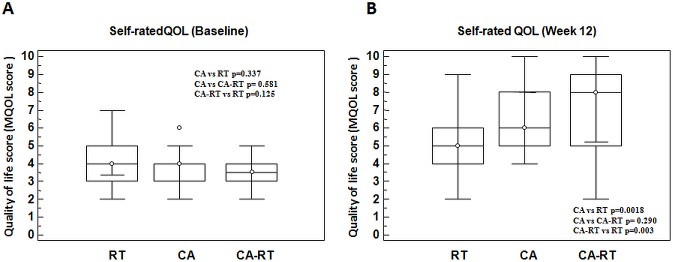
Results: An higher proportion of subjects treated by cryoablation (32%) or cryoablation followed by RT (72%;) experienced a complete response compared with patients treated by radiotherapy alone (11.2%). After Bonferroni correction strategy, the addition of radiotherapy to cryoablation significantly improved the rate of complete response compared with cryoablation alone (p = 0.011) and this paralleled with an improved self-rated quality of life. Seventeen subjects (13.6%) of patients in the radiotherapy group, 9 (36%) in the cryoablation group, and 19 (76)% in the cryoablation- radiotherapy group did not require narcotic medications.
Conclusions: The addition of radiotherapy to cryoablation favorably impacts on perceived pain, with a favorable toxicity profile. However, our data should be interpreted with caution and could serve as a framework around which to design future trials.
Conflict of interest statement
Figures
Similar articles
-
Treatment of osteolytic solitary painful osseous metastases with radiofrequency ablation or cryoablation: A retrospective study by propensity analysis.Oncol Lett. 2016 Mar;11(3):1948-1954. doi: 10.3892/ol.2016.4108. Epub 2016 Jan 14. Oncol Lett. 2016. PMID: 26998106 Free PMC article.
-
Percutane Image-Guided Cryoablation of Painful Osseous Metastases: A Retrospective Single-Center Review.Curr Probl Diagn Radiol. 2017 Jul-Aug;46(4):282-287. doi: 10.1067/j.cpradiol.2016.11.007. Epub 2016 Nov 10. Curr Probl Diagn Radiol. 2017. PMID: 28034477
-
Radiation therapy in the management of symptomatic bone metastases: the effect of total dose and histology on pain relief and response duration.Int J Radiat Oncol Biol Phys. 1998 Dec 1;42(5):1119-26. doi: 10.1016/s0360-3016(98)00264-8. Int J Radiat Oncol Biol Phys. 1998. PMID: 9869238 Clinical Trial.
-
Radiotherapy for palliation of symptoms in incurable cancer.Curr Probl Cancer. 1997 May-Jun;21(3):129-83. doi: 10.1016/s0147-0272(97)80004-9. Curr Probl Cancer. 1997. PMID: 9202888 Review.
-
Meta-analysis of dose-fractionation radiotherapy trials for the palliation of painful bone metastases.Int J Radiat Oncol Biol Phys. 2003 Mar 1;55(3):594-605. doi: 10.1016/s0360-3016(02)04147-0. Int J Radiat Oncol Biol Phys. 2003. PMID: 12573746 Review.
Cited by
-
Cryoablation for the Palliation of Painful Bone Metastasis: A Systematic Review.Cardiovasc Intervent Radiol. 2023 Nov;46(11):1469-1482. doi: 10.1007/s00270-022-03356-z. Epub 2023 Jan 11. Cardiovasc Intervent Radiol. 2023. PMID: 36631660
-
State-of-the-art of multidisciplinary approach of bone metastasis-directed therapy: review and challenging questions for preparation of a GEMO practice guidelines.Cancer Metastasis Rev. 2025 Apr 12;44(2):45. doi: 10.1007/s10555-025-10262-6. Cancer Metastasis Rev. 2025. PMID: 40220136 Free PMC article. Review.
-
Recent progress in cryoablation cancer therapy and nanoparticles mediated cryoablation.Theranostics. 2022 Feb 14;12(5):2175-2204. doi: 10.7150/thno.67530. eCollection 2022. Theranostics. 2022. PMID: 35265206 Free PMC article. Review.
-
An Overview of Decision Making in the Management of Metastatic Spinal Tumors.Indian J Orthop. 2021 Mar 6;55(4):799-814. doi: 10.1007/s43465-021-00368-8. eCollection 2021 Aug. Indian J Orthop. 2021. PMID: 34194637 Free PMC article. Review.
-
Decision Making: Osteoplasty, Ablation, or Combined Therapy for Spinal Metastases.Semin Intervent Radiol. 2017 Jun;34(2):121-131. doi: 10.1055/s-0037-1602707. Epub 2017 Jun 1. Semin Intervent Radiol. 2017. PMID: 28579680 Free PMC article. Review.
References
-
- Roodman GD. 2004. Mechanisms of bone metastasis. N Engl J Med 350:1655–1664. - PubMed
-
- Coleman RE. 2006. Clinical features of metastatic bone disease and risk of skeletal morbidity. Clin Cancer Res 12:6243S–6249S. - PubMed
-
- Coleman RE. 2001. Metastatic bone disease: clinical features, pathophysiology and treatment strategies. Cancer Treat Rev 27(3):165–176. - PubMed
MeSH terms
LinkOut - more resources
Full Text Sources
Other Literature Sources
Medical
