


Importance of Local Control in Early-Stage Prostate Cancer: Outcomes of Patients With Positive Post-Radiation Therapy Biopsy Results Treated in RTOG 9408
- PMID: 26104939
- PMCID: PMC4480595
- DOI: 10.1016/j.ijrobp.2015.03.017
Importance of Local Control in Early-Stage Prostate Cancer: Outcomes of Patients With Positive Post-Radiation Therapy Biopsy Results Treated in RTOG 9408
Abstract
Purpose: The purpose of this study was to assess the association between positive post-radiation therapy (RT) biopsy results and subsequent clinical outcomes in males with localized prostate cancer.
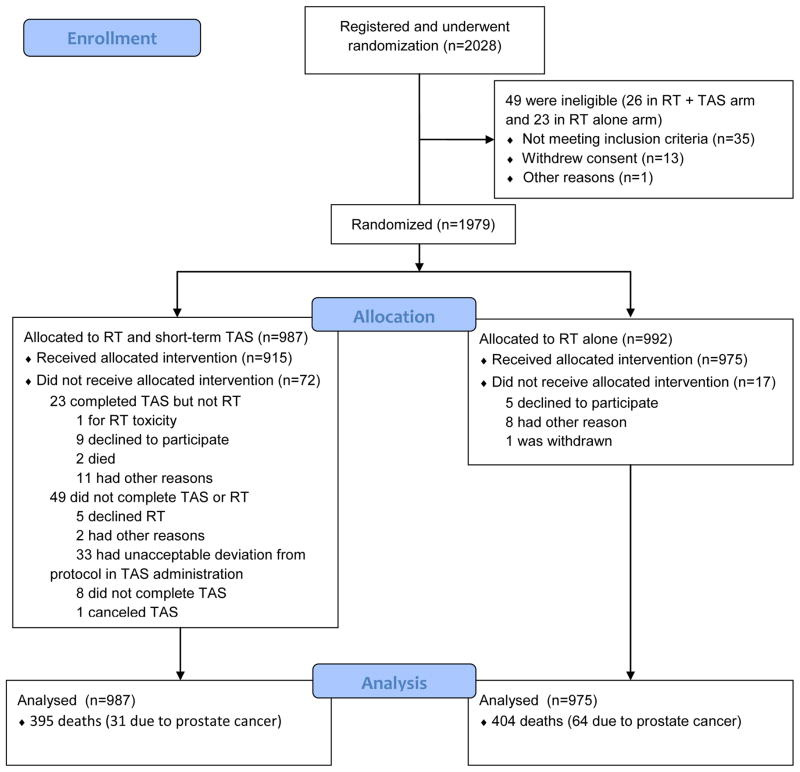
Methods and materials: Radiation Therapy Oncology Group study 94-08 analyzed 1979 males with prostate cancer, stage T1b-T2b and prostate-specific antigen concentrations of ≤ 20 ng/dL, to investigate whether 4 months of total androgen suppression (TAS) added to RT improved survival compared to RT alone. Patients randomized to receive TAS received flutamide with luteinizing hormone releasing hormone (LHRH) agonist. According to protocol, patients without evidence of clinical recurrence or initiation of additional endocrine therapy underwent repeat prostate biopsy 2 years after RT completion. Statistical analysis was performed to evaluate the impact of positive post-RT biopsy results on clinical outcomes.
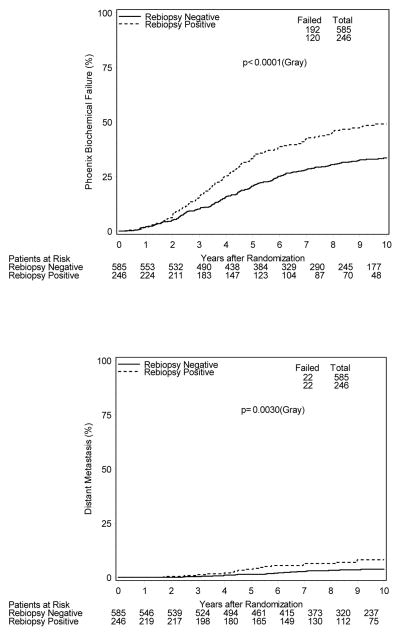
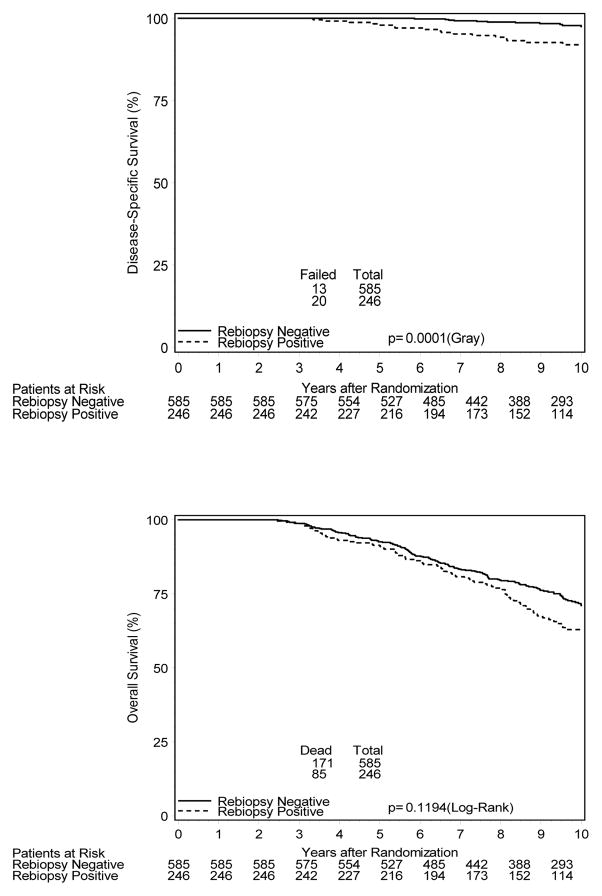
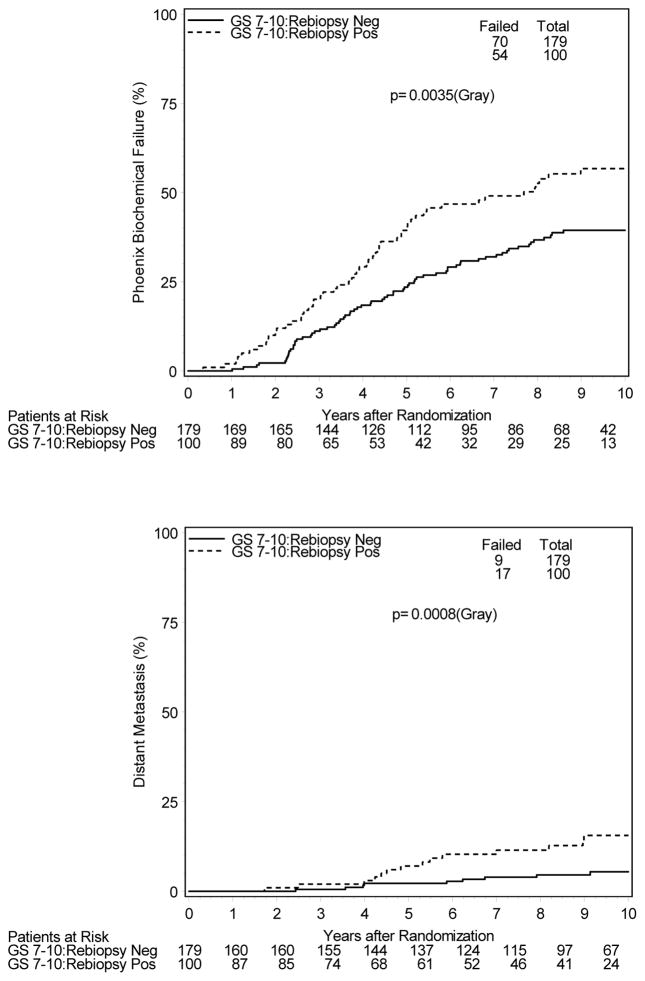
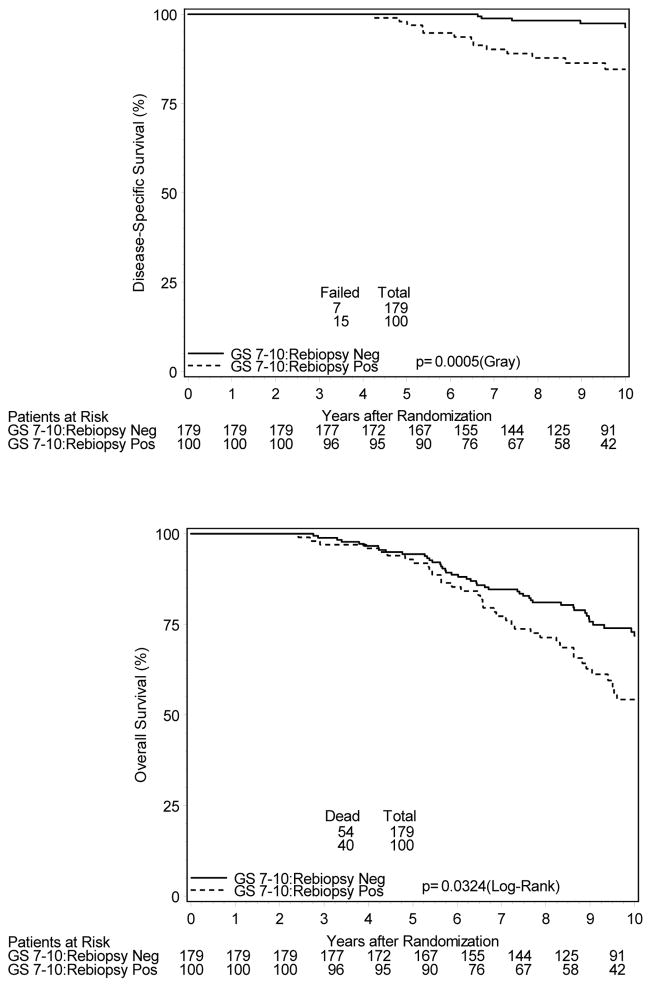
Results: A total of 831 patients underwent post-RT biopsy, 398 were treated with RT alone and 433 with RT plus TAS. Patients with positive post-RT biopsy results had higher rates of biochemical failure (hazard ratio [HR] = 1.7; 95% confidence interval [CI] = 1.3-2.1) and distant metastasis (HR = 2.4; 95% CI = 1.3-4.4) and inferior disease-specific survival (HR = 3.8; 95% CI = 1.9-7.5). Positive biopsy results remained predictive of such outcomes after correction for potential confounders such as Gleason score, tumor stage, and TAS administration. Prior TAS therapy did not prevent elevated risk of adverse outcome in the setting of post-RT positive biopsy results. Patients with Gleason score ≥ 7 with a positive biopsy result additionally had inferior overall survival compared to those with a negative biopsy result (HR = 1.56; 95% CI = 1.04-2.35).
Conclusions: Positive post-RT biopsy is associated with increased rates of distant metastases and inferior disease-specific survival in patients treated with definitive RT and was associated with inferior overall survival in patients with high-grade tumors.
Copyright © 2015 Elsevier Inc. All rights reserved.
Figures
Comment in
-
Re: Importance of Local Control in Early-Stage Prostate Cancer: Outcomes of Patients with Positive Post-Radiation Therapy Biopsy Results Treated in RTOG 9408.J Urol. 2016 Feb;195(2):351-2. doi: 10.1016/j.juro.2015.10.167. Epub 2015 Nov 4. J Urol. 2016. PMID: 26852974 No abstract available.
References
-
- Cox JD, Gallagher MJ, Hammond EH, et al. Consensus statements on radiation therapy of prostate cancer: guidelines for prostate re-biopsy after radiation and for radiation therapy with rising prostate-specific antigen levels after radical prostatectomy. J Clin Oncol. 1999;17:1155–1163. - PubMed
-
- Jones C, Hunt D, McGowan D, et al. Radiotherapy and short-term androgen deprivation for localized prostate cancer. NEJM. 2011;365:107–118. - PubMed
-
- Kaplan EL, Meier P. Nonparametric estimation from incomplete observations. J Am Stat Assoc. 1958;53:447–457.
-
- Cox DR. Regression models and life tables. J Royal Statistics Soc. 1972;34:187–220.
-
- Gray RJ. A class of K-sample tests for comparing the cumulative incidence of a competing risk. Annual Statistics. 1988;16:1141–1143.
Publication types
MeSH terms
Substances
Grants and funding
LinkOut - more resources
Full Text Sources
Other Literature Sources
Medical
