


Patient Use of Email, Facebook, and Physician Websites to Communicate with Physicians: A National Online Survey of Retail Pharmacy Users
- PMID: 26105675
- PMCID: PMC4700007
- DOI: 10.1007/s11606-015-3374-7
Patient Use of Email, Facebook, and Physician Websites to Communicate with Physicians: A National Online Survey of Retail Pharmacy Users
Abstract
Background: Patient-physician communication often occurs outside the clinic setting; many institutions discourage electronic communication outside of established electronic health record systems. Little empirical data are available on patient interest in electronic communication and Web-based health tools that are technically feasible but not widely available.
Research objective: To explore patient behavior and interest in using the Internet to contact physicians.
Design: National cross-sectional online survey.
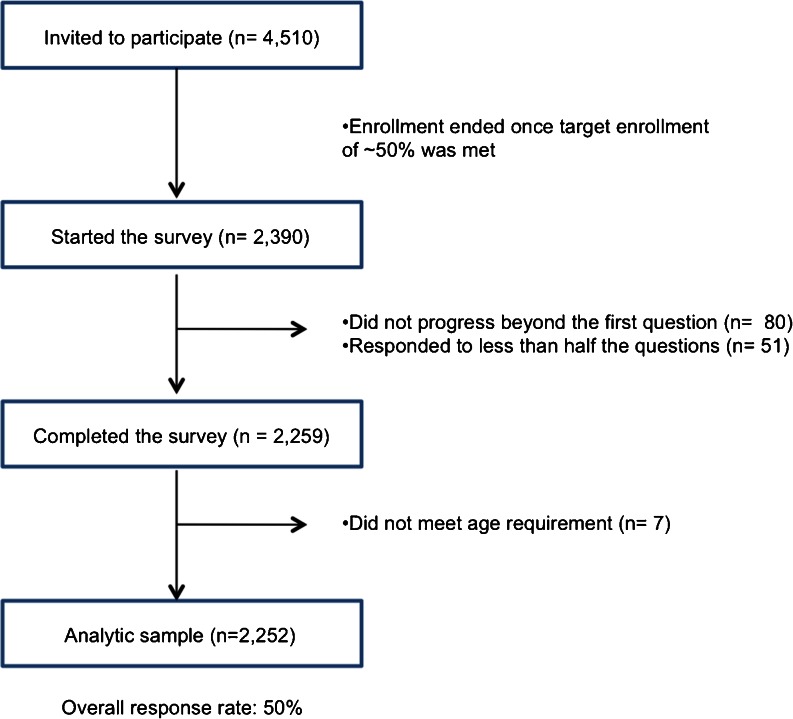
Participants: A sample of 4,510 CVS customers with at least one chronic condition in the household was used to target patients with chronic conditions and their caregivers. Subjects were identified from a national panel of over 100,000 retail pharmacy customers. Of those sampled, 2,252 responded (50.0 % response rate).
Main measures: Survey measures included demographic and health information, patient use of email and Facebook to contact physicians, and patient interest in and use of Web-based tools for health.
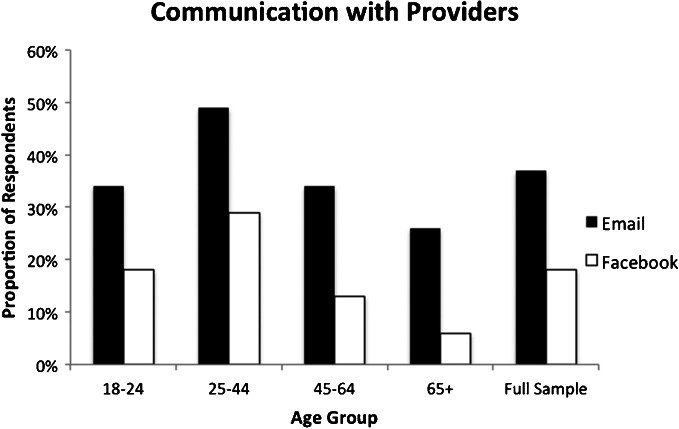
Key results: A total of 37 % of patients reported contacting their physicians via email within the last six months, and 18 % via Facebook. Older age was negatively associated with contacting physicians using email (OR 0.57 [95 % CI 0.41-0.78]) or Facebook (OR 0.28 [0.17-0.45]). Non-white race (OR 1.61 [1.18-2.18] and OR 1.82 [1.24-2.67]) and caregiver status (OR 1.58 [1.27-1.96] and OR 1.71 [1.31- 2.23]) were positively associated with using email and Facebook, respectively. Patients were interested in using Web-based tools to fill prescriptions, track their own health, and access health information (37-57 %), but few were currently doing so (4-8 %).
Conclusions: In this population of retail pharmacy users, there is strong interest among patients in the use of email and Facebook to communicate with their physicians. The findings highlight the gap between patient interest for online communication and what physicians may currently provide. Improving and accelerating the adoption of secure Web messaging systems is a possible solution that addresses both institutional concerns and patient demand.
Keywords: communication; health information technology; patient preferences.
Figures
Comment in
-
Capsule Commentary on Lee et al., Patient use of Email, Facebook, and Physicians' Websites to Communicate with Physicians: A National Online Survey of Retail Pharmacy Users.J Gen Intern Med. 2016 Jan;31(1):102. doi: 10.1007/s11606-015-3421-4. J Gen Intern Med. 2016. PMID: 26033213 Free PMC article. No abstract available.
References
-
- Farnan JM, Sulmasy LS, Worster BK, et al. Online medical professionalism: patient and public relationships: policy statement from the American College of Physicians and the Federation of State Medical Boards. Ann Intern Med. 2013;158(8):620–627. doi: 10.7326/0003-4819-158-8-201304160-00100. - DOI - PubMed
Publication types
MeSH terms
Grants and funding
LinkOut - more resources
Full Text Sources
Other Literature Sources
Medical
Miscellaneous
