. 2015 Mar 28:8:59-71.
doi: 10.1016/j.nicl.2015.02.025. eCollection 2015.

Reward salience and risk aversion underlie differential ACC activity in substance dependence

Affiliations

Reward salience and risk aversion underlie differential ACC activity in substance dependence

William H Alexander et al. Neuroimage Clin. .

Abstract

The medial prefrontal cortex, especially the dorsal anterior cingulate cortex (ACC), has long been implicated in cognitive control and error processing. Although the association between ACC and behavior has been established, it is less clear how ACC contributes to dysfunctional behavior such as substance dependence. Evidence from neuroimaging studies investigating ACC function in substance users is mixed, with some studies showing disengagement of ACC in substance dependent individuals (SDs), while others show increased ACC activity related to substance use. In this study, we investigate ACC function in SDs and healthy individuals performing a change signal task for monetary rewards. Using a priori predictions derived from a recent computational model of ACC, we find that ACC activity differs between SDs and controls in factors related to reward salience and risk aversion between SDs and healthy individuals. Quantitative fits of a computational model to fMRI data reveal significant differences in best fit parameters for reward salience and risk preferences. Specifically, the ACC in SDs shows greater risk aversion, defined as concavity in the utility function, and greater attention to rewards relative to reward omission. Furthermore, across participants risk aversion and reward salience are positively correlated. The results clarify the role that ACC plays in both the reduced sensitivity to omitted rewards and greater reward valuation in SDs. Clinical implications of applying computational modeling in psychiatry are also discussed.

Keywords: Anterior cingulate; Cognitive control; Computational models; Substance dependence.


Figures
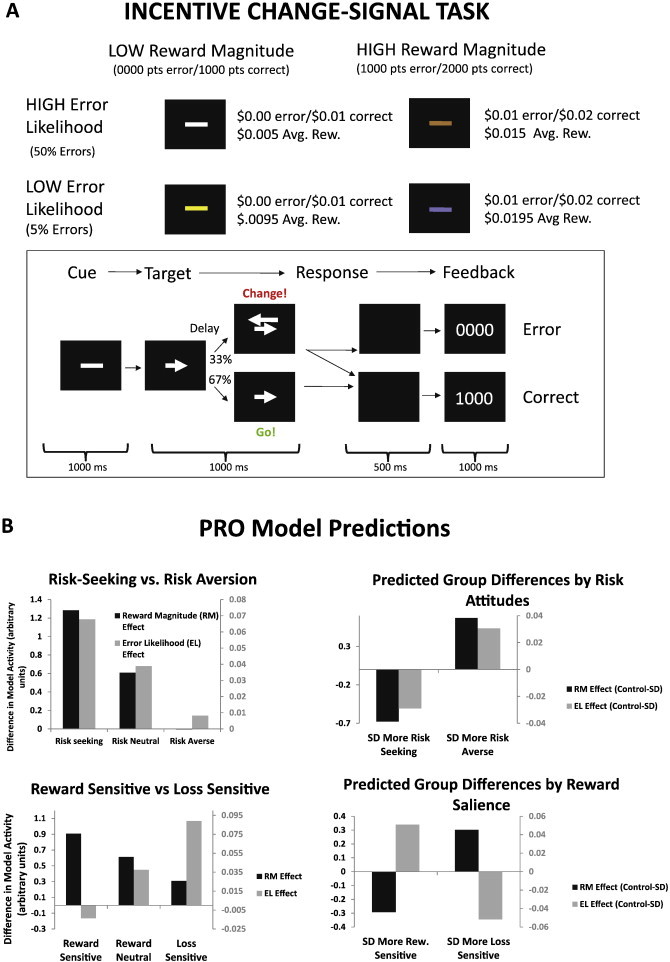
Fig. 1
Fig. 1
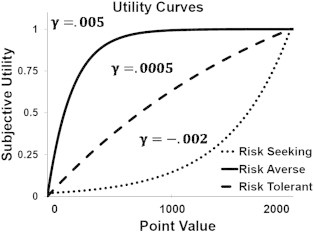
Change signal task and model predictions. In the change signal task (A), participants are presented with an initial cue indicating a response to be made. On a subset of trials, a second cue is presented after a variable delay, indicating that the subject should cancel the initial response and instead make the alternate response. The color of the cue implicitly indicates the likelihood of error (2 levels) and reward magnitude (2 levels). Simulations of the PRO model B were used to generate a priori predictions of individual differences in ACC activity related to reward salience and aversion to risk. As sensitivity to reward (indicated by the parameter λ, cf. Fig. 2) increases, error likelihood effects attenuate while reward magnitude effects increase. As risk-aversion (γ, cf. Fig. 2) increases, both error likelihood effects and effects of reward magnitude increase.
Fig. 2
Fig. 2
Example of utility functions as related to risk preferences.
Fig. 3
Fig. 3
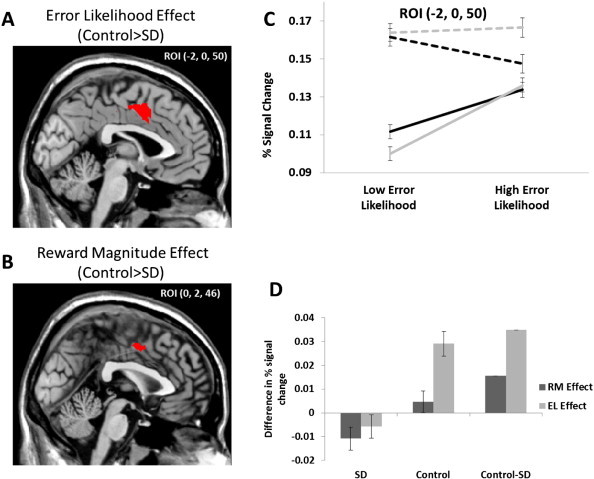
A) Within ACC, greater error likelihood effects were observed for the non-substance dependent (non-SD) compared to the substance dependent (SD) group, consistent with the hypothesis that SD individuals are more sensitive to reward and inconsistent with the hypothesis that SD participants exhibit increased risk-seeking. B) Within the region showing increased EL effects for controls, a cluster was identified showing enhanced RM effects for non-SD versus SD groups, inconsistent with both the reward sensitivity and risk-seeking hypotheses. C) Percent signal change plotted for non-SD and SD individuals for the 4 EL/RM conditions for Go/Correct trials only. D) RM and EL effects for SDs, controls, and the between-groups differences. Both RM and EL effects are larger for controls than for SDs, consistent with model predictions suggesting that SDs are more risk averse than non-substance dependent individuals (cf. Fig. 1B).
Fig. 4
Fig. 4
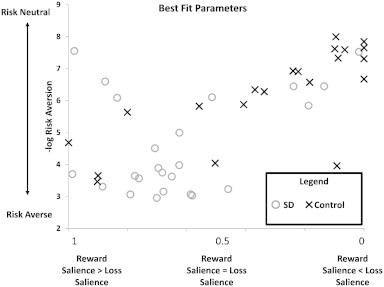
Best fit parameters for the PRO model fit to individual data. Parameters found for SDs (open circles) were significantly more reward sensitive as well as significantly more risk-averse than parameters obtained for controls (crosses). Across all subjects, aversion to risk was positively correlated with reward sensitivity.

References

    1. Alexander W.H., Brown J.W. Competition between learned reward and error outcome predictions in anterior cingulate cortex. Neuroimage. 2010;49(4):3210–3218. 19961940 - PMC - PubMed
    1. Alexander W.H., Brown J.W. Medial prefrontal cortex as an action–outcome predictor. Nat. Neurosci. 2011;14(10):1338–1344. 21926982 - PMC - PubMed
    1. American Psychiatric Association . Diagnostic and Statistical Manual of Mental Disorders. fourth edition, text revision. Author; Washington, DC: 2000.
    1. Anderhub V., Güth W., Gneezy U., Sonsino D. On the interaction of risk and time preferences: an experimental study. German Economic Review. 2001;2(3):239–253.
    1. Andersen S., Harrison G.W., Lau M.I., Rutström E.E. Eliciting risk and time preferences. Econometrica. 2008;76(3):583–618.

Publication types