Review
. 2015:2015:435160.
doi: 10.1155/2015/435160. Epub 2015 May 27.

Exhaled Breath Condensate: Technical and Diagnostic Aspects

Affiliations
Review

Exhaled Breath Condensate: Technical and Diagnostic Aspects

Efstathia M Konstantinidi et al. ScientificWorldJournal. 2015.

Abstract

Purpose: The aim of this study was to evaluate the 30-year progress of research on exhaled breath condensate in a disease-based approach.

Methods: We searched PubMed/Medline, ScienceDirect, and Google Scholar using the following keywords: exhaled breath condensate (EBC), biomarkers, pH, asthma, gastroesophageal reflux (GERD), smoking, COPD, lung cancer, NSCLC, mechanical ventilation, cystic fibrosis, pulmonary arterial hypertension (PAH), idiopathic pulmonary fibrosis, interstitial lung diseases, obstructive sleep apnea (OSA), and drugs.

Results: We found 12600 related articles in total in Google Scholar, 1807 in ScienceDirect, and 1081 in PubMed/Medline, published from 1980 to October 2014. 228 original investigation and review articles were eligible.

Conclusions: There is rapidly increasing number of innovative articles, covering all the areas of modern respiratory medicine and expanding EBC potential clinical applications to other fields of internal medicine. However, the majority of published papers represent the results of small-scale studies and thus current knowledge must be further evaluated in large cohorts. In regard to the potential clinical use of EBC-analysis, several limitations must be pointed out, including poor reproducibility of biomarkers and absence of large surveys towards determination of reference-normal values. In conclusion, contemporary EBC-analysis is an intriguing achievement, but still in early stage when it comes to its application in clinical practice.


Figures
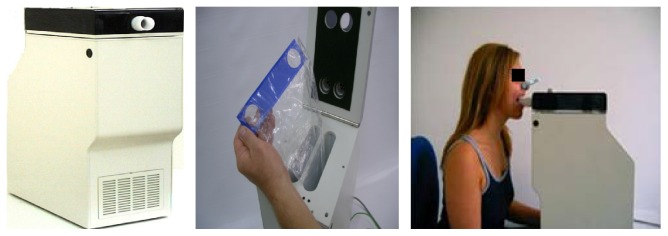
Figure 1
Figure 1
EcoScreen 2 device for exhaled breath condensate (EBC) collection (FILT Lungen-& Thorax Diagnostik GmbH). EcoScreen 2 electrically refrigerates exhaled air, conducted through a lamellar PFTE coated aluminum double lumen system. EBC is formatted in a disposable polyethylene bag (at approximately −10°C). It also allows the fractionated collection of EBC from different areas of the bronchial tree into two disposable polyethylene bags, so that the dead space condensate which contains biomarkers of no clinical relevance can be discarded. The device is not portable and weighs 20 kg (published with permission from FILT Lungen-& Thorax Diagnostik GmbH).
Figure 2
Figure 2
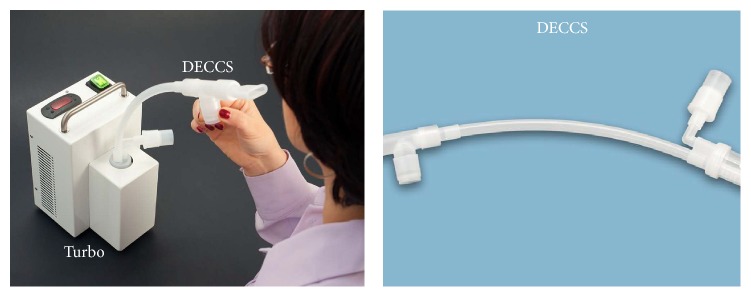
TurboDECCS device for exhaled breath condensate (EBC) collection (Medivac SRL, Italy). TurboDECCS consists of a portable Turbo Unit and a disposable DECCS collection system. DECCS is equipped with a mouthpiece, a one-way valve, a tube, and a collection cell inserted in a Peltier-type electrical cooling system (published with permission from Medivac SRL, Italy).
Figure 3
Figure 3
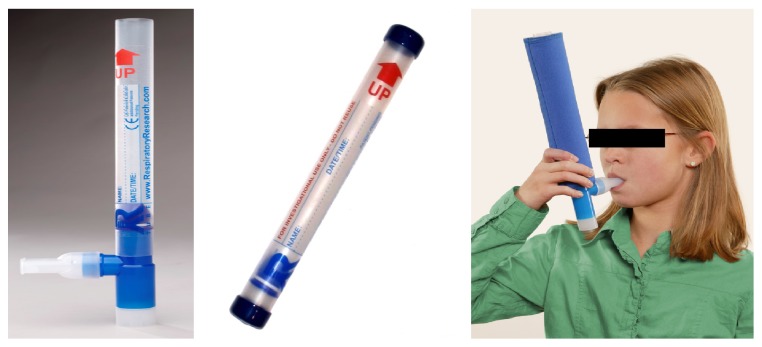
RTube device for exhaled breath condensate (EBC) collection (Respiratory Research, Inc., USA). RTube disposable collection system consists of a large Tee section (from polypropylene (PP)), which separates saliva from the exhaled breath, an one-way valve (from silicone rubber), and a PP collection tube, which is cooled by a cooling-sleeve placed around. RTube is portable and can be used by unsupervised subjects at home (published with permission from Respiratory Research, Inc., USA).
Figure 4
Figure 4
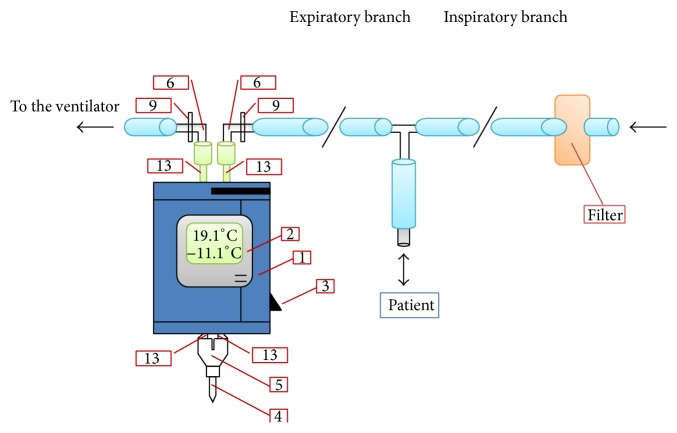
ANACON (Biostec, Valencia, Spain) condenser integrated in the mechanical ventilation circuit. The condenser is inserted in the expiratory branch of the ventilation circuit via 2 adaptors (9) and 2 elastomeric connectors (6). The exhaled air passes towards the condensation tubes (13) that pass through the body of the condenser (1). A Y piece (5) closes the circuit with the collection tube for the exhaled breath condensate (4). A thermometer (2) allows the condensation temperature to be monitored. The apparatus also contains a cooling switch (3) (reproduced with permission from [12]).

References

    1. Horvath I., Hunt J., Barnes P. J., et al. Exhaled breath condensate: methodological recommendations and unresolved questions. European Respiratory Journal. 2005;26(3):523–548. - PubMed
    1. Jackson A. S., Sandrini A., Campbell C., Chow S., Thomas P. S., Yates D. H. Comparison of biomarkers in exhaled breath condensate and bronchoalveolar lavage. American Journal of Respiratory and Critical Care Medicine. 2007;175(3):222–227. doi: 10.1164/rccm.200601-107oc. - DOI - PubMed
    1. Montuschi P., Paris D., Melck D., et al. NMR spectroscopy metabolomic profiling of exhaled breath condensate in patients with stable and unstable cystic fibrosis. Thorax. 2012;67(3):222–228. doi: 10.1136/thoraxjnl-2011-200072. - DOI - PubMed
    1. Aebersold R., Mann M. Mass spectrometry-based proteomics. Nature. 2003;422(6928):198–207. doi: 10.1038/nature01511. - DOI - PubMed
    1. Wiktorowicz J. E., Jamaluddin M. Heterogeneity in Asthma. Vol. 795. New York, NY, USA: Springer; 2014. Proteomics analysis of the asthmatic airway; pp. 221–232. (Advances in Experimental Medicine and Biology). - DOI - PubMed

MeSH terms