Review
. 2015 Nov;5(9):527-42.
doi: 10.1089/brain.2015.0344. Epub 2015 Oct 6.

Characterizing Resting-State Brain Function Using Arterial Spin Labeling

Affiliations
Review

Characterizing Resting-State Brain Function Using Arterial Spin Labeling

J Jean Chen et al. Brain Connect. 2015 Nov.

Abstract

Arterial spin labeling (ASL) is an increasingly established magnetic resonance imaging (MRI) technique that is finding broader applications in studying the healthy and diseased brain. This review addresses the use of ASL to assess brain function in the resting state. Following a brief technical description, we discuss the use of ASL in the following main categories: (1) resting-state functional connectivity (FC) measurement: the use of ASL-based cerebral blood flow (CBF) measurements as an alternative to the blood oxygen level-dependent (BOLD) technique to assess resting-state FC; (2) the link between network CBF and FC measurements: the use of network CBF as a surrogate of the metabolic activity within corresponding networks; and (3) the study of resting-state dynamic CBF-BOLD coupling and cerebral metabolism: the use of dynamic CBF information obtained using ASL to assess dynamic CBF-BOLD coupling and oxidative metabolism in the resting state. In addition, we summarize some future challenges and interesting research directions for ASL, including slice-accelerated (multiband) imaging as well as the effects of motion and other physiological confounds on perfusion-based FC measurement. In summary, this work reviews the state-of-the-art of ASL and establishes it as an increasingly viable MRI technique with high translational value in studying resting-state brain function.

Keywords: arterial transit time; arterial-spin labeling; cerebral blood flow; functional connectivity; functional magnetic resonance imaging; neurovascular coupling; perfusion; water permeability.


Figures
<b>FIG. 1.</b>
FIG. 1.
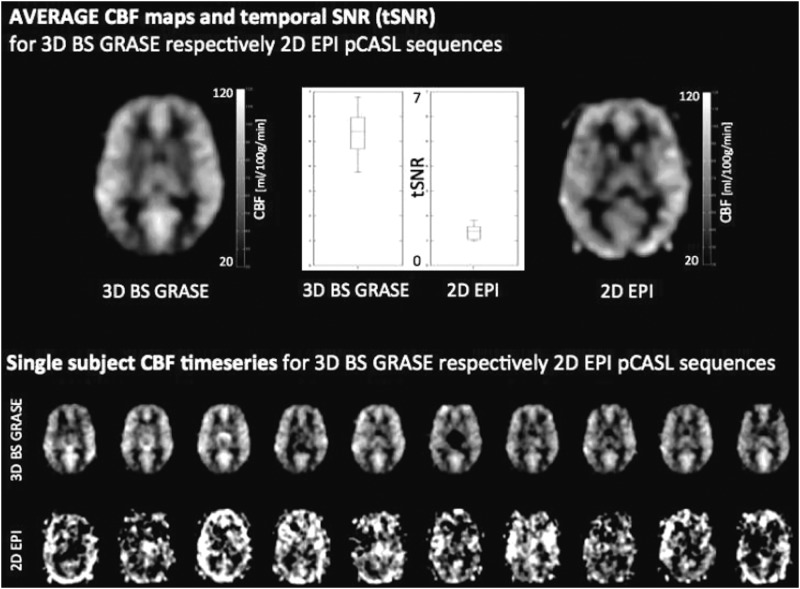
Comparison of temporal signal-to-noise ratio (SNR) and frame-by-frame perfusion image series by three-dimensional (3D) background suppression (BS) GRASE and two-dimensional (2D) echo-planar imaging (EPI) pseudocontinuous arterial spin labeling (pCASL). Although mean cerebral blood flow (CBF) maps are comparable, the temporal SNR (tSNR) of 3D GRASE pCASL is approximately three times that of 2D EPI pCASL, resulting in reliable frame-by-frame perfusion image series, while large variations exist in 2D EPI pCASL image series.
<b>FIG. 2.</b>
FIG. 2.
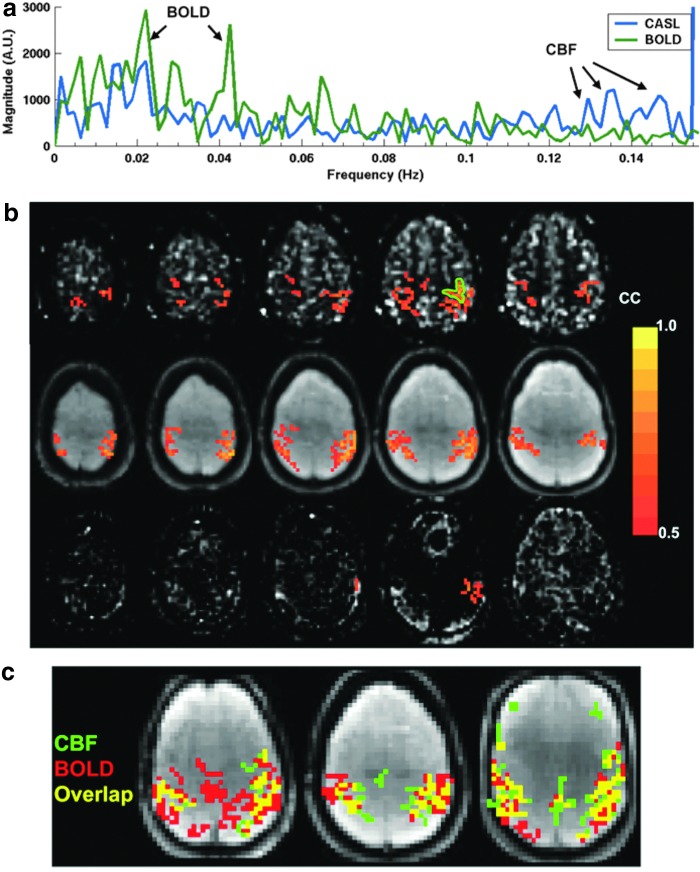
CBF-based resting-state functional connectivity (FC) measurement [Figure adapted with permission from Chuang et al. (2008)]. (a) The resting-state functional magnetic resonance imaging (fMRI) signal spectra show distinct blood oxygen level-dependent (BOLD)-related (<0.08 Hz) and CBF-related (>0.08 Hz) peaks. (b) FC maps of the motor cortex (outlined in green) were derived using high-pass-filtered CASL data (top) and are comparable with the BOLD-based connectivity maps (middle); note that the high-passed BOLD data showed minimal FC (bottom). (c) Composite functional connectivity maps show differential sensitivity of the BOLD- and CBF-based connectivity measures. Color images available online at www.liebertpub.com/brain
<b>FIG. 3.</b>
FIG. 3.
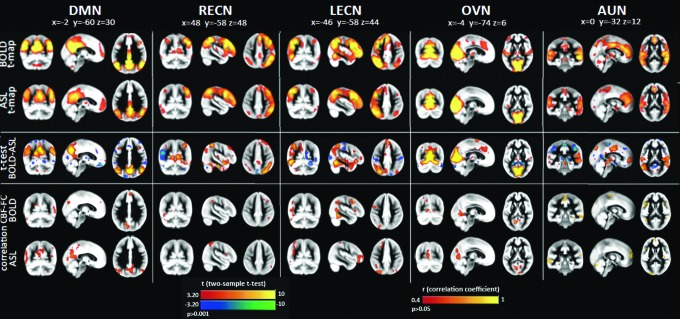
Similarities and differences between resting-state functional networks derived from BOLD and from CBF [Figure adapted with permission from Jann et al. (2015a)]. Group joint independent component network analysis (ICA) was used to derive five common resting-state brain networks: the default mode network (DMN), left and right executive control networks (LECN/RECN), occipital visual network (OVN), and auditory network (AUN). Meaningful resting-state networks were detected using both BOLD and CBF data. BOLD- and CBF-based FC maps are in the top two rows. Differences between BOLD and ASL were assessed by means of two-sample two-sided t-tests (significance threshold was set at p<0.001). Correlation maps between resting perfusion and FC are also shown (CBF-FC), with CBF-based connectivity maps more strongly associated with resting perfusion. Color images available online at www.liebertpub.com/brain
<b>FIG. 4.</b>
FIG. 4.
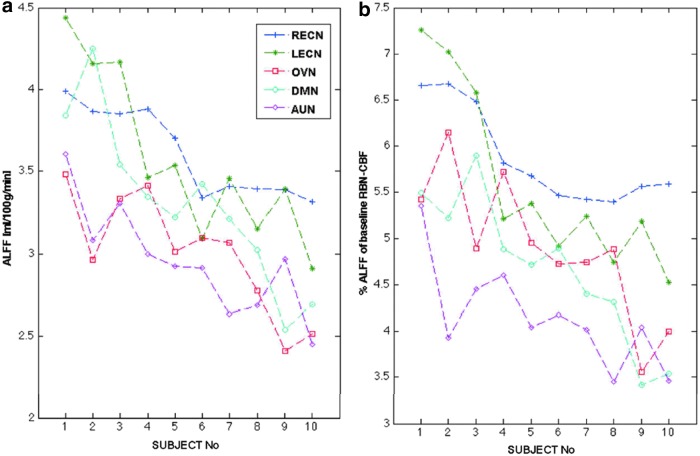
The relationship between CBF-based amplitude of low-frequency fluctuation (ALFF) and simultaneously measured resting perfusion [Figure reprinted with permission from Jann et al. (2015a)]. (a) Both the average CBF-based ALFF for each network and subject and (b) the normalized ALFF values (%ALFF=the absolute ALFF divided by the resting brain network (RBN)-CBF revealed significant differences across networks and subjects (based on analysis of variance [ANOVA] results). Subjects were ordered according to their overall mean ALFF. Color images available online at www.liebertpub.com/brain
<b>FIG. 5.</b>
FIG. 5.
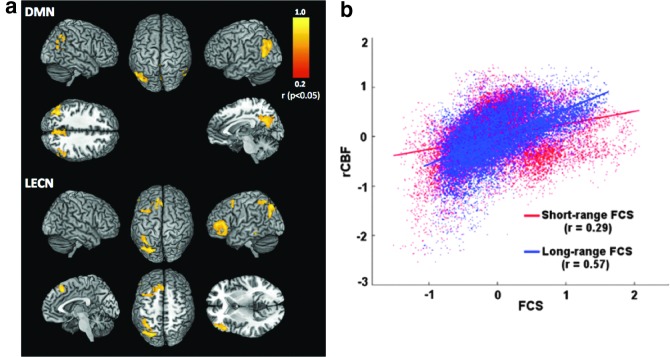
Links between FC and resting perfusion. (a) Localized positive correlations between FC and resting CBF are shown for two representative networks, namely the DMN and the LECN [Figure adapted with permission from data in Jann et al. (2015a)]. (b) A similar relationship was found between normalized regional perfusion (rCBF) and functional connectivity strength (FCS) in the cases of both long- and short-range connectivity [Figure partially taken with permission from Liang et al. (2013)]. These results indicate the intricate link between resting perfusion and FC. Color images available online at www.liebertpub.com/brain
<b>FIG. 6.</b>
FIG. 6.
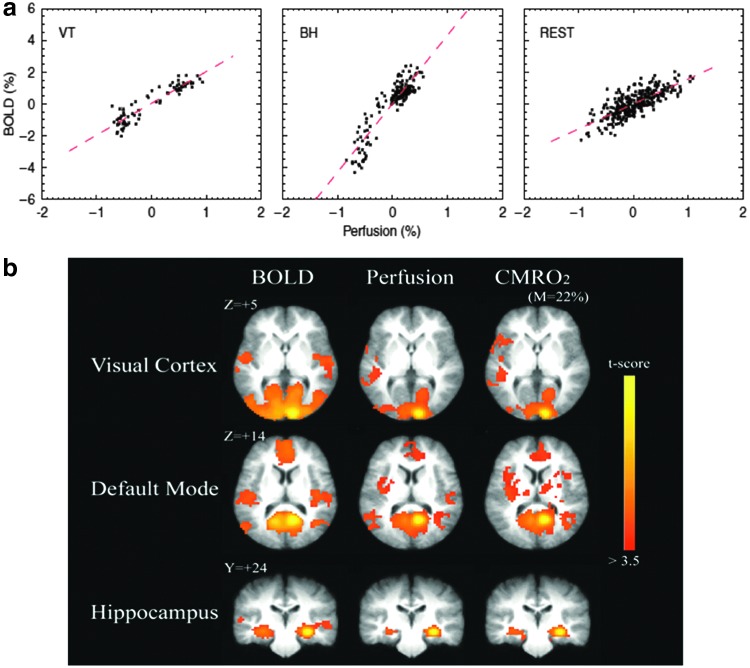
Measuring neurometabolic mechanisms of resting-state fMRI using ASL: (a) The resting-state relationship between BOLD and CBF [Reprinted with permission from Fukunaga et al. (2008)]. The relationship between BOLD and CBF fluctuations in the resting state is shown to be strongly linear. Furthermore, this CBF-BOLD relationship was shown to be similar to that observed during visual stimulation (VT) and breath holding (BH). (b) The derivation of dynamic oxidative metabolism (CMRO2) and FC from simultaneous CBF-BOLD data [Reprinted with permission from Wu et al. (2009)]. CMRO2 was derived based on the linear approximation of the CBF-BOLD relationship. Futhermore, FC maps, computed from resting-state BOLD, CBF, and CMRO2 time courses, are spatially consistent in multiple functional networks, including the visual, hippocampal, and DMNs. Color images available online at www.liebertpub.com/brain
<b>FIG. 7.</b>
FIG. 7.
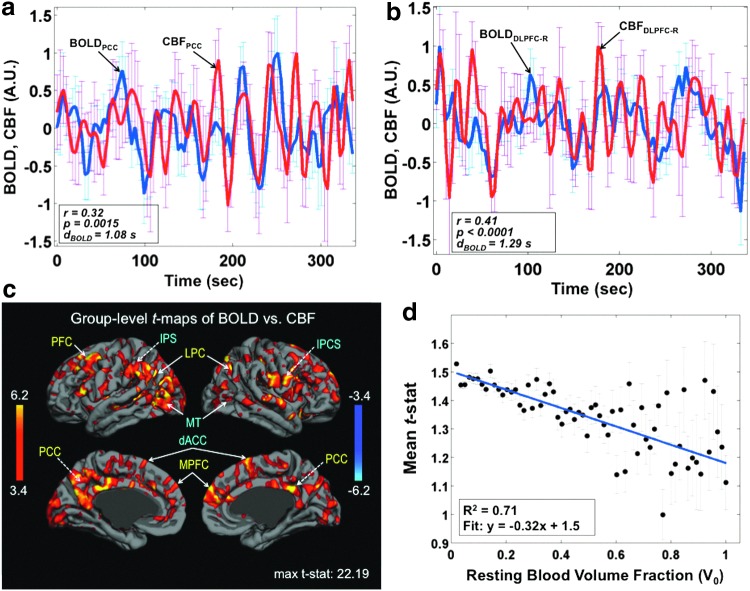
Spatial variability in the dynamic coupling between BOLD and CBF fluctuations in the resting state [adapted with permission from Tak et al. (2014)]. Sample time series corresponding to simultaneously acquired BOLD and CBF data in (a) the posterior cingulate (PCC) and (b) the dorsolateral prefrontal cortex (DCLPC-R). The parameter dBOLD indicates the estimated time delay in the BOLD signal relative to the CBF signal. (c) Group-level CBF-BOLD correlations are strongest in known functional networks: these include the DMN, the medialprefrontal (MPFC), and PCC regions, labeled in yellow, as well as regions exhibiting anticorrelations with default mode activity, namely the intraparietal sulcus (IPS) and inferior pariental lobule (IPL), both labeled in blue. (d) Moreover, CBF-BOLD coupling appeared to be strongly modulated by local macrovascular content. Color images available online at www.liebertpub.com/brain
<b>FIG. 8.</b>
FIG. 8.
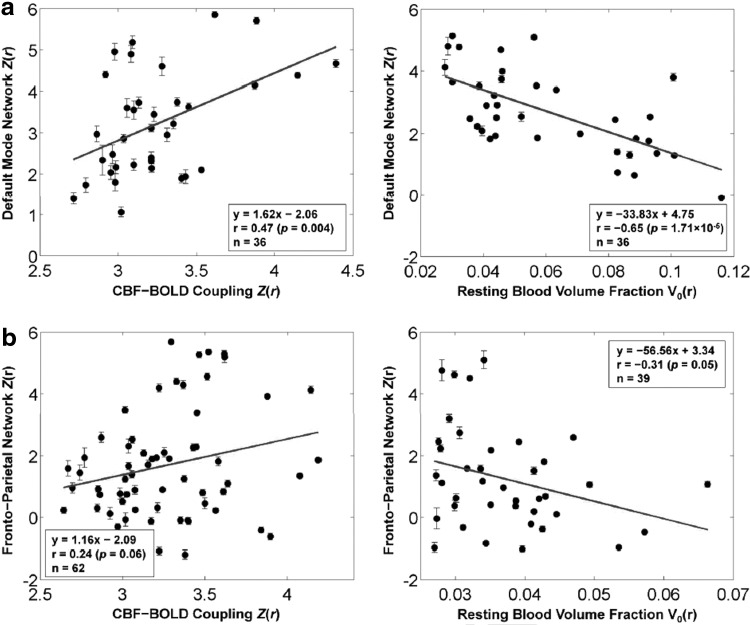
The relationship between dynamic CBF-BOLD coupling and BOLD-based FC [Figure adapted with permission from Tak et al. (2015)]. Resting-state FC strength, quantified in terms of z-scores, is significantly associated with the strength of CBF-BOLD coupling (also in terms of z-scores) shown here for two commonly observed networks: (a) the DMN and (b) the frontoparietal network. These associations are quantified through the linear equations at the bottom corner of the plots, with r indicating the correlation. On the other hand, FC strength is negatively correlated with macrovascular content across all brain networks examined, suggesting that tighter CBF-BOLD coupling, more typical around the microvasculature, results in higher FC measurements.
<b>FIG. 9.</b>
FIG. 9.
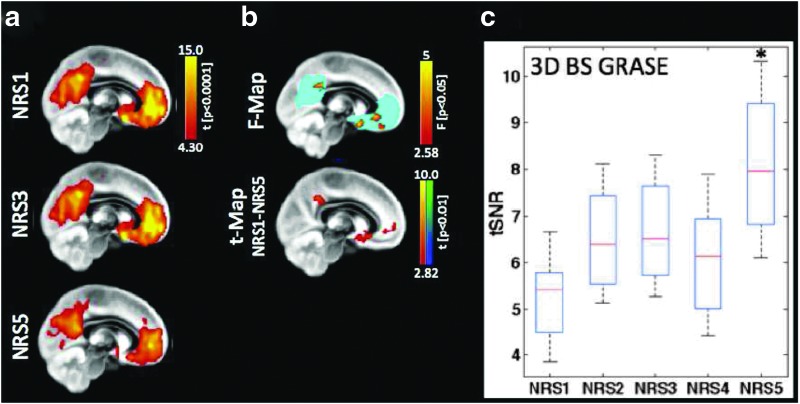
The effect of motion and noise regression strategies (NRS) on CBF-based FC calculations [Figure adapted with permission from Jann et al. (2015b)]. NRS1: no correction; NRS3: motion parameters regressed; NRS5: regressing out motion parameters plus fluctuations from white matter (WM)/cerebrospinal fluid (CSF). (a) DMN calculated by means of group ICA. (b) The F map resulting from ANOVA statistics across all NRS shows regions in which FC strength depended on the choice of NRS; the t map illustrates areas of the DMN in which noise regression resulted in significant differences in FC strength. (c) Average gray matter tSNR was significantly increased after correcting for motion and WM/CSF effects. *p<0.05. Color images available online at www.liebertpub.com/brain
<b>FIG. 10.</b>
FIG. 10.
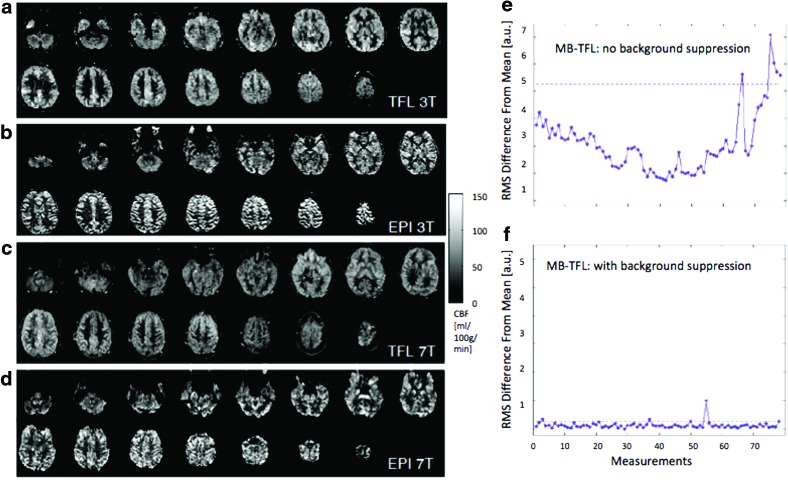
Slice-accelerated ASL acquisition for high temporal resolution [Figure adapted with permission from Wang et al. (2015)]. Shown here are sample CBF maps acquired using (a, c) multiband turbo FLASH (MB-TFL) with a slice acceleration factor of 5 and (b, d) using a standard 2D EPI readout. The CBF maps in (a, b) were acquired at 3 T and those in (c, d) were acquired at 7 T. Shown in the line plots are root-mean-square (RMS) of the raw image intensity difference between each image volume and the time series mean without (e) and with (f) background suppression for a multiband ASL scan at 3 T. These results demonstrate the advantage of using slice-accelerated ASL acquisition and the importance of background suppression. Color images available online at www.liebertpub.com/brain

References

    1. Aguirre GK, Detre JA, Zarahn E, Alsop DC. 2002. Experimental design and the relative sensitivity of BOLD and perfusion fMRI. NeuroImage 15:488–500 - PubMed
    1. Akgoren N, Fabricius M, Lauritzen M. 1994. Importance of nitric oxide for local increases of blood flow in rat cerebellar cortex during electrical stimulation. Proc Natl Acad Sci U S A 91:5903–5907 - PMC - PubMed
    1. Alsop DC, Detre JA, Golay X, Gunther M, Hendrikse J, Hernandez-Garcia L, et al. 2014. Recommended implementation of arterial spin-labeled perfusion MRI for clinical applications: a consensus of the ISMRM perfusion study group and the European consortium for ASL in dementia. Magn Reson Med [Epub ahead of print]; DOI: 10.1002/mrm.25197 - DOI - PMC - PubMed
    1. Andrews-Hanna JR, Snyder AZ, Vincent JL, Lustig C, Head D, Raichle ME, et al. 2007. Disruption of large-scale brain systems in advanced aging. Neuron 56:924–935 - PMC - PubMed
    1. Aslan S, Huang H, Uh J, Mishra V, Xiao G, van Osch MJ, et al. 2011. White matter cerebral blood flow is inversely correlated with structural and functional connectivity in the human brain. NeuroImage 56:1145–1153 - PMC - PubMed

Publication types