. 2015 Jun 24;10(6):e0125214.
doi: 10.1371/journal.pone.0125214. eCollection 2015.

Modeling the Health and Economic Burden of Hepatitis C Virus in Switzerland

Affiliations

Modeling the Health and Economic Burden of Hepatitis C Virus in Switzerland

Beat Müllhaupt et al. PLoS One. .

Abstract

Background: Chronic hepatitis C virus infection is a major cause of liver disease in Switzerland and carries a significant cost burden. Currently, only conservative strategies are in place to mitigate the burden of hepatitis C in Switzerland. This study expands on previously described modeling efforts to explore the impact of: no treatment, and treatment to reduce HCC and mortality. Furthermore, the costs associated with untreated HCV were modeled.

Methods: Hepatitis C disease progression and mortality were modeled. Baseline historical assumptions were collected from the literature and expert interviews and strategies were developed to show the impact of different levels of intervention (improved drug cure rates, treatment and diagnosis) until 2030.

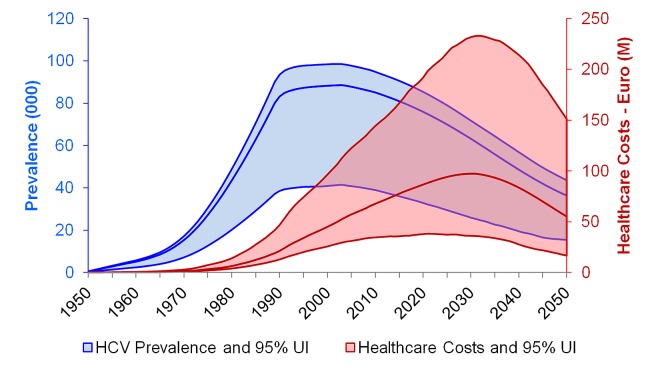
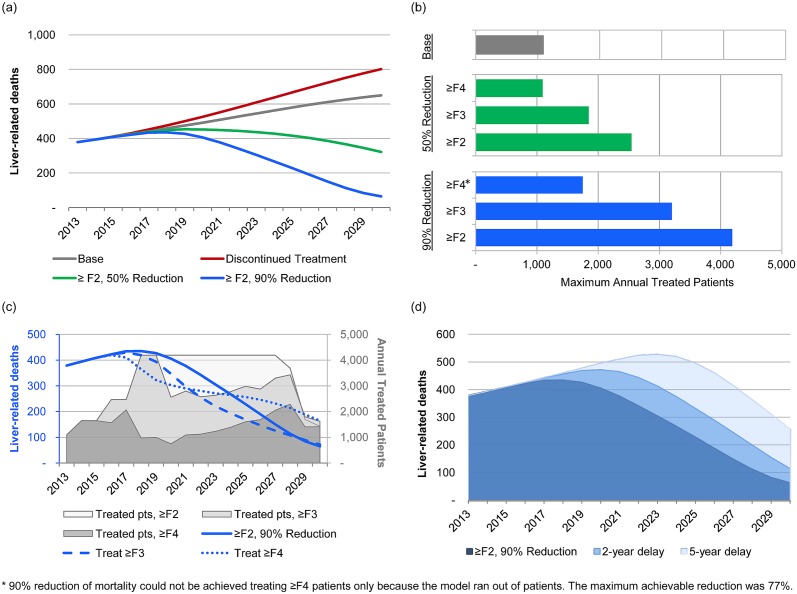
Results: Under the historical standard of care, the number of advanced stage cases was projected to increase until 2030, at which point the annual economic burden of untreated viremic infections was projected to reach €96.8 (95% Uncertainty Interval: €36 - €232) million. Scenarios to reduce HCV liver-related mortality by 90% by 2030 required treatment of 4,190 ≥F2 or 3,200 ≥F3 patients annually by 2018 using antivirals with a 95% efficacy rate. Delaying the implementation of these scenarios by 2 or 5 years reduced the impact on mortality to 75% and 57%, respectively.

Conclusions: With today's treatment efficacy and uptake rates, hepatitis C disease burden is expected to increase through 2030. A substantial reduction in disease burden can be achieved by means of both higher efficacy drugs and increased treatment uptake. However, these efforts cannot be undertaken without a simultaneous effort to diagnose more infections.


Conflict of interest statement

Competing Interests: Beat Müllhaupt has served as an advisory board member for Roche, MSD, Janssen Therapeutics, AbbVie, Boehringer Ingelheim, Gilead and BMS; as a consultant for Gilead and AbbVie; and has received research grants from Roche and Gilead. Philip Bruggmann has served as advisor and speaker for, and has received project and research grants from Roche, MSD, Janssen, AbbVie, Gilead, Viif and BMS. Sarah Blach and Homie Razavi are employees of the Center for Disease Analysis (CDA), Louisville, Colorado, USA. David Semela has served as a consultant for Gilead, an advisor for Roche, MSD, Gilead, Novartis, Janssen and Boehringer Ingelheim and has received an unrestricted research grant from Roche. Francesco Negro has served as advisor for MSD, Gilead, Novartis, Bristol Myers Squibb, AbbVie and Janssen and has received unrestricted research grants from Roche and Gilead. Florian Bihl and Daniel Lavanchy have no conflicts of interest to declare. As part of this project, none of the authors were part of any activities related to patents, product development or marketed products. The funding of this project by Gilead does not alter the authors’ adherence to PLOS ONE policies on sharing data and materials.

Figures

Fig 1
Fig 1. Total viremic cases (blue) and associated healthcare costs (red), by year, 1950–2050 (the upper and lower bounds represent 95% uncertainty intervals).
Fig 2
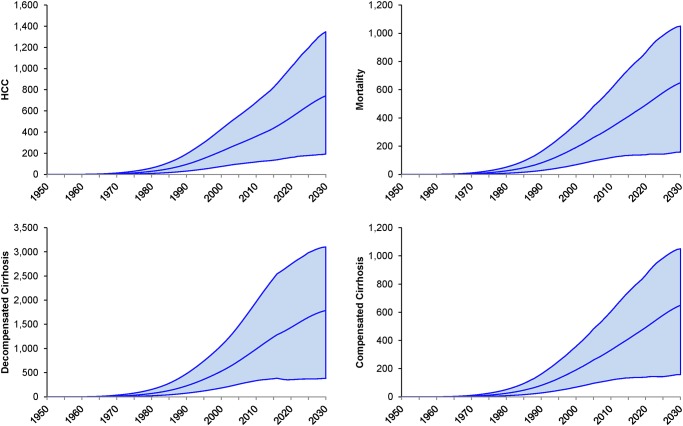
Fig 2. Change in disease burden, by year, 1950–2030 (the upper and lower bounds represent 95% uncertainty intervals).
Fig 3
Fig 3. Exploratory scenario outputs, 2013–2030.
(A) HCV-related liver-related deaths, by scenario; (B) Maximum number of patients treated annually to achieve 50% or 90% reduction, by METAVIR stage treated; (C) Impact of treatment restrictions (restriction to ≥F3 or F4) on a strategy to reduce liver-related mortality by 90%, and the annual number of patients treated before ‘running out of patients’; (D) Impact of 2-year and 5-year delays on a strategy to reduce liver-related mortality by 90%.
Fig 4
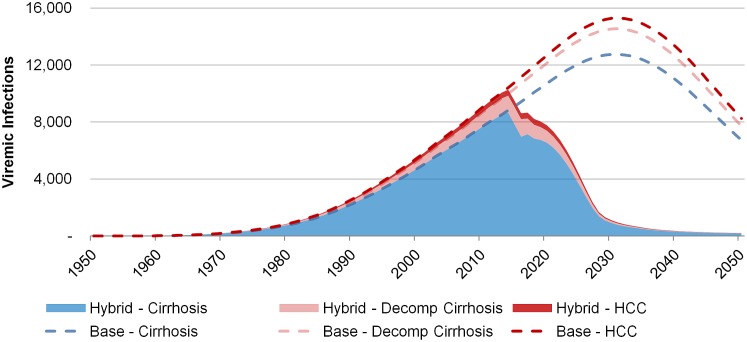
Fig 4. Projected base and hybrid scenario results for cirrhosis, decompensated cirrhosis and HCC, 1950–2050.

References

    1. World Health Organization—Department of Immunization VaB (2006) State of the art of new vaccine research and development. Geneva, Switzerland: WHO/IVB/06.01: 1–112.
    1. Edlin BR (2011) Perspective: test and treat this silent killer. Nature 474: S18–S19. 474S18a [pii]; 10.1038/474S18a - DOI - PMC - PubMed
    1. Lavanchy D (2011) Evolving epidemiology of hepatitis C virus. Clin Microbiol Infect 17: 107–115. 10.1111/j.1469-0691.2010.03432.x - DOI - PubMed
    1. Wong JB, McQuillan GM, McHutchison JG, Poynard T (2000) Estimating future hepatitis C morbidity, mortality, and costs in the United States. Am J Public Health 90: 1562–1569. - PMC - PubMed
    1. Ly KN, Xing J, Klevens RM, Jiles RB, Ward JW, Holmberg SD (2012) The increasing burden of mortality from viral hepatitis in the United States between 1999 and 2007. Ann Intern Med 156: 271–278. 156/4/271 [pii]. 10.1059/0003-4819-156-4-201202210-00004 - DOI - PubMed

Publication types

Substances