. 2015 Oct;5(10):1040-8.
doi: 10.1158/2159-8290.CD-15-0274. Epub 2015 Jun 24.

Cell-Free DNA Next-Generation Sequencing in Pancreatobiliary Carcinomas

Affiliations

Cell-Free DNA Next-Generation Sequencing in Pancreatobiliary Carcinomas

Oliver A Zill et al. Cancer Discov. 2015 Oct.

Abstract

Patients with pancreatic and biliary carcinomas lack personalized treatment options, in part because biopsies are often inadequate for molecular characterization. Cell-free DNA (cfDNA) sequencing may enable a precision oncology approach in this setting. We attempted to prospectively analyze 54 genes in tumor and cfDNA for 26 patients. Tumor sequencing failed in 9 patients (35%). In the remaining 17, 90.3% (95% confidence interval, 73.1%-97.5%) of mutations detected in tumor biopsies were also detected in cfDNA. The diagnostic accuracy of cfDNA sequencing was 97.7%, with 92.3% average sensitivity and 100% specificity across five informative genes. Changes in cfDNA correlated well with tumor marker dynamics in serial sampling (r = 0.93). We demonstrate that cfDNA sequencing is feasible, accurate, and sensitive in identifying tumor-derived mutations without prior knowledge of tumor genotype or the abundance of circulating tumor DNA. cfDNA sequencing should be considered in pancreatobiliary cancer trials where tissue sampling is unsafe, infeasible, or otherwise unsuccessful.

Significance: Precision medicine efforts in biliary and pancreatic cancers have been frustrated by difficulties in obtaining adequate tumor tissue for next-generation sequencing. cfDNA sequencing reliably and accurately detects tumor-derived mutations, paving the way for precision oncology approaches in these deadly diseases.


Conflict of interest statement

Conflicts of interest: O.Z., D.S., L.S., and A.T. are employees of Guardant Health; A.T. acknowledges ownership of Guardant Health; E.A.C. received consulting fees and research funding from Guardant Health; P.M. received research funding from Guardant Health.

Figures

Figure 1
Figure 1
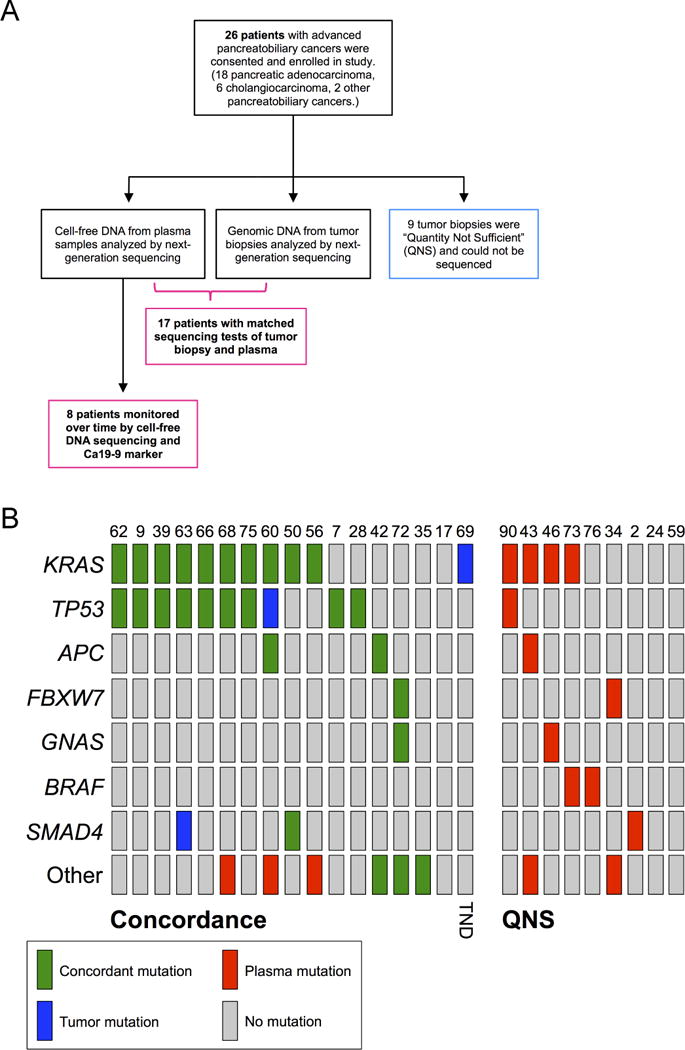
(A) Study design for measuring the feasibility, concordance, and accuracy of a plasma-based cell-free DNA sequencing test compared to biopsy-based sequencing tests for pancreatic and biliary cancer patients (in accordance with Standards for the Reporting of Diagnostic accuracy studies, STARD). Sixteen patients had mutations detected by either type of test, and one patient had no mutations detected in either plasma or in tumor tissue (n=17). (B) Oncoprint chart showing mutation occurrence for the top seven genes across all patients. The group at left (“Concordance”) shows mutations detected in the 17 samples used for the concordance analysis (see Figure 2B). The group at right (“QNS”) shows mutations detected in cfDNA from the eight QNS samples. TND, tumor not detected in cfDNA.
Figure 2
Figure 2
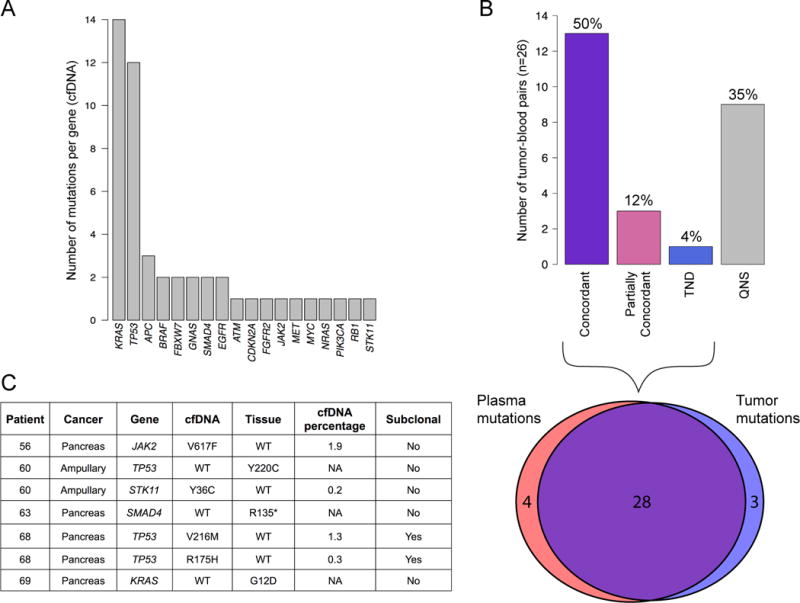
Summary of mutational concordance across 26 pancreatobiliary cancer patients. (A) Top: Numbers of matched biopsy DNA and plasma cfDNA samples in each patient-level concordance category. Concordant samples are those with all reported mutations found in both biopsy-based and plasma-based sequencing tests. Partial concordance occurred if at least one mutation, but not all mutations, were concordant between biopsy DNA and plasma cfDNA. TND: Tumor Not Detected. QNS: Quantity Not Sufficient. Bottom: Venn diagram showing overlap of reported mutations between cfDNA and tumor biopsy sequencing tests for 17 patients. (B) Numbers of mutations detected per gene by the cfDNA test across the cohort (49 mutations total). (C) Details of the seven non-concordant mutations from the 17 patients in (A).
Figure 3
Figure 3
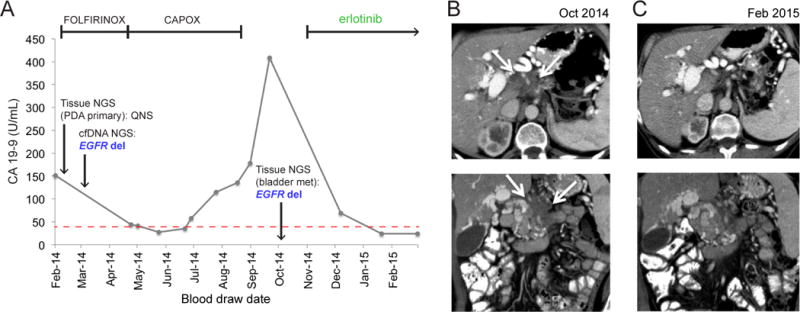
Treatment and diagnosis history, and response to targeted therapy, of a pancreatic adenocarcinoma patient with an EGFR exon19 deletion. (A) CA 19–9 levels (x axis) over time of treatment (y-axis) for patient #34. Dates of two biopsy-based NGS tests, and of EGFR indel detection by cfDNA test, are indicated along the CA 19–9 line. Time intervals for therapies administered to patient are indicated by bracketed lines at top. Erlotinib monotherapy is ongoing as of June 3, 2015. (B) Axial (top) and coronal (bottom) contrast-enhanced CT images from October 2014 demonstrate infiltrative tumor (arrows) arising from the pancreatic body and encasing the celiac axis. (D) Axial (top) and coronal (bottom) contrast-enhanced CT images from February 2015 demonstrate marked reduction in the size of the pancreatic mass.

References

    1. Ryan DP, Hong TS, Bardeesy N. Pancreatic adenocarcinoma. N Engl J Med. 2014;371:2140–1. - PubMed
    1. Lynch TJ, Bell DW, Sordella R, Gurubhagavatula S, Okimoto RA, Brannigan BW, et al. Activating mutations in the epidermal growth factor receptor underlying responsiveness of non-small-cell lung cancer to gefitinib. N Engl J Med. 2004;350:2129–39. - PubMed
    1. Slamon DJ, Leyland-Jones B, Shak S, Fuchs H, Paton V, Bajamonde A, et al. Use of chemotherapy plus a monoclonal antibody against HER2 for metastatic breast cancer that overexpresses HER2. N Engl J Med. 2001;344:783–92. - PubMed
    1. Neesse A, Michl P, Frese KK, Feig C, Cook N, Jacobetz MA, et al. Stromal biology and therapy in pancreatic cancer. Gut. 2011;60:861–8. - PubMed
    1. Biankin AV, Waddell N, Kassahn KS, Gingras MC, Muthuswamy LB, Johns AL, et al. Pancreatic cancer genomes reveal aberrations in axon guidance pathway genes. Nature. 2012;491:399–405. - PMC - PubMed

Publication types

MeSH terms