


Metabolic network modeling of microbial communities
- PMID: 26109480
- PMCID: PMC4575871
- DOI: 10.1002/wsbm.1308
Metabolic network modeling of microbial communities
Abstract
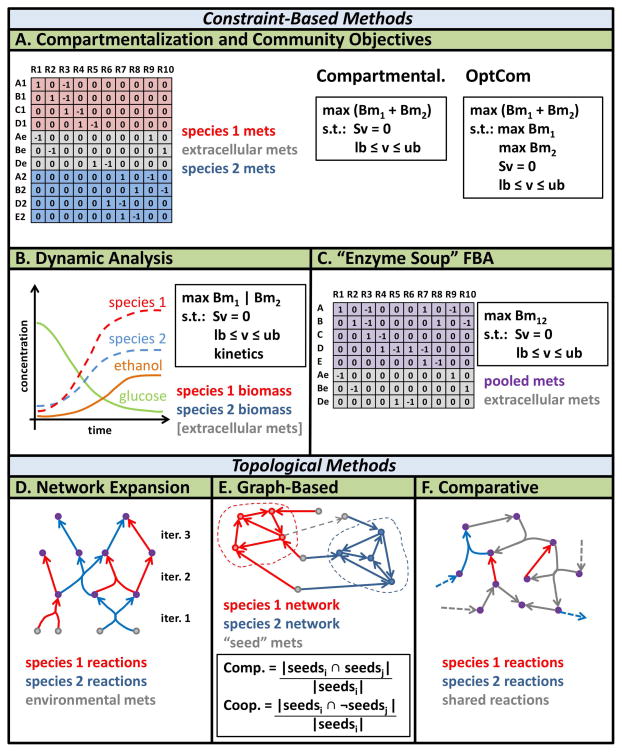
Genome-scale metabolic network reconstructions and constraint-based analyses are powerful methods that have the potential to make functional predictions about microbial communities. Genome-scale metabolic networks are used to characterize the metabolic functions of microbial communities via several techniques including species compartmentalization, separating species-level and community-level objectives, dynamic analysis, the 'enzyme-soup' approach, multiscale modeling, and others. There are many challenges in the field, including a need for tools that accurately assign high-level omics signals to individual community members, the need for improved automated network reconstruction methods, and novel algorithms for integrating omics data and engineering communities. As technologies and modeling frameworks improve, we expect that there will be corresponding advances in the fields of ecology, health science, and microbial community engineering.
© 2015 Wiley Periodicals, Inc.
Figures

References
-
- Chaparro JM, Sheflin AM, Manter DK, Vivanco JM. Manipulating the soil microbiome to increase soil health and plant fertility. Biology and Fertility of Soils. 2012;48:489–99. doi: 10.1007/s00374-012-0691-4. - DOI
-
- Smid EJ, Erkus O, Spus M, Wolkers-Rooijackers JC, Alexeeva S, Kleerebezem M. Functional implications of the microbial community structure of undefined mesophilic starter cultures. Microbial Cell Factories. BioMed Central Ltd. 2014;13(Suppl 1):S2. doi: 10.1186/1475-2859-13-S1-S2. - DOI - PMC - PubMed
Further Reading/Resources
Publication types
MeSH terms
Grants and funding
LinkOut - more resources
Full Text Sources
Other Literature Sources
