. 2015 Jun 24;4(7):e001598.
doi: 10.1161/JAHA.114.001598.

Apocynin Attenuates Cardiac Injury in Type 4 Cardiorenal Syndrome via Suppressing Cardiac Fibroblast Growth Factor-2 With Oxidative Stress Inhibition

Affiliations

Apocynin Attenuates Cardiac Injury in Type 4 Cardiorenal Syndrome via Suppressing Cardiac Fibroblast Growth Factor-2 With Oxidative Stress Inhibition

Yang Liu et al. J Am Heart Assoc. .

Abstract

Background: Type 4 cardiorenal syndrome (CRS) refers to the cardiac injury induced by chronic kidney disease. We aimed to assess oxidative stress and cardiac injury in patients with type 4 CRS, determine whether the antioxidant apocynin attenuated cardiac injury in rats with type 4 CRS, and explore potential mechanisms.

Methods and results: A cross-sectional study was conducted among patients with type 4 CRS (n=17) and controls (n=16). Compared with controls, patients with type 4 CRS showed elevated oxidative stress, which was significantly correlated with cardiac hypertrophy and decreased ejection fraction. In vivo study, male Sprague-Dawley rats underwent 5/6 subtotal nephrectomy and sham surgery, followed with apocynin or vehicle treatment for 8 weeks. Eight weeks after surgery, the 5/6 subtotal nephrectomy rats mimicked type 4 CRS, showing increased serum creatinine, cardiac hypertrophy and fibrosis, and decreased ejection fraction compared with sham-operated animals. Cardiac malondialdehyde, NADPH oxidase activity, fibroblast growth factor-2, and extracellular signal-regulated kinase 1/2 (ERK1/2) phosphorylation increased significantly in the 5/6 subtotal nephrectomy rats. These changes were significantly attenuated by apocynin. In vitro study showed that apocynin reduced angiotensin II-induced NADPH oxidase-dependent oxidative stress, upregulation of fibroblast growth factor-2 and fibrosis biomarkers, and ERK1/2 phosphorylation in cardiac fibroblasts. Importantly, the ERK1/2 inhibitor U0126 reduced the upregulation of fibroblast growth factor-2 and fibrosis biomarkers in angiotensin II-treated fibroblasts.

Conclusions: Oxidative stress is a candidate mediator for type 4 CRS. Apocynin attenuated cardiac injury in type 4 CRS rats via inhibiting NADPH oxidase-dependent oxidative stress-activated ERK1/2 pathway and subsequent fibroblast growth factor-2 upregulation. Our study added evidence to the beneficial effect of apocynin in type 4 CRS.

Keywords: cardiac remodeling; cardiorenal syndrome; extracellular signal‐regulated kinase 1/2; fibroblast growth factor; pharmacology.


Figures

Figure 1
Figure 1
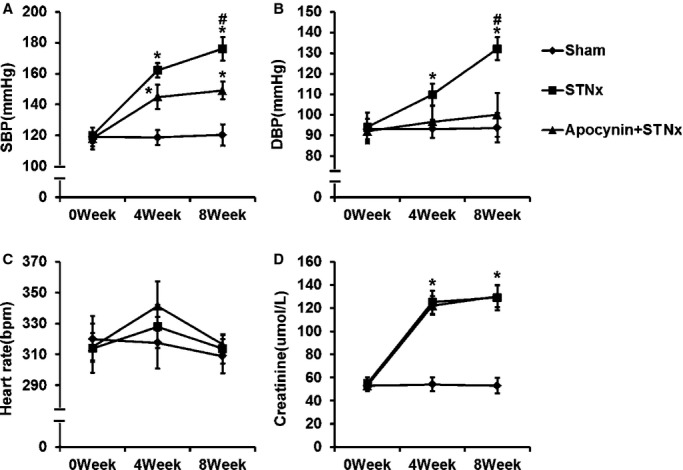
The effects of apocynin on blood pressure, heart rate and serum creatinine in rats at baseline, and the 4th and 8th week after subtotal nephrectomy. A through C, Apocynin reduced the elevated SBP and DBP in STNx rats. STNx and apocynin had no significant effect on heart rate. D, The increased serum creatinine in STNx rats was not significantly affected by apocynin. Data were expressed as mean±SD. n=10 for each group; *P<0.01 vs Sham group; #P<0.01 vs Apocynin+STNx group. DBP indicates diastolic blood pressure; SBP, systolic blood pressure; STNx, 5/6 subtotally nephrectomized.
Figure 2
Figure 2
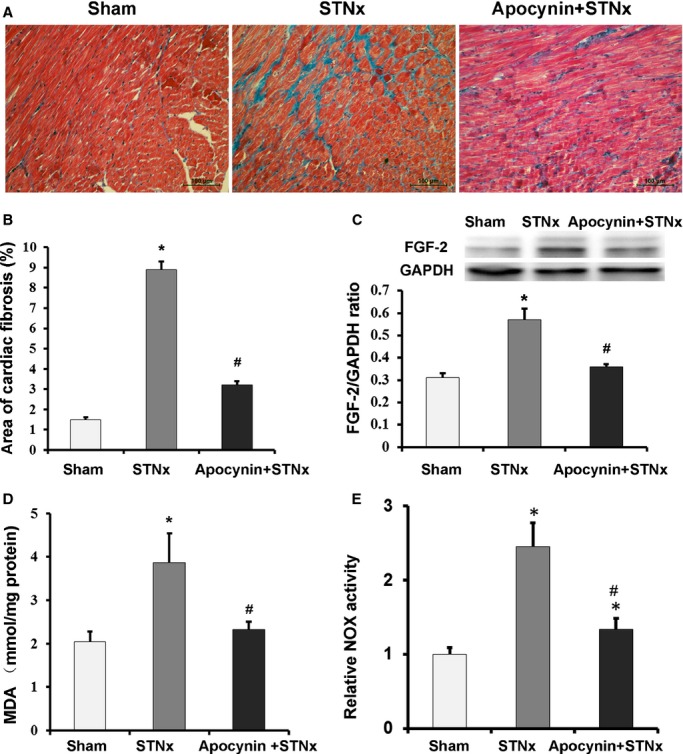
Apocynin attenuated cardiac fibrosis, expression of fibroblast growth factor-2, malondialdehyde and NOX activity in STNx rats. A, Representative Masson staining micrographs show that the increased cardiac interstitial fibrosis in STNx rats was attenuated by apocynin (bar=200 μm). B, Bar graph shows the interstitial fibrosis volume fractions (n=40 fields). C, The expression level of cardiac FGF-2 (n=6). D, MDA levels in left ventricular tissue homogenates (n=6). E, NOX activity was measured with lucigenin-enhanced chemiluminescence assay. The NOX activities in different groups were normalized to controls (n=4). Data were expressed as mean±SD. *P<0.01 vs Sham group; #P<0.01 vs STNx group. FGF-2 indicates fibroblast growth factor-2; GAPDH, anti–glyceraldehyde 3-phosphate dehydrogenase; MDA, malondialdehyde; NOX, nicotinamide adenine dinucleotide phosphate oxidase; STNx, 5/6 subtotally nephrectomized.
Figure 3
Figure 3
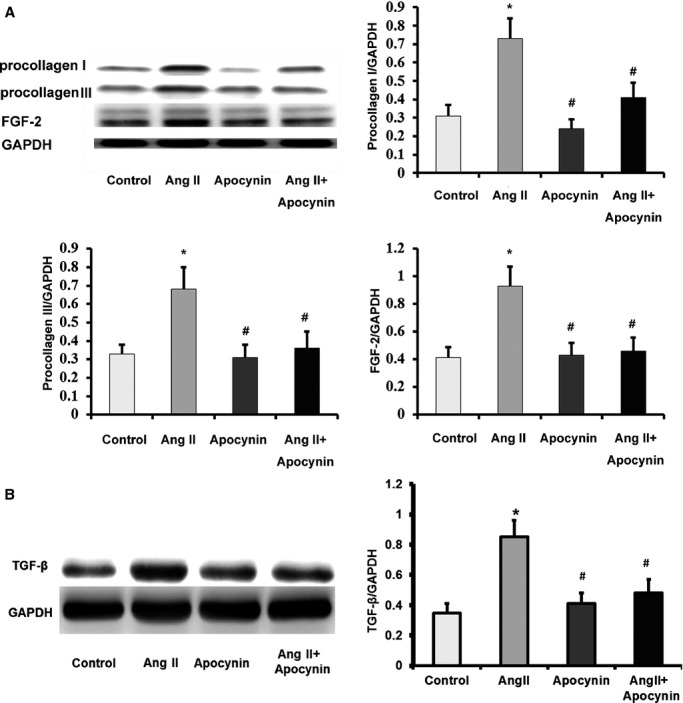
Apocynin attenuated Ang II–induced upregulations of fibrosis biomarkers and fibroblast growth factor-2 in cardiac fibroblasts. A, Western blot results showed that Ang II–induced upregulations of procollagen I, procollagen III and FGF-2 were reduced by apocynin (n=4). B, Apocynin attenuated Ang II–induced upregulation of TGF-β (n=4). Data were expressed as mean±SD. *P<0.01 vs Control group; #P<0.01 vs Ang II group. Ang II indicates angiotensin II; FGF-2, fibroblast growth factor-2; GAPDH, anti–glyceraldehyde 3-phosphate dehydrogenase; TGF-β, transforming growth factor-beta.
Figure 4
Figure 4
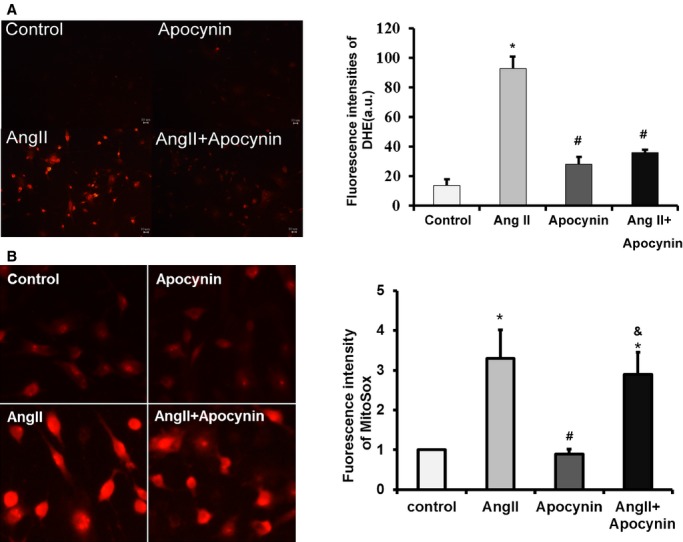
Apocynin reduced intracellular superoxide anion, but had no significant effect on mitochondrial superoxide anion production. A, Representative fluorescence micrographs (×200) on detecting intracellular superoxide anion with DHE. The bar graph shows the fluorescence intensities of DHE measured wtih a multimode microplate reader (n=3). B, Representative fluorescence micrographs (×400) on detecting mitochondrial superoxide anion with MitoSOX Red. The bar graph shows the relative fluorescence intensities normalized to controls (n=3). Data were expressed as mean±SD. *P<0.01 vs Control group; #P<0.01 vs Ang II group; &P<0.01 vs Apocynin group. Ang II indicates angiotensin II; DHE, dihydroethidium.
Figure 5
Figure 5
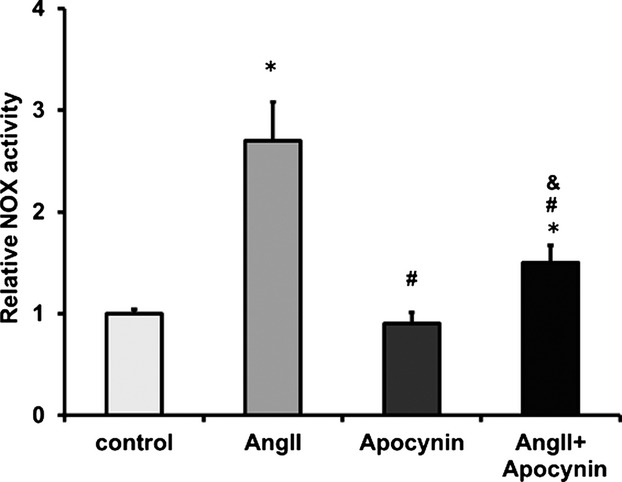
Apocynin inhibited NOX activity in Ang II–treated cardiac fibroblasts. NOX activity was measured with lucigenin-enhanced chemiluminescence assay. The NOX activities in different groups were normalized to controls (n=3). Data were expressed as mean±SD. *P<0.01 vs Control group; #P<0.01 vs Ang II group; &P<0.01 vs Apocynin group. Ang II indicates angiotensin II; NOX, nicotinamide adenine dinucleotide phosphate oxidase.
Figure 6
Figure 6
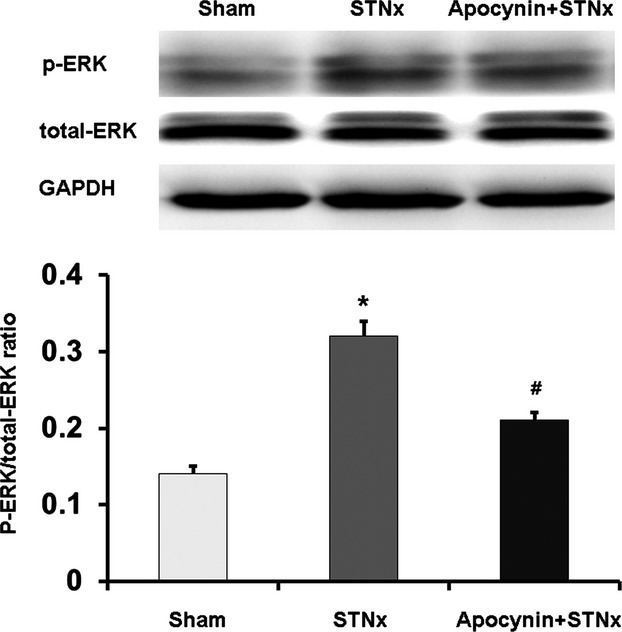
Apocynin inhibited the phosphorylation of ERK1/2 in STNx rats. Data were expressed as mean±SD. *P<0.01 vs Control group; #P<0.01 vs Ang II group. Ang II indicates angiotensin II; ERK1/2, extracellular signal-regulated kinase 1/2; GAPDH, anti–glyceraldehyde 3-phosphate dehydrogenase; p-ERK, phosphorylation extracellular signal-regulated kinase; STNx, 5/6 subtotally nephrectomized.
Figure 7
Figure 7
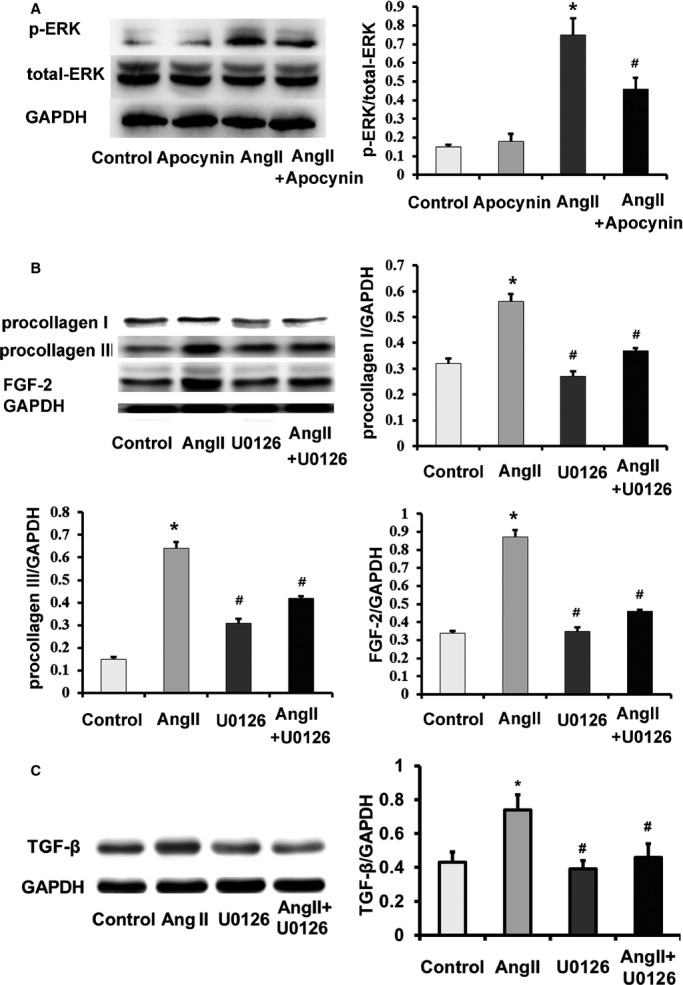
Apocynin attenuated cardiac fibrosis via inhibiting extracellular signal-regulated kinase 1/2 activation and fibroblast growth factor-2 expression. A, Ang II–induced ERK1/2 p-ERK was inhibited by apocynin. B and C, Ang II–induced expressions of FGF-2 and fibrosis biomarkers, including procollagen I procollagen III and TGF-β, were reduced by U0126 (ERK1/2 inhibitor) in cardiac fibroblasts. Data were expressed as mean±SD; n=3 for each group. *P<0.01 vs Control group; #P<0.01 vs Ang II group. Ang II indicates angiotensin II; p-ERK, phosphorylation extracellular signal-regulated kinase; FGF-2, fibroblast growth factor-2; TGF-β, transforming growth factor-beta; GAPDH, anti–glyceraldehyde 3-phosphate dehydrogenase; ERK1/2, extracellular signal-regulated kinase 1/2.

References

    1. Ronco C, Haapio M, House AA, Anavekar N, Bellomo R. Cardiorenal syndrome. J Am Coll Cardiol. 2008;52:1527–1539. - PubMed
    1. Tumlin JA, Costanzo MR, Chawla LS, Herzog CA, Kellum JA, McCullough PA, Ronco C. Cardiorenal syndrome type 4: insights on clinical presentation and pathophysiology from the eleventh consensus conference of the Acute Dialysis Quality Initiative (ADQI) Contrib Nephrol. 2013;182:158–173. - PubMed
    1. Bello AK, Nwankwo E, El Nahas AM. Prevention of chronic kidney disease: a global challenge. Kidney Int Suppl. 2005;98:S11–S17. - PubMed
    1. Jha V, Garcia-Garcia G, Iseki K, Li Z, Naicker S, Plattner B, Saran R, Wang AY, Yang CW. Chronic kidney disease: global dimension and perspectives. Lancet. 2013;382:260–272. - PubMed
    1. Clementi A, Virzi GM, Goh CY, Cruz DN, Granata A, Vescovo G, Ronco C. Cardiorenal syndrome type 4: a review. Cardiorenal Med. 2013;3:63–70. - PMC - PubMed

Publication types

MeSH terms