


Review
doi: 10.1128/JVI.02530-14.
Epub 2015 Jun 24.
The Great (Nuclear) Escape: New Insights into the Role of the Nuclear Egress Complex of Herpesviruses
Affiliations
- PMID: 26109725
- PMCID: PMC4542350
- DOI: 10.1128/JVI.02530-14
Item in Clipboard
Review
The Great (Nuclear) Escape: New Insights into the Role of the Nuclear Egress Complex of Herpesviruses
J Virol.
2015 Sep.
Abstract
Herpesviruses are unusual among enveloped viruses because they bud twice yet acquire a single envelope. They are also the only known viruses that bud into the nuclear envelope. We discovered that the herpesvirus nuclear egress complex could bud membranes without the help of other proteins by forming a coat-like hexagonal scaffold inside the budding membrane. This finding raises the possibility that a phenotypically similar nuclear export of large RNAs is cargo driven.
Copyright © 2015, American Society for Microbiology. All Rights Reserved.
Figures
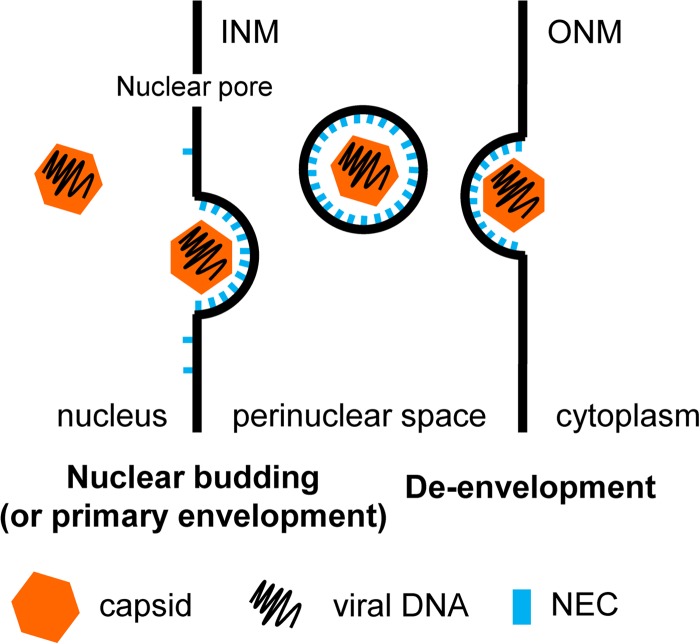
Schematic model of herpesvirus nuclear egress. The mature capsid is recruited to the INM, where the NEC is located via the UL34 TM region. Upon capsid binding, the NEC oligomerizes into a hexameric lattice and deforms the INM around the viral capsid. After scission of the bud, which may be facilitated by cellular factors, the enveloped capsid resides in the perinuclear space. Disassembly of the hexameric NEC lattice may allow fusion of the viral particle with the ONM, termed de-envelopment. The naked capsid is then released into the cytosol, where it undergoes further maturation.
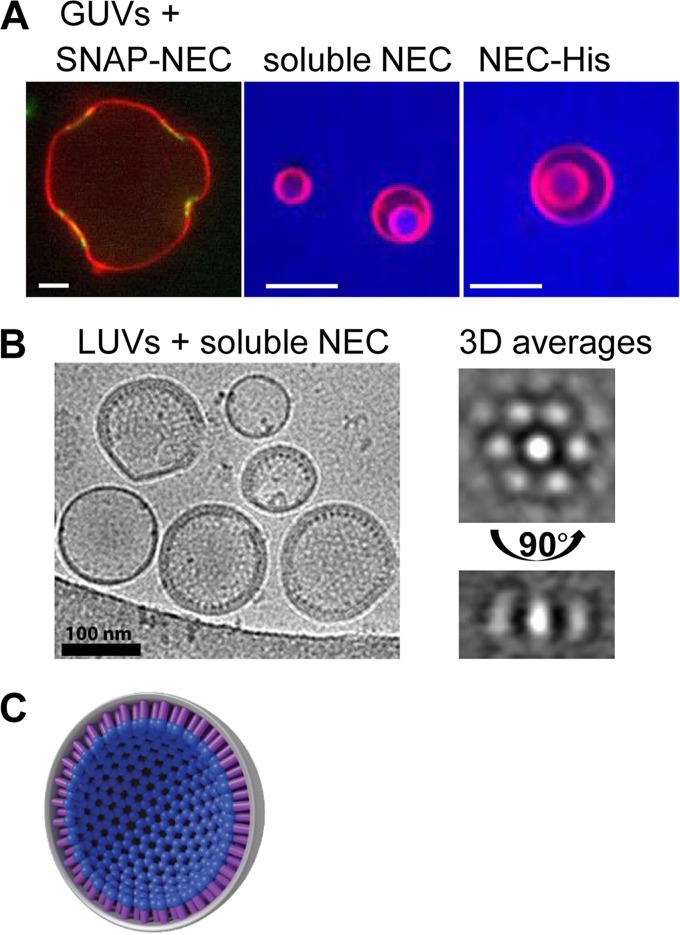
The NEC deforms and buds membranes in vitro by forming a honeycomb coat. (A) Green fluorescently labeled NEC (SNAP-NEC) binds to GUVs (red) and induces negative curvature at the binding site. The untagged NEC (soluble NEC) or artificially anchored NEC (NEC-His) buds GUVs, resulting in the appearance of ILVs. Bars, 5 μm. (B) Cryo-EM images showing circular structures on the inside of large unilamellar vesicles (LUVs) and spikes emanating from the rim. Three-dimensional (3D) averaging allowed us identify the circular structures as a hexagonal honeycomb pattern in a view of the spikes from the top. (C) Model of hexagonal coat on the inside of budded vesicles. All of the images shown are adapted from reference .
References
-
- Shiba C, Daikoku T, Goshima F, Takakuwa H, Yamauchi Y, Koiwai O, Nishiyama Y. 2000. The UL34 gene product of herpes simplex virus type 2 is a tail-anchored type II membrane protein that is significant for virus envelopment. J Gen Virol 81:2397–2405. - PubMed
-
- Reynolds AE, Wills EG, Roller RJ, Ryckman BJ, Baines JD. 2002. Ultrastructural localization of the herpes simplex virus type 1 UL31, UL34, and US3 proteins suggests specific roles in primary envelopment and egress of nucleocapsids. J Virol 76:8939–8952. doi: 10.1128/JVI.76.17.8939-8952.2002. - DOI - PMC - PubMed
Publication types
MeSH terms
Grants and funding
LinkOut - more resources
Full Text Sources
Other Literature Sources
