


Bortezomib-based vs non-bortezomib-based post-transplantation treatment in multiple myeloma patients: a systematic review and meta-analysis of Phase III randomized controlled trials
- PMID: 26109870
- PMCID: PMC4474400
- DOI: 10.2147/OTT.S84828
Bortezomib-based vs non-bortezomib-based post-transplantation treatment in multiple myeloma patients: a systematic review and meta-analysis of Phase III randomized controlled trials
Abstract
Objective: To evaluate the efficacy and safety of bortezomib-based vs non-bortezomib-based post-transplantation therapy in patients with multiple myeloma.
Methods: Data of relevant randomized controlled trials assessing the effect of bortezomib as post-transplantation consolidation or maintenance therapy was obtained through a comprehensive search. The outcome measures included response rate, progression-free survival, overall survival, and adverse events (AEs). The hazard ratio (HR), Cochran-Mantel-Haenszel odds ratio (OR), and 95% confidence interval (95% CI) were applied to evaluate the effect of bortezomib in relation to the end points such as progression-free survival, overall survival, response rate, and AEs.
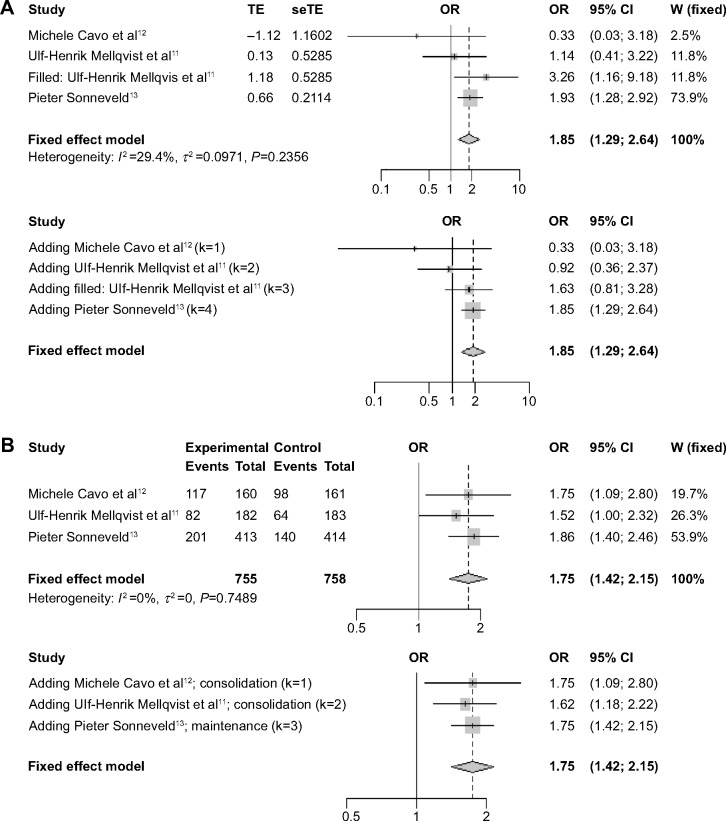
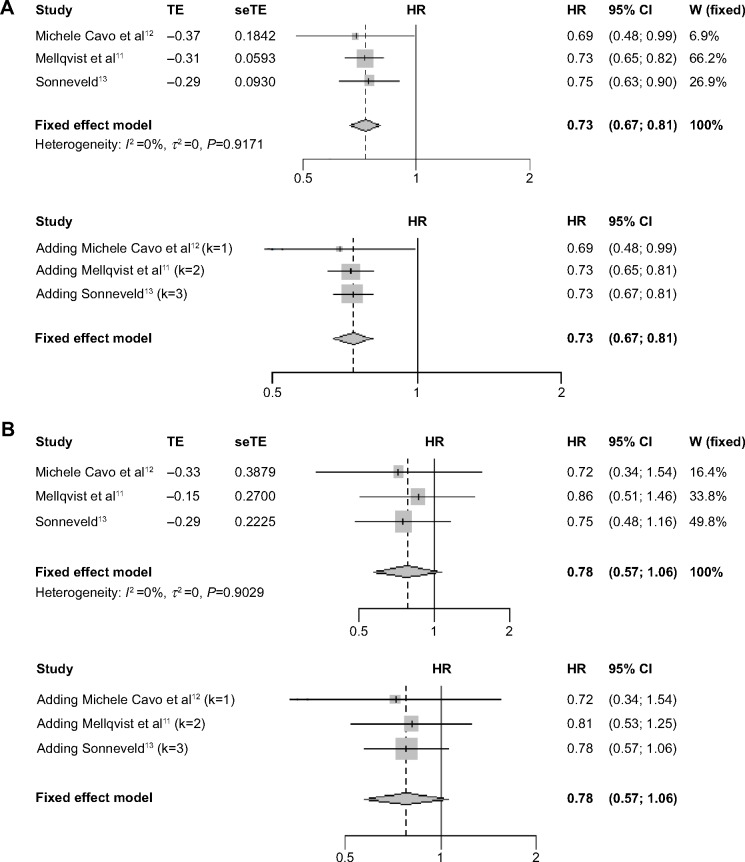
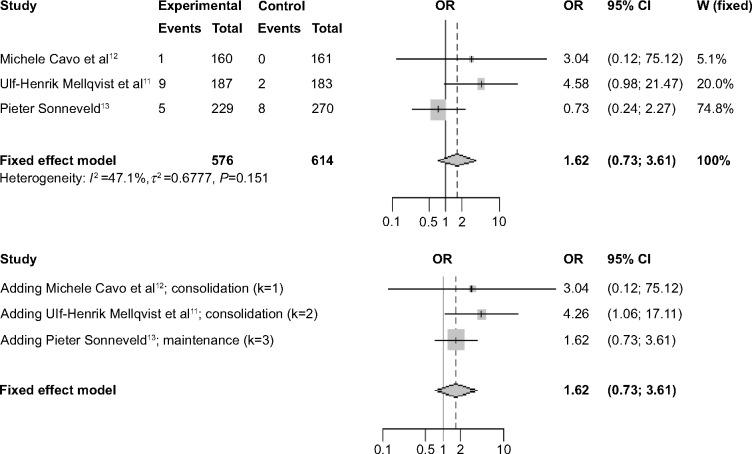
Results: Three randomized controlled trials comprising 1,518 participants were included in this study. Pooled ORs for the rates of overall response, and complete response and near complete response, were 1.85 and 1.75, respectively. Pooled HR for progression-free survival favored bortezomib-based therapy over non-bortezomib-based therapy (0.73, 95% CI: 0.67-0.81), while no statistically significant difference could be found between the two groups regarding the pooled HR for 3-year overall survival. Moreover, incidence rates of overall adverse events and grade 3 and 4 peripheral neuropathy were similar in the bortezomib-based groups and the non-bortezomib-based groups (P=0.12 and P=0.41, respectively). The corresponding cumulative meta-analyses of the rates of overall response rate, complete response and near complete response, and grades 3 and 4 peripheral neuropathy supported the superiority of bortezomib-based maintenance therapy over consolidation therapy.
Conclusion: Bortezomib-based therapy after autologous stem cell transplantation, with tolerable AEs, could obviously improve the response as well as the outcome of multiple myeloma patients, particularly when bortezomib was administered as maintenance therapy.
Keywords: bortezomib-based regimen; multiple myeloma; post-transplantation therapy.
Figures
References
-
- Sabattini E, Bacci F, Sagramoso C, Pileri SA. WHO classification of tumours of haematopoietic and lymphoid tissues in 2008: an overview. Pathologica. 2010;102(3):83–87. - PubMed
-
- Harousseau JL, Moreau P. Autologous hematopoietic stem-cell transplantation for multiple myeloma. N Engl J Med. 2009;360(25):2645–2654. - PubMed
-
- Schaar CG, Kluin-Nelemans HC, Te Marvelde C, et al. Interferon-alpha as maintenance therapy in patients with multiple myeloma. Ann Oncol. 2005;16(4):634–639. - PubMed
-
- Chou T, Tobinai K, Uike N, et al. Melphalan-prednisolone and vincristine-doxorubicin-dexamethasone chemotherapy followed by prednisolone/interferon maintenance therapy for multiple myeloma: Japan Clinical Oncology Group Study, JCOG0112. Jpn J Clin Oncol. 2011;41(4):586–589. - PubMed
-
- Berenson JR, Crowley JJ, Grogan TM, et al. Maintenance therapy with alternate-day prednisone improves survival in multiple myeloma patients. Blood. 2002;99(9):3163–3168. - PubMed
LinkOut - more resources
Full Text Sources
