Review
. 2015 May;10(5):721-5.
doi: 10.4103/1673-5374.156967.

The p75 neurotrophin receptor: at the crossroad of neural repair and death

Affiliations
Review

The p75 neurotrophin receptor: at the crossroad of neural repair and death

Rick B Meeker et al. Neural Regen Res. 2015 May.

Abstract

The strong repair and pro-survival functions of neurotrophins at their primary receptors, TrkA, TrkB and TrkC, have made them attractive candidates for treatment of nervous system injury and disease. However, difficulties with the clinical implementation of neurotrophin therapies have prompted the search for treatments that are stable, easier to deliver and allow more precise regulation of neurotrophin actions. Recently, the p75 neurotrophin receptor (p75(NTR)) has emerged as a potential target for pharmacological control of neurotrophin activity, supported in part by studies demonstrating 1) regulation of neural plasticity in the mature nervous system, 2) promotion of adult neurogenesis and 3) increased expression in neurons, macrophages, microglia, astrocytes and/or Schwann cells in response to injury and neurodegenerative diseases. Although the receptor has no intrinsic catalytic activity it interacts with and modulates the function of TrkA, TrkB, and TrkC, as well as sortilin and the Nogo receptor. This provides substantial cellular and molecular diversity for regulation of neuron survival, neurogenesis, immune responses and processes that support neural function. Upregulation of the p75(NTR) under pathological conditions places the receptor in a key position to control numerous processes necessary for nervous system recovery. Support for this possibility has come from recent studies showing that small, non-peptide p75(NTR) ligands can selectively modify pro-survival and repair functions. While a great deal remains to be discovered about the wide ranging functions of the p75(NTR), studies summarized in this review highlight the immense potential for development of novel neuroprotective and neurorestorative therapies.

Keywords: brain; injury; microglia; neural progenitor; neurodegenerative disease; neuron; plasticity; therapy.


Figures
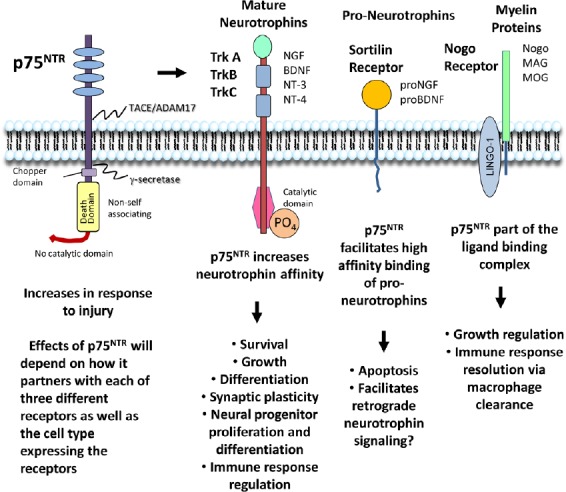
Figure 1
Figure 1
Potential signaling partners of the p75 neurotrophin receptor (p75NTR) following nervous system injury. The p75NTR is a single membrane-spanning receptor in the tumor necrosis factor (TNF) death domain containing receptor family. Four cysteine-rich extracellular domains bind each of the four neurotrophins: NGF, BDNF, NT-3 or NT-4 with low affinity and their respective pro-forms with high affinity. The intracellular portion of the receptor does not contain a catalytic domain to autoactivate the receptor. Thus, the receptor functions largely via interactions with other effector proteins. The p75NTR can interact with at least three different receptor classes which mediate different outcomes: Trk receptors, sortilin and Nogo receptor. 1) The p75NTR-Trk receptor complex increases the affinity of the mature neurotrophin/Trk interaction and enhances pro-survival and growth signaling via PI3KAkt, ERK or PLCγ pathways. In addition, expression on neural progenitors supports proliferation and differentiation. 2) Interactions of p75NTR with sortilin allow high affinity binding of the pro-neurotrophins to the p75NTR/sortilin complex leading to apoptosis. However, the role of sortilin may be diverse as it also supports neuron survival via its prominent sorting functions which include anterograde trafficking of neurotrophin receptors. 3) Interactions of the p75NTR with the Nogo receptor and Lingo-1 play a role in the control of growth. Binding of myelin proteins to the complex activates RhoA by displacement of Rho-GDI and concurrently suppress Rac leading to collapse of growth cones, neurite retraction and decreases in spine density. These various interactions afford the p75NTR the capacity to play a pivotal role in the regulation of numerous processes that determine the fate and functions of the cell. The role of the p75NTR in response to injury is largely unknown and is a potential source of new strategies to facilitate recovery of the damaged nervous system. NGF: Nerve growth factor; BDNF: brain-derived neurotrophic factor; NT-3: neurotrophin-3; NT-4: neurotrophin-4; Trk: tropomyosin regulated kinase; ERK: extracellular signal-regulated kinase; PLCγ: phospholipase C-γ.

References

    1. Beattie MS, Harrington AW, Lee R, Kim JY, Boyce SL, Longo FM, Bresnahan JC, Hempstead BL, Yoon SO. ProNGF induces p75-mediated death of oligodendrocytes following spinal cord injury. Neuron. 2002;36:375–386. - PMC - PubMed
    1. Bernabeu RO, Longo FM. The p75 neurotrophin receptor is expressed by adult mouse dentate progenitor cells and regulates neuronal and non-neuronal cell genesis. BMC Neurosci. 2010;11:136. - PMC - PubMed
    1. Choi S, Friedman WJ. Inflammatory cytokines IL-1beta and TNF-alpha regulate p75NTR expression in CNS neurons and astrocytes by distinct cell-type-specific signalling mechanisms. ASN Neuro 1. 2009 - PMC - PubMed
    1. Chu GK, Yu W, Fehlings MG. The p75 neurotrophin receptor is essential for neuronal cell survival and improvement of functional recovery after spinal cord injury. Neuroscience. 2007;148:668–682. - PubMed
    1. Costantini C, Scrable H, Puglielli L. An aging pathway controls the TrkA to p75NTR receptor switch and amyloid beta-peptide generation. Embo J. 2006;25:1997–2006. - PMC - PubMed