


Influence of phthalates on in vitro innate and adaptive immune responses
- PMID: 26110840
- PMCID: PMC4482536
- DOI: 10.1371/journal.pone.0131168
Influence of phthalates on in vitro innate and adaptive immune responses
Abstract
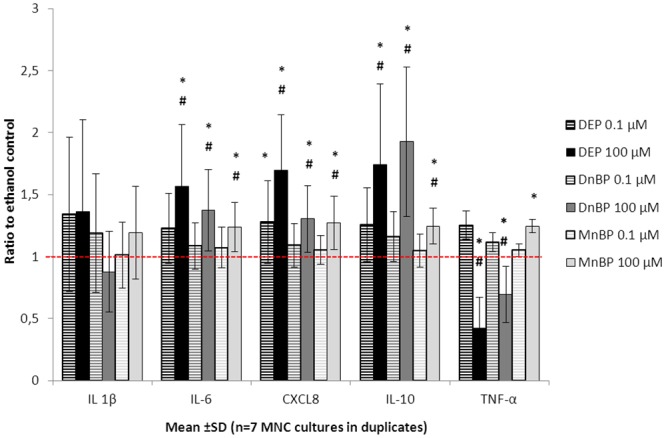
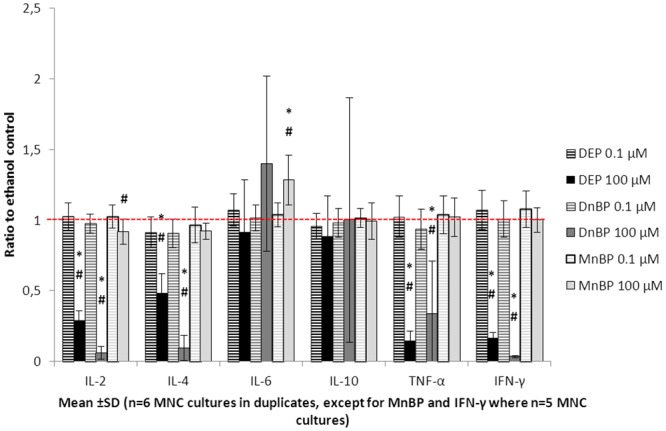
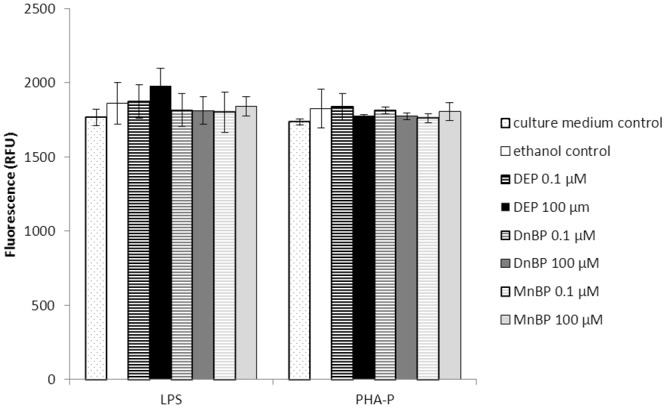
Phthalates are a group of endocrine disrupting chemicals, suspected to influence the immune system. The aim of this study was to investigate the influence of phthalates on cytokine secretion from human peripheral blood mononuclear cells. Escherichia coli lipopolysaccharide and phytohemagglutinin-P were used for stimulation of monocytes/macrophages and T cells, respectively. Cells were exposed for 20 to 22 hours to either di-ethyl, di-n-butyl or mono-n-butyl phthalate at two different concentrations. Both diesters were metabolised to their respective monoester and influenced cytokine secretion from both monocytes/macrophages and T cells in a similar pattern: the secretion of interleukin (IL)-6, IL-10 and the chemokine CXCL8 by monocytes/macrophages was enhanced, while tumour necrosis factor (TNF)-α secretion by monocytes/macrophages was impaired, as was the secretion of IL-2 and IL-4, TNF-α and interferon-γ by T cells. The investigated phthalate monoester also influenced cytokine secretion from monocytes/macrophages similar to that of the diesters. In T cells, however, the effect of the monoester was different compared to the diesters. The influence of the phthalates on the cytokine secretion did not seem to be a result of cell death. Thus, results indicate that both human innate and adaptive immunity is influenced in vitro by phthalates, and that phthalates therefore may affect cell differentiation and regenerative and inflammatory processes in vivo.
Conflict of interest statement
Figures
References
-
- Heudorf U, Mersch-Sundermann V, Angerer J. Phthalates: Toxicology and exposure. International Journal of Hygiene and Environmental Health. 2007; 210: 623–634. - PubMed
-
- Wormuth M, Scheringer M, Vollenweider M, Hungerbuhler K. What are the sources of exposure to eight frequently used phthalic acid esters in Europeans? Risk Analysis. 2006; 26: 803–824. - PubMed
-
- Frederiksen H, Skakkebaek NE, Andersson AM. Metabolism of phthalates in humans. Mol Nutr Food Res. 2007; 51: 899–911. - PubMed
Publication types
MeSH terms
Substances
LinkOut - more resources
Full Text Sources
Other Literature Sources
