


Center Variation in Intestinal Microbiota Prior to Late-Onset Sepsis in Preterm Infants
- PMID: 26110908
- PMCID: PMC4482142
- DOI: 10.1371/journal.pone.0130604
Center Variation in Intestinal Microbiota Prior to Late-Onset Sepsis in Preterm Infants
Abstract
Objective: Late onset sepsis (LOS) contributes to mortality and morbidity in preterm infants. We tested the hypotheses that microbes causing LOS originate from the gut, and that distortions in the gut microbial community increases subsequent risk of LOS.
Study design: We examined the gut microbial community in prospectively collected stool samples from preterm infants with LOS and an equal number of age-matched controls at two sites (Cincinnati, OH and Birmingham, AL), by sequencing the bacterial 16S rDNA. We confirmed our findings in a subset of infants by whole genome shotgun sequencing, and analyzed the data using R and LEfSe.
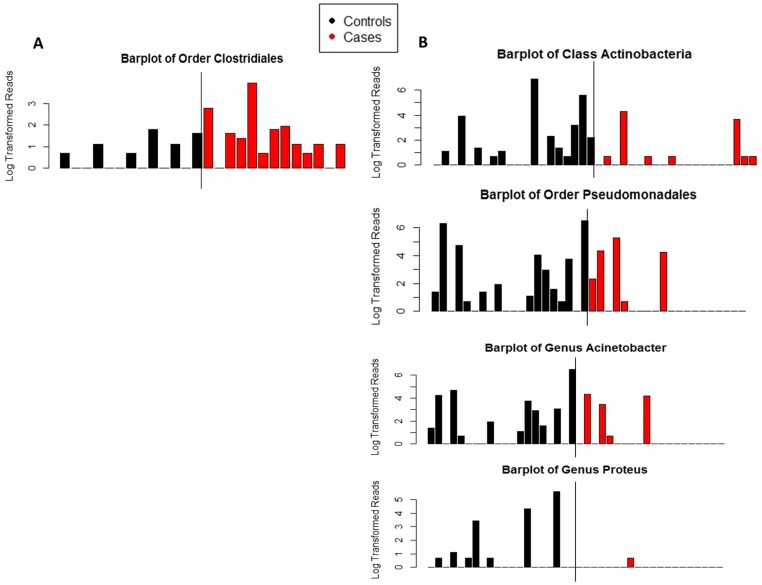
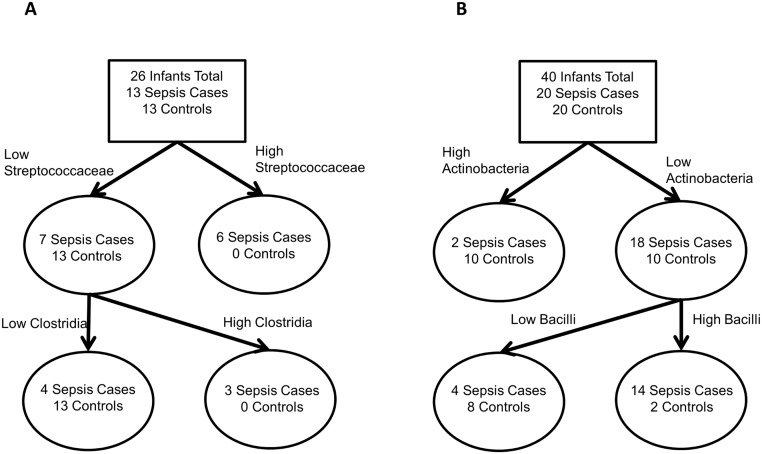
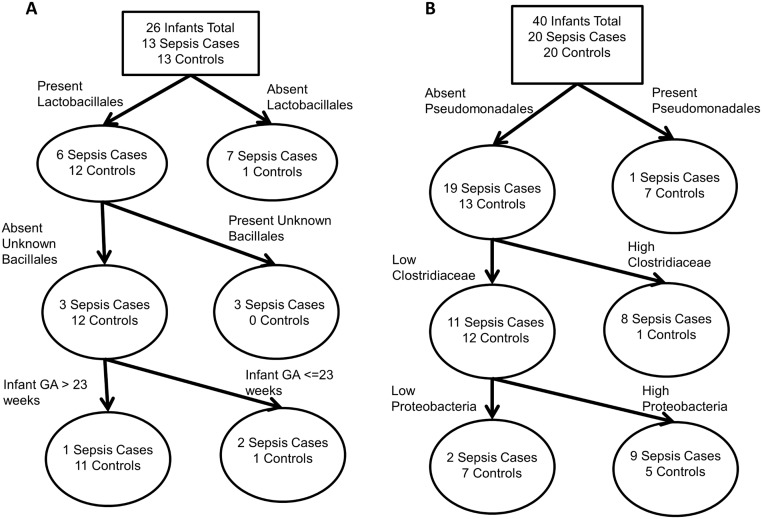
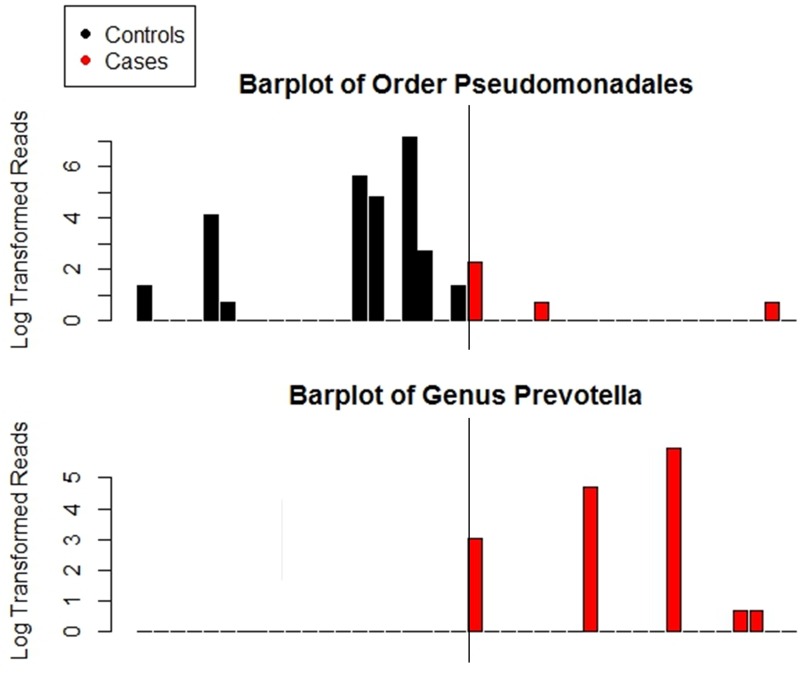
Results: Infants with LOS in Cincinnati, as compared to controls, had less abundant Actinobacteria in the first samples after birth (median 18 days before sepsis onset), and less abundant Pseudomonadales in the last samples collected prior to LOS (median 8 days before sepsis onset). Infants with LOS in Birmingham, as compared to controls, had no differences identified in the first sample microbial communities, but Lactobacillales was less abundant in the last samples prior to LOS (median 4 days before sepsis onset). Sequencing identified detectable levels of the sepsis-causative organism in stool samples prior to disease onset for 82% of LOS cases.
Conclusions: Translocation of gut microbes may account for the majority of LOS cases. Distortions in the fecal microbiota occur prior to LOS, but the form of distortion depends on timing and site. The microbial composition of fecal samples does not predict LOS onset in a generalizable fashion.
Conflict of interest statement
Figures
Similar articles
-
Intrauterine inflammation exposure may increase the risk of late-onset sepsis in premature infants: a retrospective cohort study.Ital J Pediatr. 2025 Jul 10;51(1):218. doi: 10.1186/s13052-025-02040-5. Ital J Pediatr. 2025. PMID: 40640885 Free PMC article.
-
Intestinal dysbiosis in preterm infants preceding necrotizing enterocolitis: a systematic review and meta-analysis.Microbiome. 2017 Mar 9;5(1):31. doi: 10.1186/s40168-017-0248-8. Microbiome. 2017. PMID: 28274256 Free PMC article.
-
Late-onset sepsis treatment in very preterm infants alters longitudinal microbiome trajectory with lower abundance of Bifidobacterium despite probiotic supplementation.Gut Microbes. 2025 Dec;17(1):2523808. doi: 10.1080/19490976.2025.2523808. Epub 2025 Jul 6. Gut Microbes. 2025. PMID: 40618372 Free PMC article.
-
Higher versus lower amino acid intake in parenteral nutrition for newborn infants.Cochrane Database Syst Rev. 2018 Mar 5;3(3):CD005949. doi: 10.1002/14651858.CD005949.pub2. Cochrane Database Syst Rev. 2018. PMID: 29505664 Free PMC article.
-
Different corticosteroids and regimens for accelerating fetal lung maturation for babies at risk of preterm birth.Cochrane Database Syst Rev. 2022 Aug 9;8(8):CD006764. doi: 10.1002/14651858.CD006764.pub4. Cochrane Database Syst Rev. 2022. PMID: 35943347 Free PMC article.
Cited by
-
Lactobacillus rhamnosus modulates murine neonatal gut microbiota and inflammation caused by pathogenic Escherichia coli.BMC Microbiol. 2024 Nov 6;24(1):452. doi: 10.1186/s12866-024-03598-6. BMC Microbiol. 2024. PMID: 39506682 Free PMC article.
-
Gut microbiota in preterm infants with late-onset sepsis and pneumonia: a pilot case-control study.BMC Microbiol. 2024 Jul 22;24(1):272. doi: 10.1186/s12866-024-03419-w. BMC Microbiol. 2024. PMID: 39039501 Free PMC article.
-
Gut Dysbiosis, Bacterial Colonization and Translocation, and Neonatal Sepsis in Very-Low-Birth-Weight Preterm Infants.Front Microbiol. 2021 Oct 7;12:746111. doi: 10.3389/fmicb.2021.746111. eCollection 2021. Front Microbiol. 2021. PMID: 34690993 Free PMC article.
-
Adverse consequences of neonatal antibiotic exposure.Curr Opin Pediatr. 2016 Apr;28(2):141-9. doi: 10.1097/MOP.0000000000000338. Curr Opin Pediatr. 2016. PMID: 26886785 Free PMC article. Review.
-
Maternal activation of the EGFR prevents translocation of gut-residing pathogenic Escherichia coli in a model of late-onset neonatal sepsis.Proc Natl Acad Sci U S A. 2020 Apr 7;117(14):7941-7949. doi: 10.1073/pnas.1912022117. Epub 2020 Mar 16. Proc Natl Acad Sci U S A. 2020. PMID: 32179676 Free PMC article.
References
-
- Hornik CP, Fort P, Clark RH, Watt K, Benjamin DK Jr., Smith PB, et al. Early and late onset sepsis in very-low-birth-weight infants from a large group of neonatal intensive care units. Early human development. 2012;88 Suppl 2:S69–74. Epub 2012/05/29. 10.1016/s0378-3782(12)70019-1 - DOI - PMC - PubMed
-
- Stoll BJ, Hansen NI, Adams-Chapman I, Fanaroff AA, Hintz SR, Vohr B, et al. Neurodevelopmental and growth impairment among extremely low-birth-weight infants with neonatal infection. JAMA: the journal of the American Medical Association. 2004;292(19):2357–65. Epub 2004/11/18. 10.1001/jama.292.19.2357 . - DOI - PubMed
Publication types
MeSH terms
Associated data
Grants and funding
- U54HG004969/HG/NHGRI NIH HHS/United States
- HHSN272200900018C/AI/NIAID NIH HHS/United States
- T32 ES 10957-11/ES/NIEHS NIH HHS/United States
- P01 HD013021/HD/NICHD NIH HHS/United States
- UG1 HD027853/HD/NICHD NIH HHS/United States
- 5UL1RR026314-03/RR/NCRR NIH HHS/United States
- HG005969/HG/NHGRI NIH HHS/United States
- U10 HD027853/HD/NICHD NIH HHS/United States
- P01HD13021/HD/NICHD NIH HHS/United States
- R01 HG005969/HG/NHGRI NIH HHS/United States
- U54 HG004969/HG/NHGRI NIH HHS/United States
- R01 HD059140/HD/NICHD NIH HHS/United States
- T32 ES010957/ES/NIEHS NIH HHS/United States
- UL1 RR026314/RR/NCRR NIH HHS/United States
- R01HD059140/HD/NICHD NIH HHS/United States
- HD27853/HD/NICHD NIH HHS/United States
LinkOut - more resources
Full Text Sources
Other Literature Sources
Medical
