Effectiveness of Trauma-Focused Cognitive Behavioral Therapy Among Trauma-Affected Children in Lusaka, Zambia: A Randomized Clinical Trial
- PMID: 26111066
- PMCID: PMC9067900
- DOI: 10.1001/jamapediatrics.2015.0580
Effectiveness of Trauma-Focused Cognitive Behavioral Therapy Among Trauma-Affected Children in Lusaka, Zambia: A Randomized Clinical Trial
Abstract
Importance: Orphans and vulnerable children (OVC) are at high risk for experiencing trauma and related psychosocial problems. Despite this, no randomized clinical trials have studied evidence-based treatments for OVC in low-resource settings.
Objective: To evaluate the effectiveness of lay counselor-provided trauma-focused cognitive behavioral therapy (TF-CBT) to address trauma and stress-related symptoms among OVC in Lusaka, Zambia.
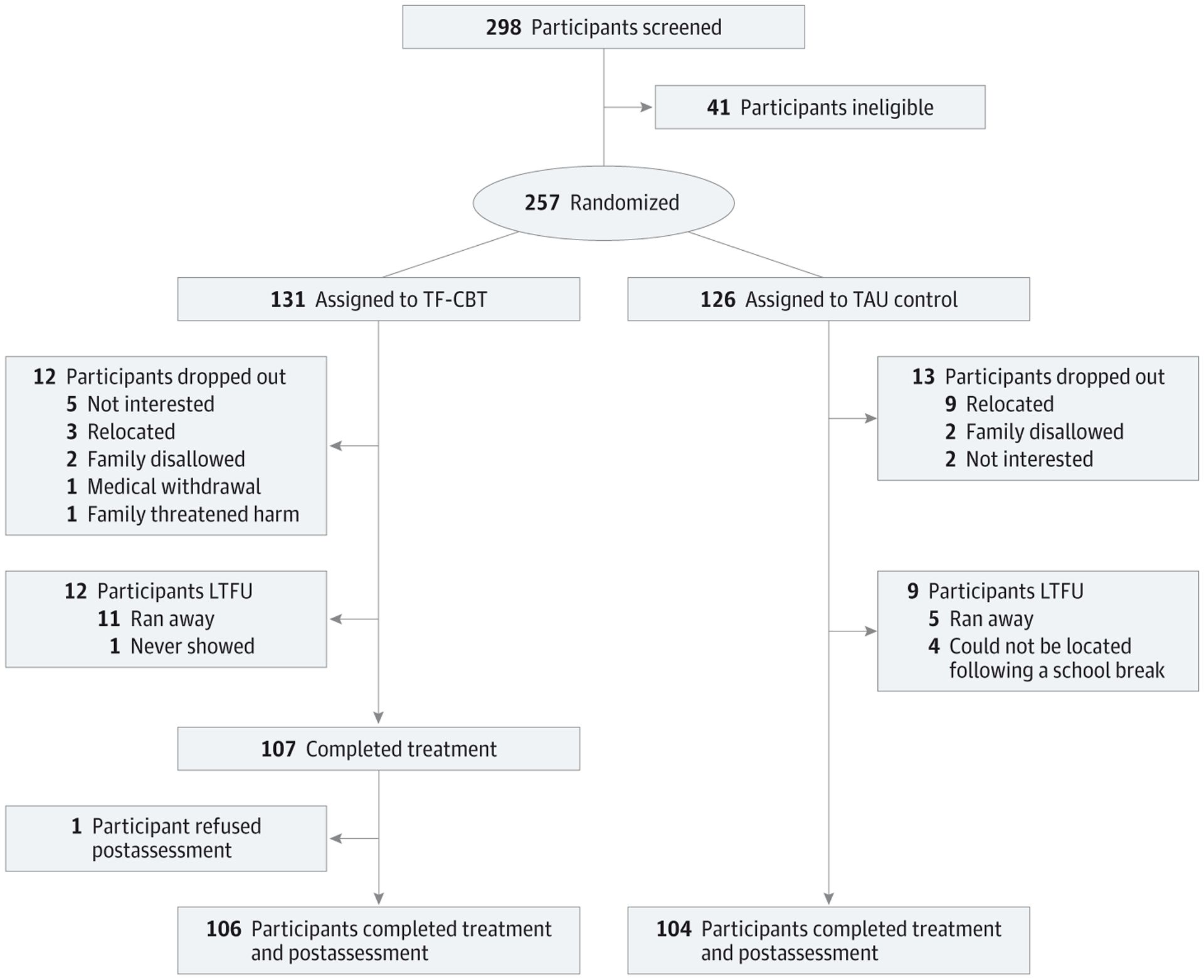
Design, setting, and participants: This randomized clinical trial compared TF-CBT and treatment as usual (TAU) (varying by site) for children recruited from August 1, 2012, through July 31, 2013, and treated until December 31, 2013, for trauma-related symptoms from 5 community sites within Lusaka, Zambia. Children were aged 5 through 18 years and had experienced at least one traumatic event and reported significant trauma-related symptoms. Analysis was with intent to treat.
Interventions: The intervention group received 10 to 16 sessions of TF-CBT (n = 131). The TAU group (n = 126) received usual community services offered to OVC.
Main outcomes and measures: The primary outcome was mean item change in trauma and stress-related symptoms using a locally validated version of the UCLA Posttraumatic Stress Disorder Reaction Index (range, 0-4) and functional impairment using a locally developed measure (range, 0-4). Outcomes were measured at baseline and within 1 month after treatment completion or after a waiting period of approximately 4.5 months after baseline for TAU.
Results: At follow-up, the mean item change in trauma symptom score was -1.54 (95% CI, -1.81 to -1.27), a reduction of 81.9%, for the TF-CBT group and -0.37 (95% CI, -0.57 to -0.17), a reduction of 21.1%, for the TAU group. The mean item change for functioning was -0.76 (95% CI, -0.98 to -0.54), a reduction of 89.4%, and -0.54 (95% CI, -0.80 to -0.29), a reduction of 68.3%, for the TF-CBT and TAU groups, respectively. The difference in change between groups was statistically significant for both outcomes (P < .001). The effect size (Cohen d) was 2.39 for trauma symptoms and 0.34 for functioning. Lay counselors participated in supervision and assessed whether the intervention was provided with fidelity in all 5 community settings.
Conclusions and relevance: The TF-CBT adapted for Zambia substantially decreased trauma and stress-related symptoms and produced a smaller improvement in functional impairment among OVC having experienced high levels of trauma.
Trial registration: clinicaltrials.gov Identifier: NCT01624298.
Conflict of interest statement
Figures
Comment in
-
Psychological Treatments for Orphans and Vulnerable Children Affected by Traumatic Events and Chronic Adversity in Sub-Saharan Africa.JAMA. 2015 Aug 4;314(5):511-2. doi: 10.1001/jama.2015.8383. JAMA. 2015. PMID: 26241602 No abstract available.
References
-
- UNICEF. Towards an AIDS-Free Generation – Children and AIDS: Sixth Stocktaking Report, 2013. http://www.avert.org/children-orphaned-hiv-and-aids.htm#sthash.UT2jNnZs..... Accessed July 24, 2014.
-
- UNAIDS. Towards an AIDS Free Generation. UNAIDS Children and AIDS Sixth Stocktaking Report. 2013. http://www.unaids.org/sites/default/files/en/media/unaids/contentassets/.... Accessed July 24, 2014.
-
- Kieling C, Baker-Henningham H, Belfer M, et al. Child and adolescent mental health worldwide: evidence for action. Lancet. 2011;378(9801):1515–1525. - PubMed
-
- Benjet C Childhood adversities of populations living in low-income countries: prevalence, characteristics, and mental health consequences. Curr Opin Psychiatry. 2010;23(4):356–362. - PubMed
-
- Idele P, Gillespie A, Porth T, et al. Epidemiology of HIV and AIDS among adolescents: current status, inequities, and data gaps. J Acquir Immune Defic Syndr. 2014;66(suppl 2):S144–S153. - PubMed
Publication types
MeSH terms
Associated data
Grants and funding
LinkOut - more resources
Full Text Sources
Medical
Miscellaneous