


Characterization of Volatile Compounds of Eleven Achillea Species from Turkey and Biological Activities of Essential Oil and Methanol Extract of A. hamzaoglui Arabacı & Budak
- PMID: 26111175
- PMCID: PMC6272225
- DOI: 10.3390/molecules200611432
Characterization of Volatile Compounds of Eleven Achillea Species from Turkey and Biological Activities of Essential Oil and Methanol Extract of A. hamzaoglui Arabacı & Budak
Abstract
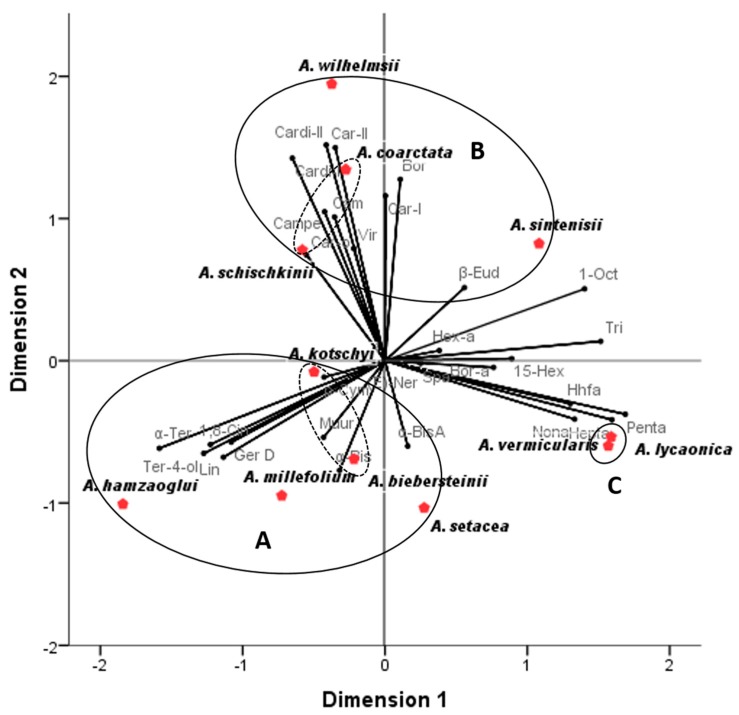
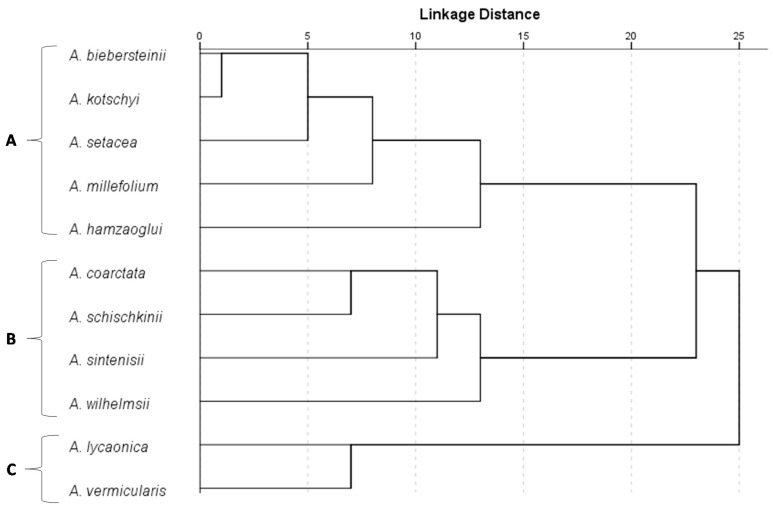
According to distribution of genus Achillea, two main centers of diversity occur in S.E. Europe and S.W. Asia. Diversified essential oil compositions from Balkan Peninsula have been numerously reported. However, report on essential oils of Achillea species growing in Turkey, which is one of the main centers of diversity, is very limited. This paper represents the chemical compositions of the essential oils obtained by hydrodistillation from the aerial parts of eleven Achillea species, identified simultaneously by gas chromatography and gas chromatography-mass spectrometry. The main components were found to be 1,8-cineole, p-cymene, viridiflorol, nonacosane, α-bisabolol, caryophyllene oxide, α-bisabolon oxide A, β-eudesmol, 15-hexadecanolide and camphor. The chemical principal component analysis based on thirty compounds identified three species groups and a subgroup, where each group constituted a chemotype. This is the first report on the chemical composition of A. hamzaoglui essential oil; as well as the antioxidant and antimicrobial evaluation of its essential oil and methanolic extract.
Keywords: Achillea; Achillea hamzaoglui; Asteraceae; GC-MS; antimicrobial; antioxidant; essential oil; hierarchical cluster analysis (HCA); principal components analysis (PCA).
Conflict of interest statement
The authors declare no conflict of interest.
Figures
References
-
- Nemeth E. Achillea species used medicinally in Hungary. Israel J. Plant Sci. 2010;58:279–289. doi: 10.1560/IJPS.58.2.279. - DOI
-
- Huber-Morath A. Achillea L. In: Davis P.H., editor. Flora of Turkey and the East Aegean Islands. Volume 5. Edinburgh University Press; Edinburgh, UK: 1975. pp. 224–252.
-
- Duman H. Achillea L. In: Güner A., Özhatay N., Ekim T., Başer K.H.C., editors. Flora of Turkey and the East Aegean Islands. Volume 11. Edinburgh University Press; Edinburgh, UK: 2000. pp. 158–159.
-
- Arabaci T., Budak Ü. Achillea hamzaoglui (Asteraceae)a new species from Turkey. Ann. Bot. Fennici. 2009;46:459–463. doi: 10.5735/085.046.0516. - DOI
Publication types
MeSH terms
Substances
LinkOut - more resources
Full Text Sources
Other Literature Sources
Medical
Miscellaneous
