


Recent strategies and progress in identifying host factors involved in virus replication
- PMID: 26112615
- PMCID: PMC7185747
- DOI: 10.1016/j.mib.2015.06.001
Recent strategies and progress in identifying host factors involved in virus replication
Abstract
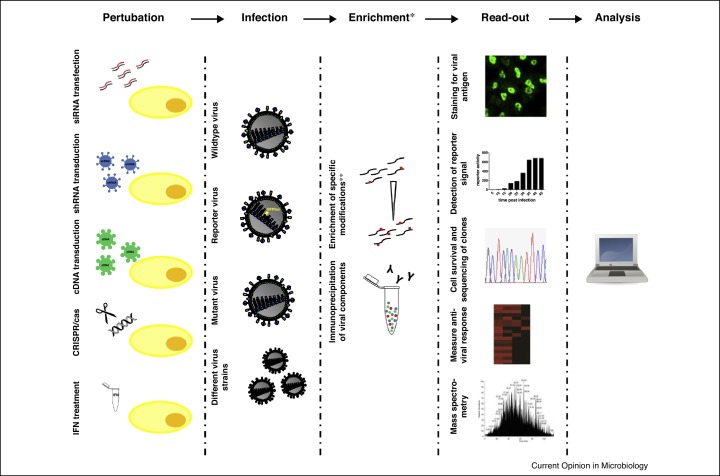
Viruses are completely dependent on their host cells for the successful production of progeny viruses. At each stage of the viral life cycle an intricate interplay between virus and host takes place with the virus aiming to usurp the host cell for its purposes and the host cell trying to block the intruder from propagation. In recent years these interactions have been studied on a global level by systems biology approaches, such as RNA interference screens, transcriptomic or proteomic methodologies, and exciting new insights into the pathogen-host relationship have been revealed. In this review, we summarize the available data, give examples for important findings from such studies and point out current limitations and potential future directions.
Copyright © 2015 Elsevier Ltd. All rights reserved.
Figures
References
-
- Nurse P., Hayles J. The cell in an era of systems biology. Cell. 2011;144:850–854. - PubMed
-
- Brass A.L., Huang I.C., Benita Y., John S.P., Krishnan M.N., Feeley E.M., Ryan B.J., Weyer J.L., van der Weyden L., Fikrig E. The IFITM proteins mediate cellular resistance to influenza A H1N1 virus, West Nile virus, and dengue virus. Cell. 2009;139:1243–1254. - PMC - PubMed
-
This study revealed the antiviral potential of the IFITM proteins as a result of a genome-wide RNAi screen.
-
- Karlas A., Machuy N., Shin Y., Pleissner K.P., Artarini A., Heuer D., Becker D., Khalil H., Ogilvie L.A., Hess S. Genome-wide RNAi screen identifies human host factors crucial for influenza virus replication. Nature. 2010;463:818–822. - PubMed
Publication types
MeSH terms
Substances
LinkOut - more resources
Full Text Sources
Other Literature Sources
