


Rs7193343 polymorphism in zinc finger homeobox 3 (ZFHX3) gene and atrial fibrillation: an updated meta-analysis of 10 case-control comparisons
- PMID: 26112950
- PMCID: PMC4480884
- DOI: 10.1186/s12872-015-0044-y
Rs7193343 polymorphism in zinc finger homeobox 3 (ZFHX3) gene and atrial fibrillation: an updated meta-analysis of 10 case-control comparisons
Abstract
Background: The previous genome-wide studies have shown that rs7193343 single-nucleotide polymorphism (SNP) in zinc finger homeobox 3 (ZFHX3) gene correlate with risk of atrial fibrillation (AF). However, the distribution of this SNP differs significantly among various populations. The present study was to investigate whether combined evidence shows the association between ZFHX3 rs7193343 SNP and the risk of AF in various populations.
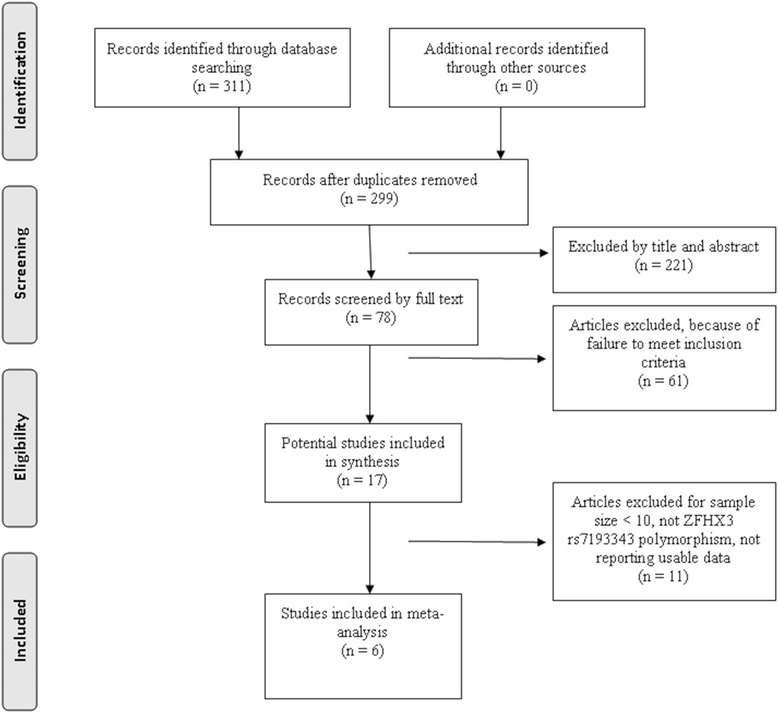
Methods: A systematic search of all studies published through Dec 2014 was conducted using the Medline, Embase, WanFang, ScienceDirect, CNKI, and OVID databases. The case-control studies that evaluated an association between rs7193343 SNP and risk of AF were identified. The association between the ZFHX3 rs7193343 SNP and AF susceptibility was assessed using genetic models.
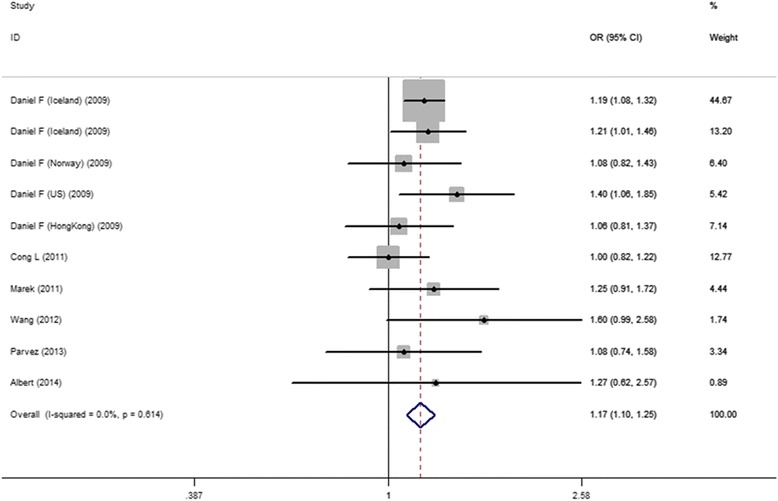
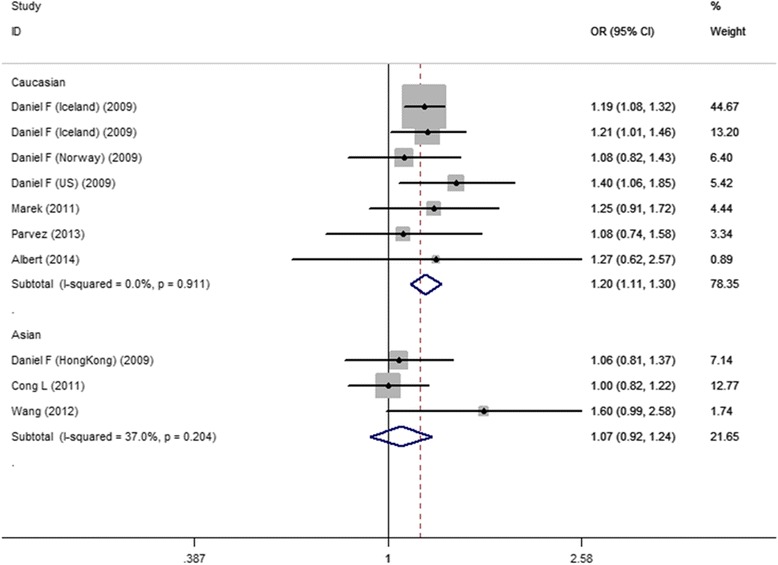
Results: We collected 10 comparisons from six studies for rs7193343 SNP, including 1037 cases and 4310 controls in Asian, 5583 cases and 38215 controls in Caucasian, and then performed an updated meta-analysis and subgroup analysis based on ethnicity. In overall population, the occurrence of AF was found to be associated with T-allelic of rs7193343 SNP in ZFHX3 (OR =1.17, 95% CI 1.10-1.26). In subgroup analysis, we observed there was significant association between T-allele of rs7193343 and risk of AF in Caucasian subgroups (OR =1.20, 95% CI 1.12-1.30), but no statistically significance (OR = 1.07, 95% CI 0.92-1.24) in Asian population.
Conclusion: In Caucasian population, genetic variant rs7193343 SNP is associated with risk of AF in Caucasian population. However, no association is found in Asian population based on the current evidence. Further studies with larger sample size involving case-control populations with multiple ethnics are still required in the future.
Figures
References
-
- Feinberg WM, Blackshear JL, Laupacis A, Kronmal R, Hart RG. Prevalence, age distribution, and gender of patients with atrial fibrillation. Analysis and implications. Arch Intern Med. 1995;155(5):469–73. - PubMed
-
- Fuster V, Ryden LE, Cannom DS, Crijns HJ, Curtis AB, Ellenbogen KA, Halperin JL, Le Heuzey JY, Kay GN, Lowe JE, et al. ACC/AHA/ESC 2006 guidelines for the management of patients with atrial fibrillation: full text: a report of the American College of Cardiology/American Heart Association Task Force on practice guidelines and the European Society of Cardiology Committee for Practice Guidelines (Writing Committee to Revise the 2001 guidelines for the management of patients with atrial fibrillation) developed in collaboration with the European Heart Rhythm Association and the Heart Rhythm Society. Europace. 2006;8(9):651–745. doi: 10.1093/europace/eul097. - DOI - PubMed
-
- Go AS, Hylek EM, Phillips KA, Chang Y, Henault LE, Selby JV, Singer DE. Prevalence of diagnosed atrial fibrillation in adults: national implications for rhythm management and stroke prevention: the AnTicoagulation and Risk Factors in Atrial Fibrillation (ATRIA) Study. JAMA. 2001;285(18):2370–5. doi: 10.1001/jama.285.18.2370. - DOI - PubMed
Publication types
MeSH terms
Substances
LinkOut - more resources
Full Text Sources
Other Literature Sources
Medical
Research Materials
