


How Did Arthropod Sesquiterpenoids and Ecdysteroids Arise? Comparison of Hormonal Pathway Genes in Noninsect Arthropod Genomes
- PMID: 26112967
- PMCID: PMC4524487
- DOI: 10.1093/gbe/evv120
How Did Arthropod Sesquiterpenoids and Ecdysteroids Arise? Comparison of Hormonal Pathway Genes in Noninsect Arthropod Genomes
Abstract
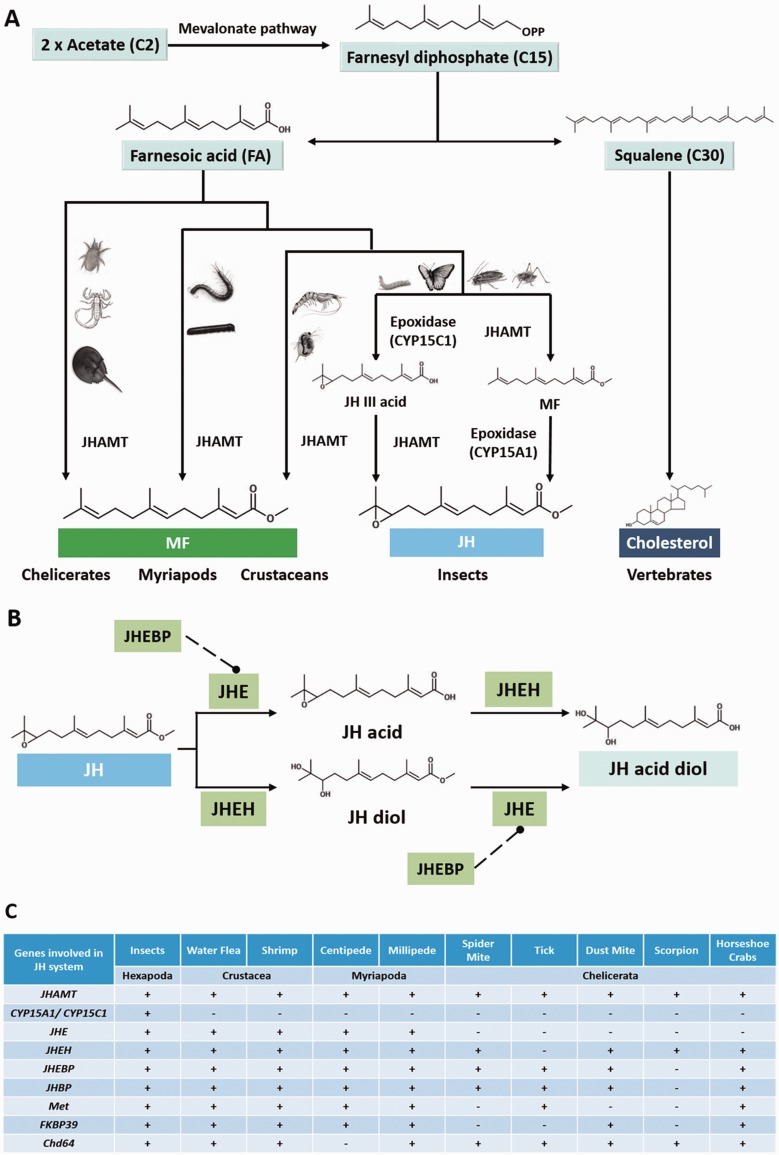
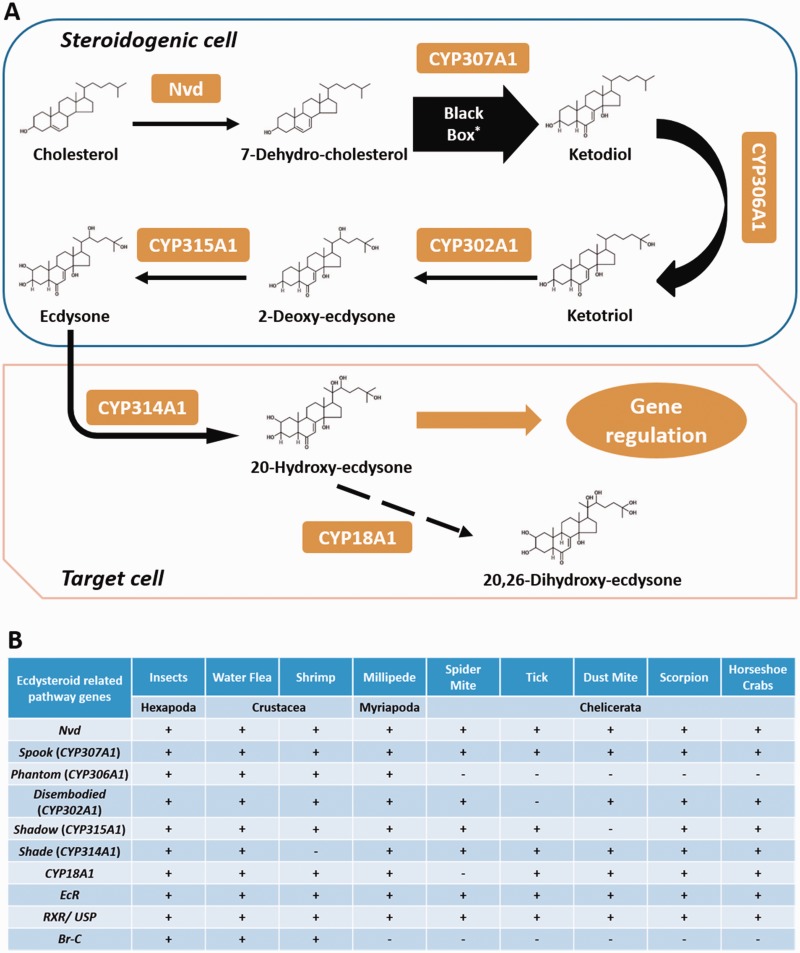
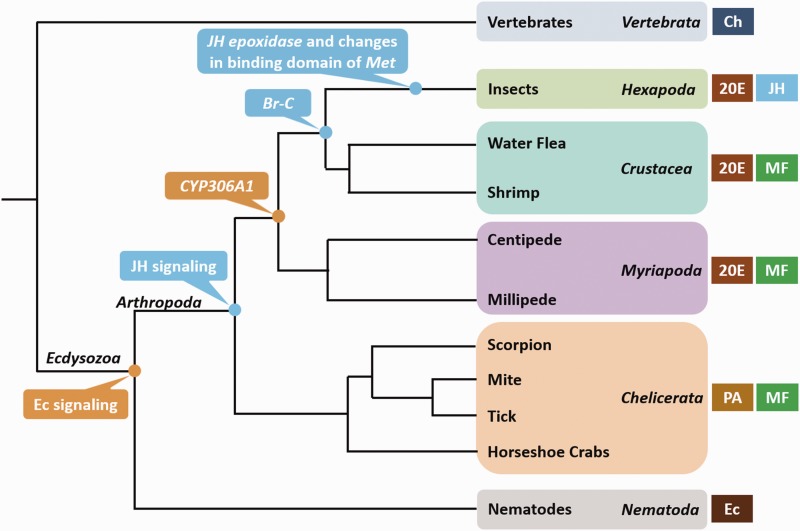
The phylum Arthropoda contains the largest number of described living animal species, with insects and crustaceans dominating the terrestrial and aquatic environments, respectively. Their successful radiations have long been linked to their rigid exoskeleton in conjunction with their specialized endocrine systems. In order to understand how hormones can contribute to the evolution of these animals, here, we have categorized the sesquiterpenoid and ecdysteroid pathway genes in the noninsect arthropod genomes, which are known to play important roles in the regulation of molting and metamorphosis in insects. In our analyses, the majority of gene homologs involved in the biosynthetic, degradative, and signaling pathways of sesquiterpenoids and ecdysteroids can be identified, implying these two hormonal systems were present in the last common ancestor of arthropods. Moreover, we found that the "Broad-Complex" was specifically gained in the Pancrustacea, and the innovation of juvenile hormone (JH) in the insect linage correlates with the gain of the JH epoxidase (CYP15A1/C1) and the key residue changes in the binding domain of JH receptor ("Methoprene-tolerant"). Furthermore, the gain of "Phantom" differentiates chelicerates from the other arthropods in using ponasterone A rather than 20-hydroxyecdysone as molting hormone. This study establishes a comprehensive framework for interpreting the evolution of these vital hormonal pathways in these most successful animals, the arthropods, for the first time.
Keywords: Arthropoda; Chelicerata; Myriapoda; ecdysteroid; juvenile hormone; methyl farnesoate.
© The Author(s) 2015. Published by Oxford University Press on behalf of the Society for Molecular Biology and Evolution.
Figures
References
-
- Altschul SF, Gish W, Miller W, Myers EW, Lipman DJ. 1990. Basic local alignment search tool. J Mol Biol. 215:403–410. - PubMed
-
- Anand A, Crone EJ, Zera AJ. 2008. Tissue and stage-specific juvenile hormone esterase (JHE) and epoxide hydrolase (JHEH) enzyme activities and Jhe transcript abundance in lines of the cricket Gryllus assimilis artificially selected for plasma JHE activity: implications for JHE microevolution. J Insect Physiol. 54:1323–1331. - PubMed
-
- Bayer CA, von Kalm L, Fristrom JW. 1997. Relationships between protein isoforms and genetic functions demonstrate functional redundancy at the Broad-Complex during Drosophila metamorphosis. Dev Biol. 187(2):267–282. - PubMed
-
- Belles X, Martin D, Piulachs MD. 2005. The mevalonate pathway and the synthesis of juvenile hormone in insects. Annu Rev Entomol. 50:181–199. - PubMed
-
- Buaklin A, Sittikankaew K, Khamnamtong B, Menasveta P, Klinbunga S. 2013. Characterization and expression analysis of the Broad-complex (Br-c) gene of the giant tiger shrimp Penaeus monodon. Comp Biochem Physiol B Biochem Mol Biol. 164(4):280–289. - PubMed
Publication types
MeSH terms
Substances
LinkOut - more resources
Full Text Sources
Other Literature Sources
Molecular Biology Databases
