


Dietary habits and leisure-time physical activity in relation to adiposity, dyslipidemia, and incident dysglycemia in the pathobiology of prediabetes in a biracial cohort study
- PMID: 26116207
- PMCID: PMC4828921
- DOI: 10.1016/j.metabol.2015.05.015
Dietary habits and leisure-time physical activity in relation to adiposity, dyslipidemia, and incident dysglycemia in the pathobiology of prediabetes in a biracial cohort study
Abstract
Background: Dietary and exercise data are frequently recorded in clinical research, but their correlation with metabolic measures needs further evaluation.
Objective: We examined the association of food and exercise habits with body size, lipid profile, and glycemia in a prospective biracial cohort.
Methods: The Pathobiology of Prediabetes in A Biracial Cohort study followed initially normoglycemic offspring of parents with type 2 diabetes (T2DM) for the occurrence of incident prediabetes, defined as impaired fasting glucose (IFG) and/or impaired glucose tolerance (IGT). At enrollment, participants underwent a 75-gram OGTT, anthropometry, measurement of fasting lipids, insulin, and body fat (DEXA), and completed the Food Habits Questionnaire (FHQ), and Modifiable Activity Questionnaire (MAQ). We assessed the relationship between FHQ and MAQ scores and adiposity, cardiometabolic measures, and incident dysglycemia.
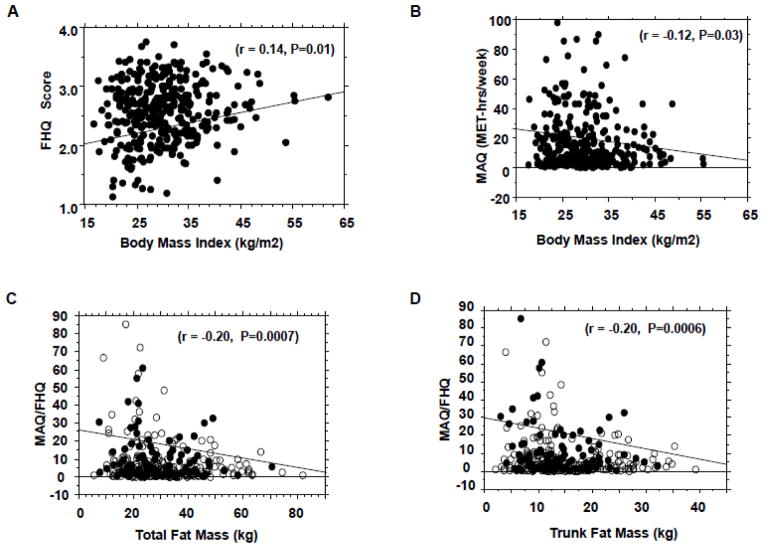
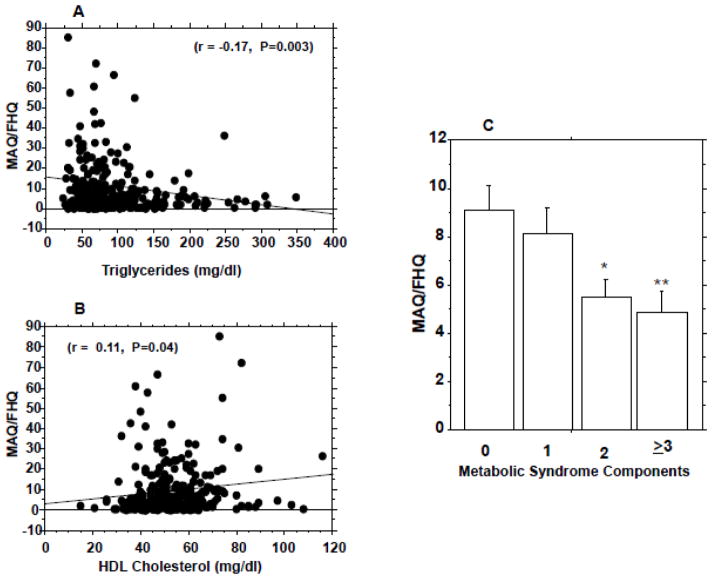
Results: Among our cohort of 338 subjects (188 black, 150 white; mean age {±SD} 45.2±10.2 years, BMI 30.3±7.2 kg/m(2)), FHQ and MAQ scores were individually correlated with BMI (r=0.14, -0.12; P=0.01, 0.03) and waist circumference (r=0.19, -0.11; P=0.004, 0.05). Diet-adjusted leisure activity (MAQ/FHQ) was significantly correlated with total body fat (r=-0.20, P=0.0007), trunk fat (r=-0.20, P=0.0006), and serum triglycerides (r=-0.17, P=0.003) and HDL cholesterol (r=0.11, P=0.04) levels. During 5.5 years of follow-up, 111 subjects (Progressors) developed prediabetes (n=101) or diabetes (n=10) and 227 remained normoglycemic (Non-progressors). Age, BMI, MAQ and MAQ/FHQ values were significant predictors of incident prediabetes/diabetes. Progressors reported similar dietary habits (FHQ score 2.57±0.49 vs. 2.57±0.53) but 30% lower physical activity (MAQ score 15.2±20.5 vs. 22.3±30.5 MET-hr/wk, P=0.015) compared with non-progressors.
Conclusions: Among African-American and Caucasian offspring of parents with T2DM, self-reported dietary and exercise habits correlated with measures of adiposity and dyslipidemia; however, physical activity, but not dietary recall, significantly predicted incident dysglycemia during 5.5 years of follow-up.
Keywords: Body fat; Dyslipidemia; Ethnicity; Prediabetes; Prospective study.
Copyright © 2015 Elsevier Inc. All rights reserved.
Conflict of interest statement
Figures
References
-
- Ramsey F, Ussery-Hall A, Garcia D, McDonald G, Easton A, Kambon M, Balluz L, Garvin W, Vigeant J. Prevalence of selected risk behaviors and chronic diseases--Behavioral Risk Factor Surveillance System (BRFSS), 39 steps communities, United States, 2005. MMWR Surveill Summ. 2008;57:1–20. - PubMed
-
- [accessed 8 January 2015];Nutrition Resources for Health Professionals. Data and Statistics. http://www.cdc.gov/nutrition/professionals/data/index.html.
-
- Centers for Disease Control and Prevention. [accessed 8 January 2015];What We Eat in America, NHANES 2003–2004. http://www.cdc.gov/nchs/nhanes/wweia.htm.
Publication types
MeSH terms
Grants and funding
LinkOut - more resources
Full Text Sources
Other Literature Sources
Medical
Miscellaneous
