


Global Mapping of the Inc-Human Interactome Reveals that Retromer Restricts Chlamydia Infection
- PMID: 26118995
- PMCID: PMC4540348
- DOI: 10.1016/j.chom.2015.06.004
Global Mapping of the Inc-Human Interactome Reveals that Retromer Restricts Chlamydia Infection
Abstract
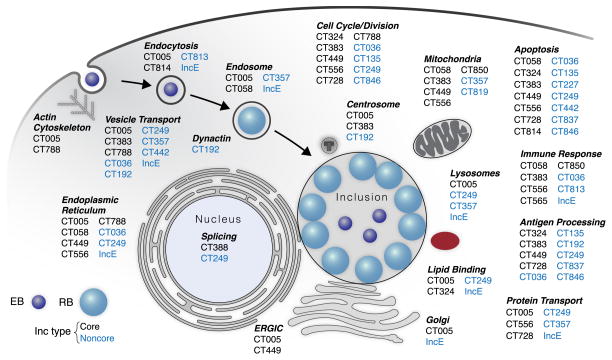
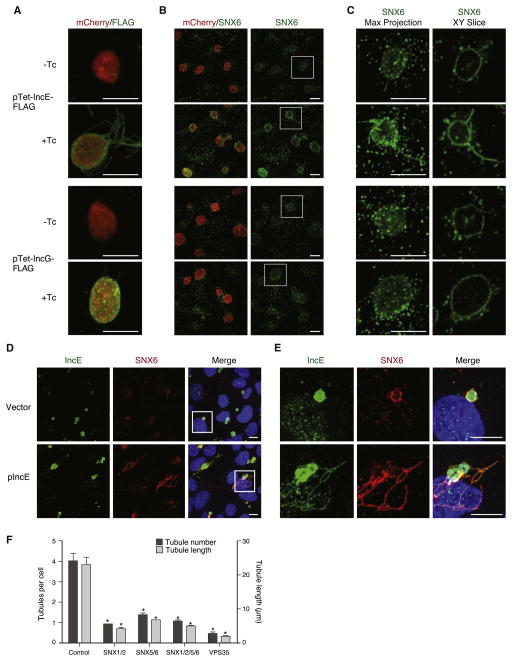
Chlamydia trachomatis is a leading cause of genital and ocular infections for which no vaccine exists. Upon entry into host cells, C. trachomatis resides within a membrane-bound compartment—the inclusion—and secretes inclusion membrane proteins (Incs) that are thought to modulate the host-bacterium interface. To expand our understanding of Inc function(s), we subjected putative C. trachomatis Incs to affinity purification-mass spectroscopy (AP-MS). We identified Inc-human interactions for 38/58 Incs with enrichment in host processes consistent with Chlamydia's intracellular life cycle. There is significant overlap between Inc targets and viral proteins, suggesting common pathogenic mechanisms among obligate intracellular microbes. IncE binds to sorting nexins (SNXs) 5/6, components of the retromer, which relocalizes SNX5/6 to the inclusion membrane and augments inclusion membrane tubulation. Depletion of retromer components enhances progeny production, revealing that retromer restricts Chlamydia infection. This study demonstrates the value of proteomics in unveiling host-pathogen interactions in genetically challenging microbes.
Copyright © 2015 Elsevier Inc. All rights reserved.
Figures





References
-
- Bannantine JP, Griffiths RS, Viratyosin W, Brown WJ, Rockey DD. A secondary structure motif predictive of protein localization to the chlamydial inclusion membrane. Cell Microbiol. 2000;2:35–47. - PubMed
-
- Bauer MF, Hofmann S, Neupert W, Brunner M. Protein translocation into mitochondria: the role of TIM complexes. Trends in cell biology. 2000;10:25–31. - PubMed
Publication types
MeSH terms
Substances
Grants and funding
- U54 AI081680/AI/NIAID NIH HHS/United States
- R21 AI062768/AI/NIAID NIH HHS/United States
- A121844/PHS HHS/United States
- T32 AI007334/AI/NIAID NIH HHS/United States
- R21 AI105561/AI/NIAID NIH HHS/United States
- R01 AI100759/AI/NIAID NIH HHS/United States
- R01AI101441/AI/NIAID NIH HHS/United States
- P01 091575/PHS HHS/United States
- P50 GM081879/GM/NIGMS NIH HHS/United States
- K08 AI091656/AI/NIAID NIH HHS/United States
- R01 AI073770/AI/NIAID NIH HHS/United States
- P01 090935/PHS HHS/United States
- AI081694/AI/NIAID NIH HHS/United States
- K08 AI104766/AI/NIAID NIH HHS/United States
- P50 GM082250/GM/NIGMS NIH HHS/United States
- AI100759/AI/NIAID NIH HHS/United States
- P0065678/PHS HHS/United States
- K08AI091656/AI/NIAID NIH HHS/United States
- P30 AI027763/AI/NIAID NIH HHS/United States
- R01 AI101441/AI/NIAID NIH HHS/United States
- R01 AI039558/AI/NIAID NIH HHS/United States
- U19 AI106754/AI/NIAID NIH HHS/United States
- U19 AI113187/AI/NIAID NIH HHS/United States
- U54AI081680/AI/NIAID NIH HHS/United States
- R01 AI081694/AI/NIAID NIH HHS/United States
- AI105561/AI/NIAID NIH HHS/United States
- CA-0063244/CA/NCI NIH HHS/United States
- P01 AI090935/AI/NIAID NIH HHS/United States
LinkOut - more resources
Full Text Sources
Other Literature Sources
Molecular Biology Databases
