


Shampoo and Conditioners: What a Dermatologist Should Know?
- PMID: 26120149
- PMCID: PMC4458934
- DOI: 10.4103/0019-5154.156355
Shampoo and Conditioners: What a Dermatologist Should Know?
Abstract
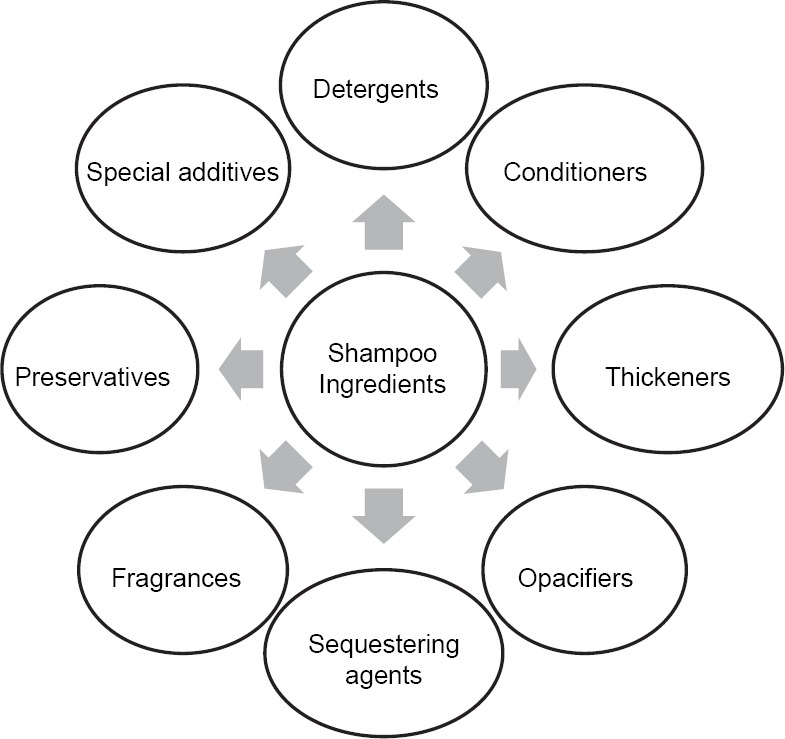
Dermatologists many a times encounter questions from patients and even colleagues asking about how to keep their hair looking clean, healthy and beautiful. Therefore, familiarity and a basic knowledge of the available hair care products will help them to guide their patients properly. A shampoo not only provides the cleaning of the scalp skin and hair as its primary function, but in addition also serves to condition and beautify hair and acts as an adjunct in the management of various scalp disorders. To achieve this, various ingredients in the correct proportion are mixed to provide a shampoo which is suitable for individuals having different hair types and hair need. Among the ingredients that go into the making of a shampoo are detergents, conditioners, thickeners, sequestering agents, pH adjusters, preservatives and specialty additives. Hair conditioners are designed to improve hair manageability, decrease hair static electricity and add luster. They are used in several ways depending upon the state of hair and requirement of the individual. This article attempts to put forward the basic and practical aspects regarding use of these products.
Keywords: Conditioner; hair; shampoo.
Conflict of interest statement
Figures
References
-
- Bhushan B. New York: Springer-Verlag Berlin Heidelberg; 2010. Biophysics of Human Hair, Biological and Medical Physics, Biomedical Engineering; pp. 1–19.
-
- Campion MJ. Hobson-Jobson: The words English owes to India. [Last accessed on 2014 Sep 21]. Available on http://www.bbc.com/news/magazine-18796493 .
-
- Bouillon C. Shampoos and hair conditioners. Clin Dermatol. 1988;6:83–92. - PubMed
-
- Halligudi N, AL Khudori MS. Evaluation of cosmetic properties of different brands of shampoos from multinational brands in Oman. Journal of Drug Discovery and Therapeutics. 2013;1(7):91–6. “From Pert: Do You Wash and Go?”. Company Science Behind the Brands. Procter and Gamble. Archived from the original on 2007-02-16. http://web.archive.org/web/20070216104007. / http://www.pg.com/science/pbi_pert.jhtml . Retrieved 2007-03-26 quoted in.
-
- Robbins CR. Interaction of shampoo and creme rinse ingredients with human hair. In: Robbins CR, editor. Chemical and physical behaviour of human hair. 2nd ed. New York: Springer-Verlag; 1988. pp. 122–67.
Publication types
LinkOut - more resources
Full Text Sources
Other Literature Sources