


Study of the Distribution of Malassezia Species in Patients with Pityriasis Versicolor in Kolar Region, Karnataka
- PMID: 26120178
- PMCID: PMC4458963
- DOI: 10.4103/0019-5154.156436
Study of the Distribution of Malassezia Species in Patients with Pityriasis Versicolor in Kolar Region, Karnataka
Abstract
Context: Pityriasis versicolor is a superficial, chronically recurring fungal infection caused by Malassezia species. Recently it has been revised taxanomically into 14 species, in that only 7 species have been well studied in relation to pityriasis versicolor.
Aims: To identify Malassezia species isolated from patients with pityriasis versicolor and to find out any correlation between the species with clinical presentation of lesions.
Settings and design: Prospective study comprising of 100 clinically diagnosed cases of pityriasis versicolor attending Dermatology Outpatient Department over a period of 1 year.
Materials and methods: The clinical specimens were collected under aseptic precautions and subjected to culture on Sabouraud's Dextrose Agar overlaid with olive oil and modified Dixon agar. The isolates were identified by biochemical tests.
Statistical analysis used: Statistical analysis was done using proportion, mean and chi-square test.
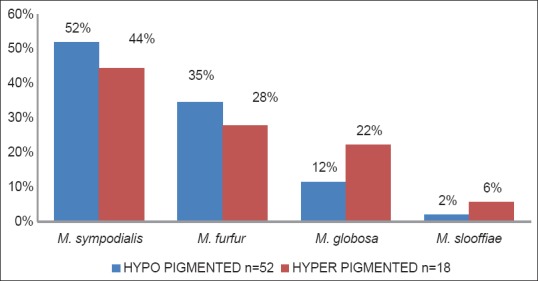
Results: Of the 100 cases, 73% were males, 26% were females and predominant age group was 21-30 years. Out of 100 samples, 70 yielded growth. The most common isolate was M. sympodialis (50%), followed by M. furfur (32.86%), M. globosa (14.28%) and M. slooffiae (2.86%). Among 100 cases, 74% had hypopigmented and 26% had hyperpigmented lesions. M. sympodialis and M. furur were predominantly isolated from hypopigmented lesions and M. globosa and M. slooffiae were found to be more common in hyperpigmented lesions.
Conclusions: M. sympodialis was the most common isolate, followed by M. furfur, M. globosa and M. slooffiae. There was no significant difference in distribution of different species in patients with hypo or hyper pigmented lesions.
Keywords: Hyperpigmentation; Malassezia; hypopigmentation; pityriasis versicolor.
Conflict of interest statement
Figures
References
-
- Rao GS, Kuruvilla M, Kumar P, Vinod V. Clinicoepidemiological studies on Tinea versicolor. Indian J Dermatol Venereal Leprol. 2002;68:208–9. - PubMed
-
- Erchiga VC, Gueho E. 10th ed. Edward Arnold: London; 2005. Topley and Wilson's Microbiology and microbial infections – Medical Mycology; pp. 202–19.
-
- Kaur M, Narang T, Bala M, Gupte S, Aggarwal P, Manhas A. Study of the Malassezia species in patients with pityriasis versicolor and healthy individuals in Tertiary care hospital, Punjab. Indian J Med Microbiol. 2013;31:270–4. - PubMed
-
- Bhattacharyya T, Edward M, Cordery C, Richardson MD. Colonization of living skin equivalents by Malassezia furfur. Med Mycol. 1998;36:15–9. - PubMed
LinkOut - more resources
Full Text Sources
Other Literature Sources