. 2015 Jul 15;6(7):1248-58.
doi: 10.1021/acschemneuro.5b00094. Epub 2015 Jul 7.

Serotonin (5-HT) 5-HT2A Receptor (5-HT2AR):5-HT2CR Imbalance in Medial Prefrontal Cortex Associates with Motor Impulsivity

Affiliations

Serotonin (5-HT) 5-HT2A Receptor (5-HT2AR):5-HT2CR Imbalance in Medial Prefrontal Cortex Associates with Motor Impulsivity

Noelle C Anastasio et al. ACS Chem Neurosci. .

Abstract

A feature of multiple neuropsychiatric disorders is motor impulsivity. Recent studies have implicated serotonin (5-HT) systems in medial prefrontal cortex (mPFC) in mediating individual differences in motor impulsivity, notably the 5-HT2AR receptor (5-HT2AR) and 5-HT2CR. We investigated the hypothesis that differences in the ratio of 5-HT2AR:5-HT2CR protein expression in mPFC would predict the individual level of motor impulsivity and that the engineered loss of the 5-HT2CR would result in high motor impulsivity concomitant with elevated 5-HT2AR expression and pharmacological sensitivity to the selective 5-HT2AR antagonist M100907. High and low impulsive rats were identified in a 1-choice serial reaction time task. Native protein levels of the 5-HT2AR and the 5-HT2CR predicted the intensity of motor impulsivity and the 5-HT2AR:5-HT2CR ratio in mPFC positively correlated with levels of premature responses in individual outbred rats. The possibility that the 5-HT2AR and 5-HT2CR act in concert to control motor impulsivity is supported by the observation that high phenotypic motor impulsivity associated with a diminished mPFC synaptosomal 5-HT2AR:5-HT2CR protein:protein interaction. Knockdown of mPFC 5-HT2CR resulted in increased motor impulsivity and triggered a functional disruption of the local 5-HT2AR:5-HT2CR balance as evidenced by a compensatory upregulation of 5-HT2AR protein expression and a leftward shift in the potency of M100907 to suppress impulsive behavior. We infer that there is an interactive relationship between the mPFC 5-HT2AR and 5-HT2CR, and that a 5-HT2AR:5-HT2CR imbalance may be a functionally relevant mechanism underlying motor impulsivity.

Keywords: 1-Choice serial reaction time task; 5-HT2A receptor; 5-HT2C receptor; medial prefrontal cortex; motor impulsivity; serotonin.


Conflict of interest statement

Conflict of Interest

Dr. Cunningham is a consultant for Arena Pharmaceuticals. Dr. Moeller is a consultant for Boehringer-Ingelheim. All other authors declare no conflicts of interest.

Figures
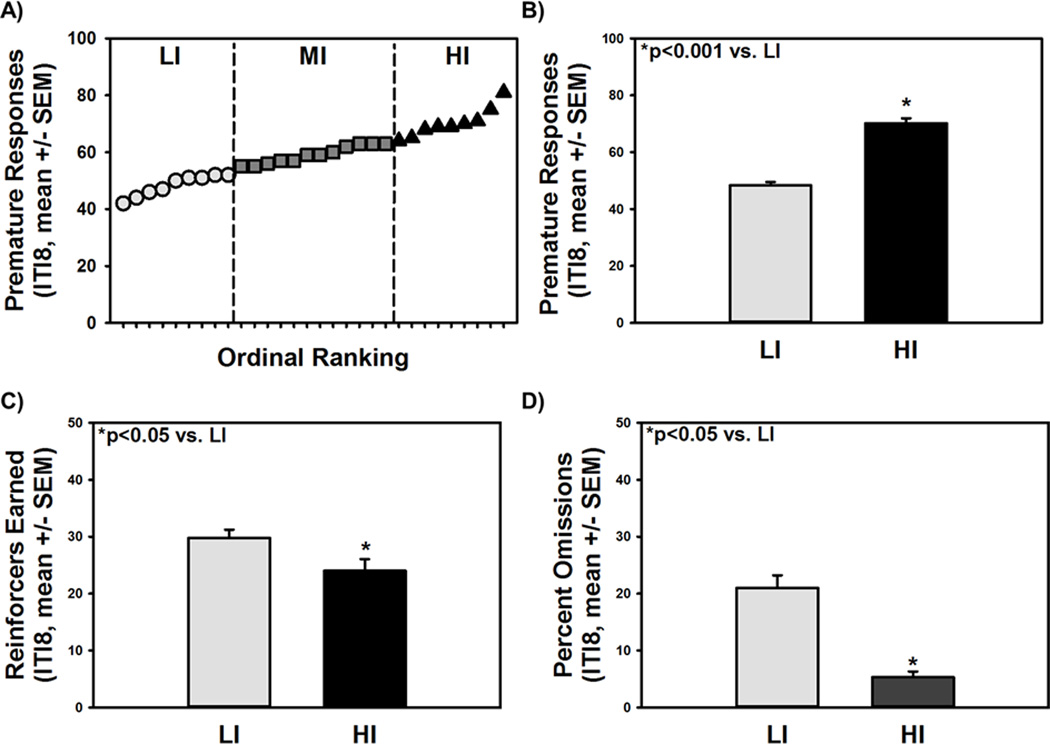
Figure 1
Figure 1. Phenotypic stratification of motor impulsivity with the 1-CSRT task
[A] The number of premature responses made during the ITI8 challenge session was used to stratify rats as high impulsive (HI, upper quartile) or low impulsive (LI, lower quartile) relative to mid impulsive (MI, middle two quartiles) rats. [B] HI rats displayed higher premature responses (*p<0.001 vs. LI), [C] earned fewer reinforcers (*p<0.05 vs. LI), and [D] made fewer omissions relative to LI rats (*p<0.05 vs. LI).
Figure 2
Figure 2. Inherent motor impulsivity predicts mPFC 5-HT2AR:5-HT2CR synaptosomal protein profile
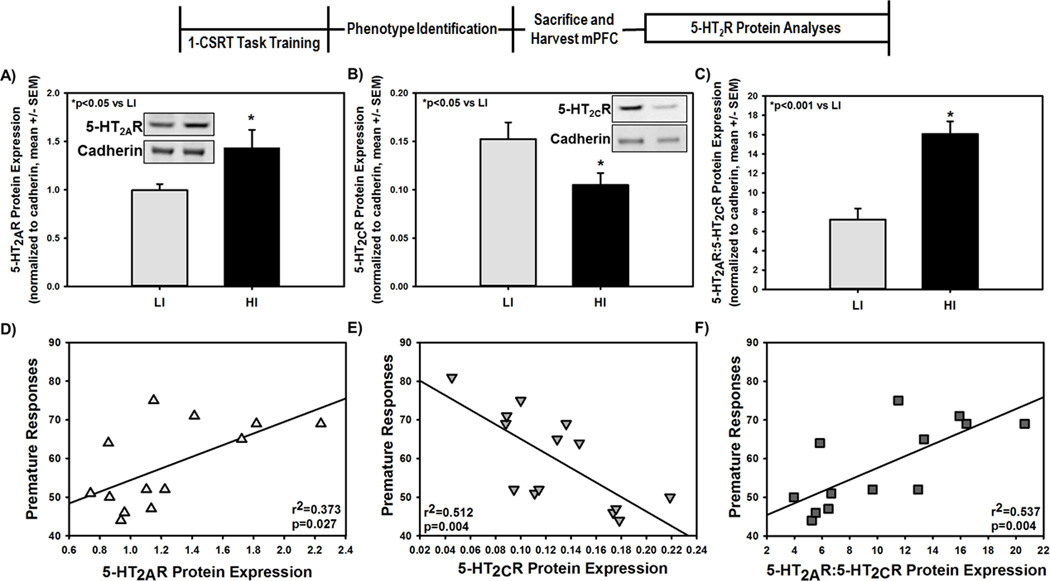
Following 1-CSRT task training and phenotypic identification, the mPFC was collected for biochemical analysis. Immunoblots for the [A inset] 5-HT2AR, [B inset] 5-HT2CR and [A and B inset] cadherin loading control were performed using crude synaptosomal protein from the mPFC. Densitometric quantitation revealed [A] higher 5-HT2AR, [B] lower 5-HT2CR, and [C] a heightened ratio of 5-HT2AR:5-HT2CR protein expression in HI relative to LI rats (*p<0.05 vs. LI). There was a correlation between [D] premature responses and 5-HT2AR protein expression (r2=0.373; p<0.05), [E] premature responses and 5-HT2CR protein expression (r2=0.512; p<0.001), and [F] premature responses and the 5-HT2AR:5-HT2CR ratio (r2=0.537; p<0.001).
Figure 3
Figure 3. The 5-HT2AR:5-HT2CR mPFC protein complex is disrupted in high motor impulsivity
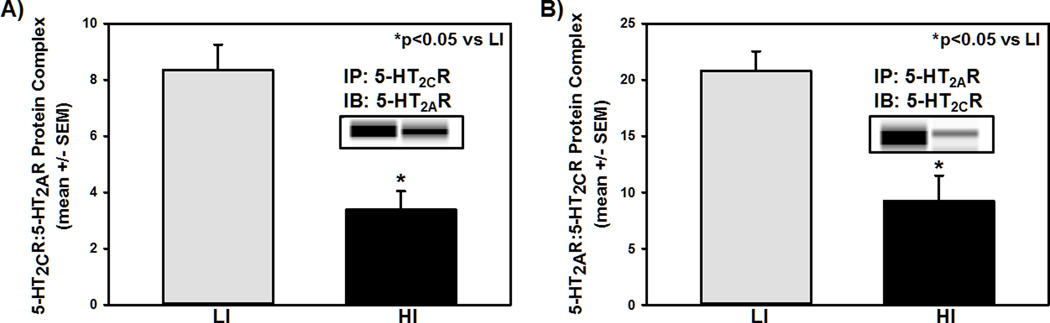
Following 1-CSRT task training and phenotypic identification, the mPFC was collected for biochemical analysis. [A] Immunoprecipitation (IP) for 5-HT2CR followed by immunoblot (IB) for 5-HT2AR yielded 5-HT2AR immunoreactivity in both HI and LI rats. [B] Immunoprecipiation for 5-HT2AR and IB for 5-HT2CR yielded 5-HT2CR immunoreactivity in both HI and LI rats. [A and B] Qualitative (insets) and quantitative demonstration that synaptosomal 5-HT2CR associates with 5-HT2AR in the mPFC to a lesser extent in HI relative to LI rats (*p<0.05). The insets are representative electrophoretic bands. Arbitrary units (A.U.) of densitometry are presented.
Figure 4
Figure 4. Knockdown of mPFC 5-HT2CR recapitulates high motor impulsivity
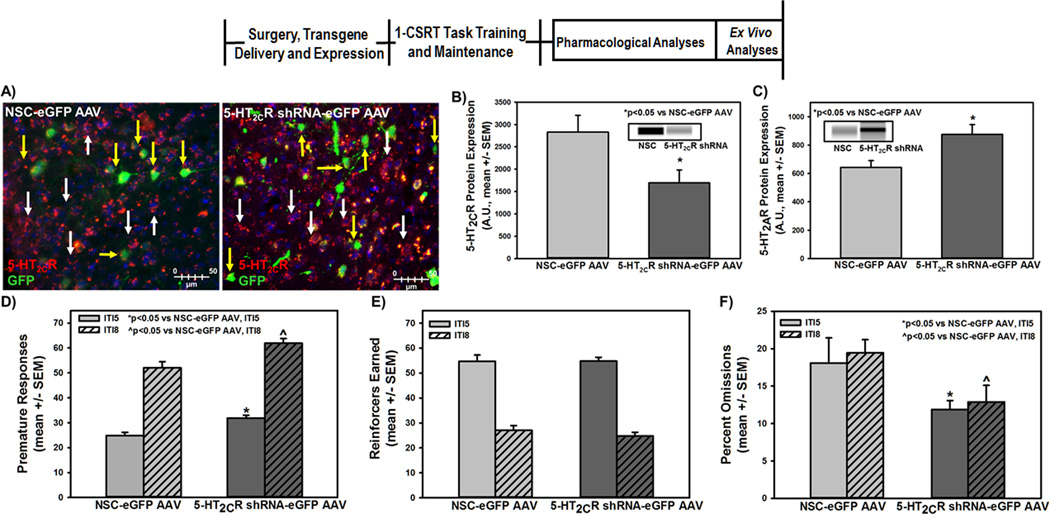
Following intra-mPFC transgene delivery and stable viral vector expression, control and 5-HT2CR knockdown rats were subjected to the 1-CSRT task. [A] Neurons infected with the NSC-eGFP AAV (left) or 5-HT2CR shRNA-eGFP AAV (right) demonstrate green immunofluorescence; a subset of infected neurons are denoted by yellow arrows. A subset of noninfected neurons are denoted with white arrows. All infected neurons are not denoted. Red immunofluorescence indicates 5-HT2CR protein expression. The NSC-eGFP AAV (green) did not alter 5-HT2CR protein expression (red) in infected neurons (yellow arrows) relative to non-AAV infected neurons (white arrows). The 5-HT2CR shRNA-eGFP AAV (green) induced a knockdown of 5-HT2CR protein (red) in infected neurons (yellow arrows) relative to non-infected neurons (white arrows). Ex vivo biochemical analyses indicate that 5-HT2CR knockdown rats display [B] lower mPFC 5-HT2CR protein levels (p<0.05 vs. NSC-eGFP AAV-VEH) and [C] higher mPFC 5-HT2AR protein levels (p<0.05 vs. NSC-eGFP AAV-VEH) relative to control rats. The insets are representative electrophoretic bands. Arbitrary units (A.U.) of densitometry are presented. [D] The 5-HT2CR knockdown rats expressed significantly higher premature responses vs. control rats on an IT5 maintenance session (open bars) and an ITI8 challenge session (hatched bars) (*p<0.05 vs. NSC-eGFP AAV). [E] There was no significant difference between 5-HT2CR knockdown and control rats for the number of reinforcers earned. [F] The 5-HT2CR knockdown rats expressed significantly lower percent omissions vs. control rats on an IT5 maintenance session (open bars) and an ITI8 challenge session (hatched bars) (*p<0.05 vs. NSC-eGFP AAV).
Figure 5
Figure 5. Knockdown of mPFC 5-HT2CR recapitulates high motor impulsivity and enhances 5-HT2AR regulation of motor impulsivity
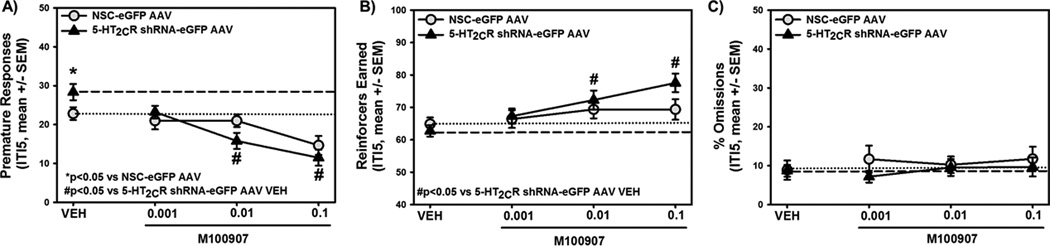
Following stable viral vector expression and 1-CSRT task training, the effects of M100907 (0.001, 0.01, and 0.1 mg/kg) were evaluated under ITI5 conditions. [A] Baseline levels of premature responses in 5-HT2CR knockdown rats administered vehicle (VEH; ▲, dashed line) were significantly higher than the vehicle baseline in control rats (○, dotted line; *p<0.05 vs. NSC-eGFP AAV-VEH). In the 5-HT2CR knockdown rats, M100907 significantly suppressed premature responses at 0.01 and 0.1 mg/kg (#p<0.05 vs. 5-HT2CR shRNA-eGFP AAV-VEH), below the vehicle baseline of control rats. [B] Baseline levels of reinforcers earned in 5-HT2CR knockdown rats administered vehicle (VEH; ▲, dashed line) did not differ from the vehicle baseline in control rats (○,dotted line). M100907 significantly increased the number of reinforcers earned at 0.01 and 0.1 mg/kg (#p<0.05 vs. 5-HT2CR shRNA-eGFP AAV-VEH), above the vehicle baseline of control rats. [C] Baseline levels of omissions in 5-HT2CR knockdown rats administered vehicle (VEH; ▲, dashed line) did not differ from the vehicle baseline in control rats (○, dotted line). M100907 did not alter the number of percent omissions in 5-HT2CR knockdown or control rats.

References

    1. Moeller FG, Barratt ES, Dougherty DM, Schmitz JM, Swann AC. Psychiatric aspects of impulsivity. Am.J.Psychiatry. 2001;158:1783–1793. - PubMed
    1. American Psychiatric Association. Diagnostic and statistical manual of mental disorders : DSM-5. 5th. Arlington, VA: American Psychiatric Publishing; 2013.
    1. Weafer J, Baggott MJ, de Wit H. Test-retest reliability of behavioral measures of impulsive choice, impulsive action, and inattention. Exp Clin Psychopharmacol. 2013;21:475–481. - PMC - PubMed
    1. Economidou D, Theobald DE, Robbins TW, Everitt BJ, Dalley JW. Norepinephrine and dopamine modulate impulsivity on the five-choice serial reaction time task through opponent actions in the shell and core sub-regions of the nucleus accumbens. Neuropsychopharmacology. 2012;37:2057–2066. - PMC - PubMed
    1. Dalley JW, Fryer TD, Brichard L, Robinson ES, Theobald DE, Laane K, Pena Y, Murphy ER, Shah Y, Probst K, Abakumova I, Aigbirhio FI, Richards HK, Hong Y, Baron JC, Everitt BJ, Robbins TW. Nucleus accumbens D2/3 receptors predict trait impulsivity and cocaine reinforcement. Science. 2007;315:1267–1270. - PMC - PubMed

Publication types

MeSH terms

LinkOut - more resources