


doi: 10.1038/ng.3347.
Epub 2015 Jun 29.
Rare A2ML1 variants confer susceptibility to otitis media
Collaborators,
Affiliations
- PMID: 26121085
- PMCID: PMC4528370
- DOI: 10.1038/ng.3347
Item in Clipboard
Rare A2ML1 variants confer susceptibility to otitis media
Nat Genet.
2015 Aug.
Abstract
A duplication variant within the middle ear-specific gene A2ML1 cosegregates with otitis media in an indigenous Filipino pedigree (LOD score = 7.5 at reduced penetrance) and lies within a founder haplotype that is also shared by 3 otitis-prone European-American and Hispanic-American children but is absent in non-otitis-prone children and >62,000 next-generation sequences. We identified seven additional A2ML1 variants in six otitis-prone children. Collectively, our studies support a role for A2ML1 in the pathophysiology of otitis media.
Figures
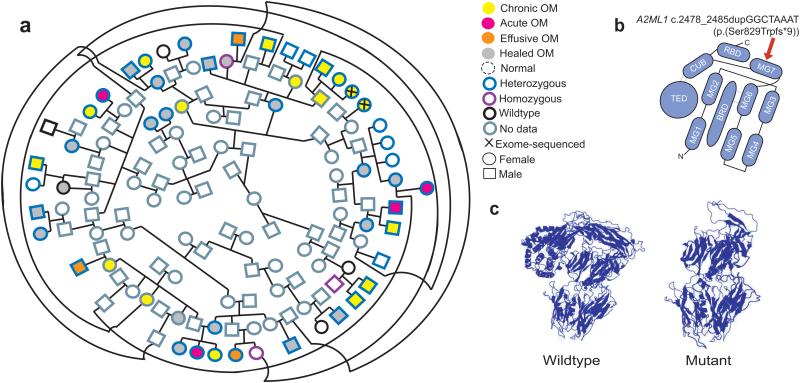
[A] Pedigree connecting 37 variant carriers who have the full spectrum of otitis media (age 3 months to 58 years, median 13 years). An individual with healed otitis media and intellectual disability (ID) is wildtype for the duplication, but her 13-year old son who has chronic otitis media but no ID and her unaffected 4-month old daughter are heterozygous. Nine variant carriers had no evidence of otitis media (median 18 years), while four individuals are wildtype and unaffected. [B] Predicted A2ML1 domains based on alpha 2-macroglobulin structure. MG, macroglobulin-like domains 1-7; BRD, bait-region domain; CUB, consists of two four-stranded antiparallel β-sheets; TED, thiol-ester binding domain; RBD, receptor-binding domain. The A2ML1 frameshift variant is expected to occur within the MG7 domain (red arrow). [C] Modeling predicts loss of the receptor-binding and thiol-ester domains due to the A2ML1 duplication.
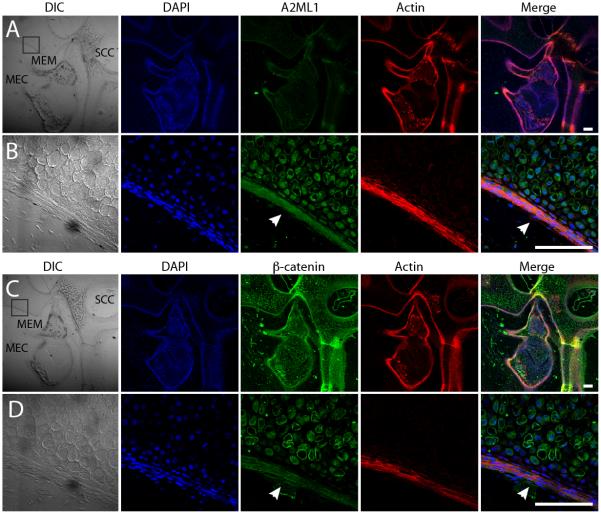
[A, C] Sagittal cryosections from P6 wildtype mice showing the middle ear cavity (MEC), the middle ear mucosa (MEM) and semicircular canal of the inner ear (SCC). [B, D] Higher magnification depicting boxed sections in A and C. [A-D] Confocal images of the cryosections immunostained with antibodies for DAPI (blue), A2ML1 (green in A & B), β-catenin (green in C & D) and rhodamine phalloidin (Actin, red). White arrowheads point to MEM with A2ML1 [B] and β-catenin expression [D]. DIC, differential interference contrast. Scale bar: 100 μm.
References
-
- Acuin J. Chronic suppurative otitis media. Burden of Illness and Management Options. World Health Organization; Geneva: 2004.
-
- Kvestad E, et al. Otitis media: genetic factors and sex differences. Twin Res. 2004;7:239–244. - PubMed
-
- Patel JA, et al. Association of proinflammatory cytokine gene polymorphisms with susceptibility to otitis media. Pediatrics. 2006;118:2273–2279. - PubMed
Publication types
MeSH terms
Substances
Grants and funding
LinkOut - more resources
Full Text Sources
Other Literature Sources
Medical
Molecular Biology Databases
