Review
. 2015 Oct;73(7):ftv044.
doi: 10.1093/femspd/ftv044. Epub 2015 Jun 29.

HIV-associated lymphoma in the era of combination antiretroviral therapy: shifting the immunological landscape

Affiliations
Review

HIV-associated lymphoma in the era of combination antiretroviral therapy: shifting the immunological landscape

Virginia Carroll et al. Pathog Dis. 2015 Oct.

Abstract

HIV infection increases the risk of many types of cancer, including lymphoma. Combination antiretroviral therapy (cART) has reduced, but not eliminated, the risk of HIV-associated lymphoma. There has been a substantial shift in the subtypes of lymphoma observed in HIV-infected patients treated with cART. In this review, we will first outline these changes based on epidemiological studies and describe the impact of cART on lymphoma risk and mortality. Then, we will discuss some immunological factors that may contribute to the increased risk of lymphoma persisting after the administration of cART, including immunological non-response to therapy, chronic B-cell activation and dysfunction, T follicular helper cells, natural killer cells and altered lymphopoiesis. A better understanding of the pathophysiologic mechanisms of HIV-associated lymphoma under effective cART will inform future treatment strategies.

Keywords: HIV-1; antiretroviral drugs; chronic infection; immune activation; lymphomagenesis; virus.


Figures

Graphical Abstract Figure.
This comprehensive and informative review of HIV-related lymphoma explores how HIV infection may promote the development of lymphoma despite effective antiretroviral therapy, highlighting B-cell interaction with persistent HIV proteins, infected T follicular helper cells and altered immunity.
Figure 1.
Figure 1.
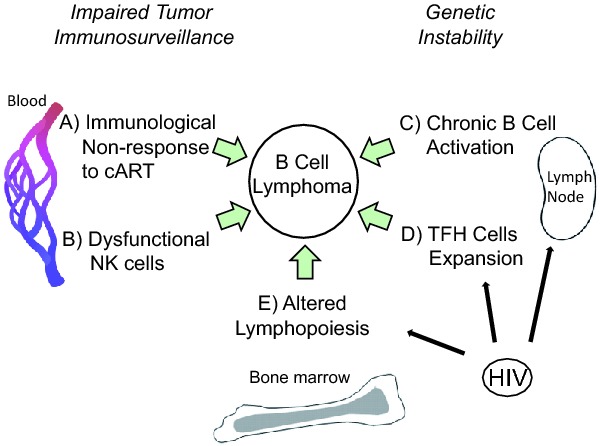
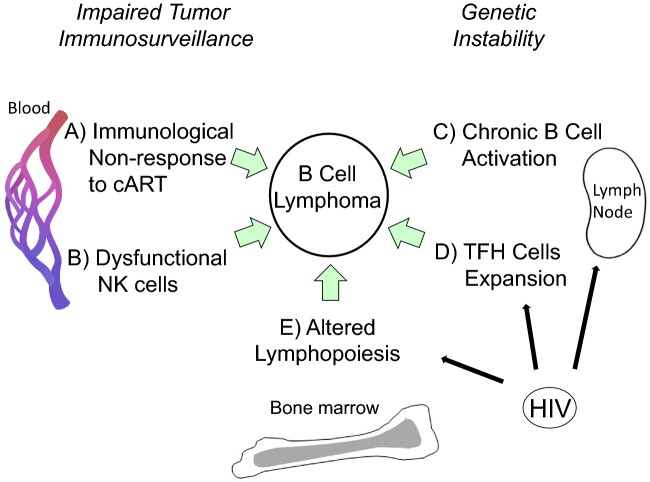
Development of HIV-associated lymphoma after cART: contribution of immunological changes. After cART, many aspects of immunity remain altered in HIV-infected individuals that may predispose to B-cell lymphoma. (A) Immunological non-response to cART. About 20% of patients experience limited CD4 T-cell recovery or none at all. (B) Dysfunctional NK cells. Despite effective cART, cytotoxic NK cells in aviremic patients have impaired ADCC, an activated phenotype, and are excluded from lymph nodes, an important site of both HIV replication and B-cell transformation. (C) Chronic B cell activation. Residual immune activation, i.e. IL-6, CD40L and/or TLR ligands, leads to polyclonal B-cell activation. Prolonged stimulation may lead to genetic errors via aberrant immunoglobulin class switching or somatic hypermutation in germinal center- or post-germinal center B cells. (D) TFH cells expansion. High numbers of TFH cells in lymph nodes from treated or untreated HIV patients correlate with B-cell abnormalities, including increased germinal center B cells, increased plasma cells and reduced memory B cells. (E) Altered lymphopoiesis. In the bone marrow, increased HPC turnover may lead to accumulation of genetic errors. Also, persistent HIV infection of stroma or HPCs may functionally alter responses to normal cytokine signals for B-cell development and may change the bone marrow microenvironment to encourage lymphoma colonization. Persistent or latent HIV infection of lymph node and bone marrow cells may play a direct role in C, D and E.

References

    1. Basta D, Latinovic O, Lafferty MK. Angiogenic, lymphangiogenic and adipogenic effects of HIV-1 Matrix protein p17. 2015 submitted. - PMC - PubMed
    1. Bohlius J, Schmidlin K, Costagliola D, et al. Prognosis of HIV-associated non-Hodgkin lymphoma in patients starting combination antiretroviral therapy. AIDS. 2009;23:2029–37. - PubMed
    1. Buckner CM, Moir S, Ho J, et al. Characterization of plasmablasts in the blood of HIV-infected viremic individuals: evidence for nonspecific immune activation. J Virol. 2013;87:5800–11. - PMC - PubMed
    1. Caccuri F, Giagulli C, Bugatti A, et al. HIV-1 matrix protein p17 promotes angiogenesis via chemokine receptors CXCR1 and CXCR2. P Natl Acad Sci USA. 2012;109:14580–5. - PMC - PubMed
    1. Caccuri F, Rueckert C, Giagulli C, et al. HIV-1 matrix protein p17 promotes lymphangiogenesis and activates the endothelin-1/endothelin B receptor axis. Arterioscl Throm Vas. 2014;34:846–56. - PubMed

Publication types

MeSH terms

Substances