


Interventions for increasing the proportion of health professionals practising in rural and other underserved areas
- PMID: 26123126
- PMCID: PMC6791300
- DOI: 10.1002/14651858.CD005314.pub3
Interventions for increasing the proportion of health professionals practising in rural and other underserved areas
Abstract
Background: The inequitable distribution of health professionals, within countries, poses an important obstacle to the optimal functioning of health services.
Objectives: To assess the effectiveness of interventions aimed at increasing the proportion of health professionals working in rural and other underserved areas.
Search methods: We searched the Cochrane Central Register of Controlled Trials (CENTRAL, including specialised register of the Cochrane Effective Practice and Organisation of Care Group; March 2014), MEDLINE (1966 to March 2014), EMBASE (1988 to March 2014), CINAHL (1982 to March 2014), LILACS (February 2014), Science Citation Index and Social Sciences Citation Index (up to April 2014), Global Health (March 2014) and the World Health Organization (WHO) International Clinical Trials Registry Platform (ICTRP) (June 2013). We also searched reference lists of all papers and relevant reviews identified, and contacted authors of relevant papers regarding any further published or unpublished work.
Selection criteria: Randomised trials, non-randomised trials, controlled before-and-after studies and interrupted time series studies evaluating the effects of various interventions (e.g. educational, financial, regulatory or support strategies) on the recruitment or retention, or both, of health professionals in underserved areas.
Data collection and analysis: Two review authors independently screened titles and abstracts and assessed full texts of potentially relevant studies for eligibility. Two review authors independently extracted data from eligible studies.
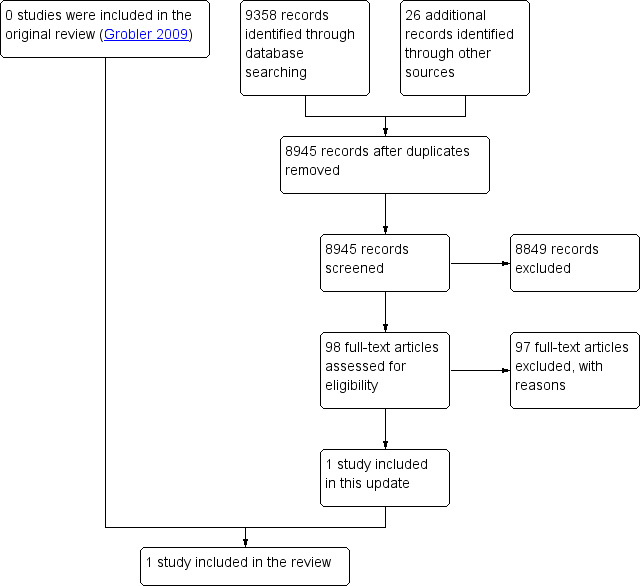
Main results: For this first update of the original review, we screened 8945 records for eligibility. We retrieved and assessed the full text of 125 studies. Only one study met the inclusion criteria of the review. This interrupted time series study, conducted in Taiwan, found that the implementation of a National Health Insurance scheme in 1995 was associated with improved equity in the geographic distribution of physicians and dentists. We judged the certainty of the evidence provided by this one study very low.
Authors' conclusions: There is currently limited reliable evidence regarding the effects of interventions aimed at addressing the inequitable distribution of health professionals. Well-designed studies are needed to confirm or refute findings of observational studies of educational, financial, regulatory and supportive interventions that might influence healthcare professionals' decisions to practice in underserved areas. Governments and medical schools should ensure that when interventions are implemented, their impacts are evaluated using scientifically rigorous methods to establish the true effects of these measures on healthcare professional recruitment and retention in rural and other underserved settings.
Conflict of interest statement
None known.
Figures
Update of
-
Interventions for increasing the proportion of health professionals practising in rural and other underserved areas.Cochrane Database Syst Rev. 2009 Jan 21;(1):CD005314. doi: 10.1002/14651858.CD005314.pub2. Cochrane Database Syst Rev. 2009. Update in: Cochrane Database Syst Rev. 2015 Jun 30;(6):CD005314. doi: 10.1002/14651858.CD005314.pub3. PMID: 19160251 Updated.
References
References to studies included in this review
References to studies excluded from this review
Adzei 2012 {published data only}
-
- Adzei FA, Atinga RA. Motivation and retention of health workers in Ghana's district hospitals. Journal of Health Organization and Management 2012;26:467‐85. - PubMed
Ageyi‐Baffour 2013 {published data only}
Antwi 2013 {published data only}
-
- Antwi J, Phillips DC. Wages and health worker retention: evidence from public sector wage reforms in Ghana. Journal of Development Economics 2013;102:101‐15.
Awofeso 2010 {published data only}
-
- Awofeso N. Improving health workforce recruitment and retention in rural and remote regions of Nigeria. Rural and Remote Health 2010;10(1):1319. - PubMed
Barnighausen 2009 {published data only}
Baumann 2006 {published data only}
-
- Baumann A, Yan J, Degelder J, Malikov K. Retention strategies for nursing: a profile of four countries. Human Health Resources Series Number 5, Hamilton, Ontario 2006.
Bazemore 2011 {published data only}
Bigbee 2014 {published data only}
-
- Bigbee J, Mixon D. Recruitment and retention of rural nursing students: a retrospective study. Rural and Remote Health 2014;14:1‐10. - PubMed
Buchan 2013 {published data only}
Burch 2011 {published data only}
-
- Burch VC, McKinley D, Wyk J, Kiguli‐Walube S, Cameron D, Cilliers FJ, et al. Career intentions of medical students trained in six sub‐Saharan African countries. Education for Health 2011;24:614. - PubMed
Buykx 2010 {published data only}
-
- Buykx P, Humphreys J, Wakerman J, Pashen D. Systematic review of effective retention incentives for health workers in rural and remote areas: towards evidence‐based policy. Australian Journal of Rural Health 2010;18:102‐9. - PubMed
Clark 2013 {published data only}
-
- Clark TR, Freedman SB, Croft AJ, Dalton HE, Luscombe GM, Brown AM, et al. Medical graduates becoming rural doctors: rural background versus extended rural placement. Medical Journal of Australia 2013;199:779‐82. - PubMed
Codjia 2010 {published data only}
-
- Codjia L, Jabot F, Dubois H. Evaluation of the program to support la médicalisation rural health areas in Mali [Evaluation du programme d’appui à la médicalisation des aires de santé rurale au Mali]. www.who.int/hrh/resources/case_mali/fr/index.html (accessed November 2014).
Crump 2013 {published data only}
-
- Crump WJ, Fricker RS, Ziegler C, Wiegman DL, Rowland ML. Rural track training based at a small regional campus: equivalency of training, residency choice, and practice location of graduates. Academic Medicine 2013;88:1122‐8. - PubMed
Deutschlander 2014 {published data only}
-
- Deutschlander S, Suter E, Grymonpre R. Interprofessional practice education: is the 'interprofessional' component relevant to recruiting new graduates to underserved areas?. Rural and Remote Health 2014;14:1‐11. - PubMed
Deveney 2013 {published data only}
-
- Deveney K, Deatherage M, Oehling D, Hunter J. Association between dedicated rural training year and the likelihood of becoming a general surgeon in a small town. JAMA Surgery 2013;148:817‐21. - PubMed
Devine 2013 {published data only}
-
- Devine SG, Williams G, Nielsen I. Rural Allied Health Scholarships: do they make a difference?. Rural and Remote Health 2013;13:2459. - PubMed
de Vries 2003 {published data only (unpublished sought but not used)}
-
- Vries E, Reid S. Do South African medical students of rural origin return to rural practice?. South African Medical Journal 2003;93:789‐93. - PubMed
de Vries 2010 {published data only}
-
- Vries E, Irlam J, Couper I, Kornik S, (CHEER) Members of the Collaboration for Health Equity through Education and Research. Career plans of final‐year medical students in South Africa. South African Medical Journal 2010;100:227‐8. - PubMed
Ditlopo 2011 {published data only}
-
- Ditlopo P, Blaauw D, Bidwell P, Thomas S. Analyzing the implementation of the rural allowance in hospitals in North West Province, South Africa. Journal of Public Health Policy 2011;32:S80‐93. - PubMed
Dolea 2010 {published data only}
Dunbabin 2006 {published data only}
-
- Dunbabin JS, McEwin K, Cameron I. Postgraduate medical placements in rural areas: their impact on the rural medical workforce. Rural Remote Health 2006;6:481. - PubMed
Efendi 2012 {published data only}
-
- Efendi F. Health worker recruitment and deployment in remote areas of Indonesia. Rural and Remote Health 2012;12. - PubMed
Eley 2006 {published data only}
-
- Eley D, Baker P. Does recruitment lead to retention? Rural Clinical School training experiences and subsequent intern choices. Rural and Remote Health 2006;6:511. - PubMed
Eley 2012 {published data only}
-
- Eley DS, Synnott R, Baker PG, Chater AB. A decade of Australian Rural Clinical School graduates ‐ where are they and why?. Rural and Remote Health 2012;12:1937. - PubMed
Erney 1991 {published data only}
-
- Erney SL, Allen DL, Siska KF. Effect of a year‐long primary care clerkship on graduates' selection of family practice residencies. Academic Medicine 1991;66(4):234‐6. [PUBMED: 2012657] - PubMed
Eyal 2012 {published data only}
Frehywot 2010 {published data only}
George 2012 {published data only}
-
- George G, Quinlan T, Reardon C, Aguilera J‐F. Where are we short and who are we short of? A review of the human resources for health in South Africa. Health SA Gesondheid 2012;17.
Gorsche 2012 {published data only}
-
- Gorsche RG, Woloschuk W. Rural physicians' skills enrichment program: a cohort control study of retention in Alberta. Australian Journal of Rural Health 2012;20:254‐8. - PubMed
Gow 2013 {published data only}
Haq 2013 {published data only}
-
- Haq C, Stearns M, Brill J, Crouse B, Foertsch J, Knox K, et al. Training in urban medicine and public health: TRIUMPH. Academic Medicine 2013;88:352‐63. - PubMed
Harris 1982 {published data only}
-
- Harris DL, Coleman M, Mallea M. Impact of participation in a family practice track program on student career decisions. Journal of Medical Education 1982;57(8):609‐14. [PUBMED: 7097734] - PubMed
Henderson 2008 {published data only}
Henry 2009 {published data only}
-
- Henry JA, Edwards BJ, Crotty B. Why do medical graduates choose rural careers?. Rural and Remote Health 2009;9:1083. - PubMed
Herold 1993 {published data only}
-
- Herold AH, Woodard LJ, Pamies RJ, Roetzheim RG, Durme DJ, Micceri T. Influence of longitudinal primary care teaching on medical students' specialty choices. Academic Medicine 1993;68(4):281‐4. [PUBMED: 8466611] - PubMed
Huicho 2012 {published data only}
Inoue 2007 {published data only}
-
- Inoue K, Matsumoto M, Sawada T. Evaluation of a medical school for rural doctors. Journal of Rural Health 2007;23:183‐7. - PubMed
Inoue 2009 {published data only}
-
- Inoue K, Matsumoto M, Toyokawa S, Kobayashi Y. Transition of physician distribution (1980‐2002) in Japan and factors predicting future rural practice. Rural and Remote Health 2009;9:1070. - PubMed
Jackson 2003 {published data only}
-
- Jackson J, Shannon CK, Pathman DE, Mason E, Nemitz JW. A comparative assessment of West Virginia's financial incentive programs for rural physicians. Journal of Rural Health 2003;19:329‐39. - PubMed
Jamieson 2013 {published data only}
-
- Jamieson JL, Kernahan J, Calam B, Sivertz KS. One program, multiple training sites: does site of family medicine training influence professional practice location?. Rural and Remote Health 2013;13:2496. - PubMed
Kane 2013 {published data only}
-
- Kane KY, Quinn KJ, Stevermer JJ, Porter JL, Webb WD, Williamson HA Jr, et al. Summer in the country: changes in medical students' perceptions following an innovative rural community experience. Academic Medicine 2013;88:1157‐63. - PubMed
Lehmann 2008 {published data only}
Longombe 2009 {published data only}
-
- Longombe AO. Medical schools in rural areas ‐ necessity or aberration?. Rural and Remote Health 2009;9:1131. - PubMed
Lupton 2012 {published data only}
-
- Lupton K, Vercammen‐Grandjean C, Forkin J, Wilson E, Grumbach K. Specialty choice and practice location of physician alumni of University of California premedical postbaccalaureate programs. Academic Medicine 2012;87:115‐20. - PubMed
MacDowell 2013 {published data only}
-
- MacDowell M, Glasser M, Hunsaker M. A decade of rural physician workforce outcomes for the Rockford Rural Medical Education (RMED) Program, University of Illinois. Academic Medicine 2013;88:1941‐7. - PubMed
Matsumoto 2008a {published data only}
-
- Matsumoto M, Inoue K, Kajii E. Characteristics of medical students with rural origin: implications for selective admission policies. Health Policy 2008;87:194‐202. - PubMed
Matsumoto 2008b {published data only}
-
- Matsumoto M, Inoue K, Kajii E. A contract‐based training system for rural physicians: follow‐up of Jichi Medical University graduates (1978‐2006). Journal of Rural Health 2008;24:360‐8. - PubMed
Matsumoto 2010a {published data only}
-
- Matsumoto M, Inoue K, Kajii E, Takeuchi K. Retention of physicians in rural Japan: concerted efforts of the government, prefectures, municipalities and medical schools. Rural and Remote Health 2010;10:1432. - PubMed
Matsumoto 2010b {published data only}
-
- Matsumoto M, Inoue K, Kajii E. Policy implications of a financial incentive programme to retain a physician workforce in underserved Japanese rural areas. Social Science and Medicine 2010;71:667‐71. - PubMed
Matsumoto 2010c {published data only}
-
- Matsumoto M, Inoue K, Bowman R, Noguchi S, Toyokawa S, Kajii E. Geographical distributions of physicians in Japan and US: impact of healthcare system on physician dispersal pattern. Health Policy 2010;96:255‐61. - PubMed
Matsumoto 2010d {published data only}
-
- Matsumoto M, Inoue K, Bowman R, Noguchi S, Kajii E. Physician scarcity is a predictor of further scarcity in US, and a predictor of concentration in Japan. Health Policy 2010;95:129‐36. - PubMed
Matsumoto 2012 {published data only}
-
- Matsumoto M, Inoue K, Kashima S, Takeuchi K. Does the insufficient supply of physicians worsen their urban‐rural distribution? A Hiroshima‐Nagasaki comparison. Rural and Remote Health 2012;12. - PubMed
Mbemba 2013 {published data only}
Mennin 1996 {published data only}
-
- Mennin SP, Kalishman S, Friedman M, Pathak D, Snyder J. A survey of graduates in practice from the University of New Mexico's conventional and community‐oriented, problem‐based tracks. Academic Medicine 1996;71(10):1079‐89. [PUBMED: 9177642] - PubMed
Miranda 2012 {published data only}
Morell 2014 {published data only}
Munga 2014 {published data only}
-
- Munga MA, Torsvik G, Maestad O. Using incentives to attract nurses to remote areas of Tanzania: a contingent valuation study. Health Policy and Planning 2014;29:227‐36. - PubMed
Orzanco 2011 {published data only}
-
- Orzanco MG, Lovato C, Bates J, Slade S, Grand'Maison P, Vanasse A. Nature and nurture in the family physician's choice of practice location. Rural and Remote Health 2011;11:1849. - PubMed
Ozegowski 2013 {published data only}
-
- Ozegowski S. Effective policy mechanisms for an equitable geographical distribution of general practitioners: a qualitative comparative analysis of the accessibility of primary care in Europe. Journal of Health Services Research and Policy 2013;18:151‐9. - PubMed
Pena 2010 {published data only}
Playford 2014 {published data only}
-
- Playford DE, Evans SF, Atkinson DN, Auret KA, Riley GJ. Impact of the Rural Clinical School of Western Australia on work location of medical graduates. Medical Journal of Australia 2014;200:104‐7. - PubMed
Rabinowitz 1993 {published data only}
-
- Rabinowitz HK. Recruitment, retention, and follow‐up of graduates of a program to increase the number of family physicians in rural and underserved areas. New England Journal of Medicine 1993;328:934‐9. - PubMed
Rabinowitz 2001 {published data only}
-
- Rabinowitz HK, Diamond JJ, Markham FW, Paynter NP. Critical factors for designing programs to increase the supply and retention of rural primary care physicians. JAMA 2001;286:1041‐8. - PubMed
Rabinowitz 2005 {published data only}
-
- Rabinowitz HK, Diamond JJ, Markham FW, Rabinowitz C. Long‐term retention of graduates from a program to increase the supply of rural family physicians. Academic Medicine 2005;80(8):728‐32. [PUBMED: 16043525] - PubMed
Rabinowitz 2011 {published data only}
-
- Rabinowitz HK, Diamond JJ, Markham FW, Santana AJ. Increasing the supply of women physicians in rural areas: outcomes of a medical school rural program. Journal of the American Board of Family Medicine 2011;24:740‐4. - PubMed
Rabinowitz 2012a {published data only}
-
- Rabinowitz HK, Petterson S, Boulger JG, Hunsaker ML, Diamond JJ, Markham FW, et al. Medical school rural programs: a comparison with international medical graduates in addressing state‐level rural family physician and primary care supply. Academic Medicine 2012;87:488‐92. - PubMed
Rabinowitz 2012b {published data only}
-
- Rabinowitz HK, Diamond JJ, Markham FW, Santana AJ. The relationship between entering medical students' backgrounds and career plans and their rural practice outcomes three decades later. Academic Medicine 2012;87:493‐7. - PubMed
Rabinowitz 2012c {published data only}
-
- Rabinowitz HK, Diamond JJ, Markham FW, Santana AJ. The relationship between matriculating medical students' planned specialties and eventual rural practice outcomes. Academic Medicine 2012;87:1086‐90. - PubMed
Rabinowitz 2013 {published data only}
-
- Rabinowitz HK, Diamond JJ, Markham FW, Santana AJ. Retention of rural family physicians after 20‐25 years: outcomes of a comprehensive medical school rural program. Journal of the American Board of Family Medicine 2013;26:24‐7. - PubMed
Rockers 2012 {published data only}
Rockers 2013a {published data only}
-
- Rockers PC, Jaskiewicz W, Kruk ME, Phathammavong O, Vangkonevilay P, Paphassarang C, et al. Differences in preferences for rural job postings between nursing students and practicing nurses: evidence from a discrete choice experiment in Lao People's Democratic Republic. Human Resources for Health 2013;11:22. - PMC - PubMed
Rockers 2013b {published data only}
Rosenblatt 1979 {published data only}
-
- Rosenblatt RA, Alpert JJ. The effect of a course in family medicine on future career choice: a long‐range follow‐up of a controlled experiment in medical education. Journal of Family Practice 1979;8(1):87‐91. [PUBMED: 759553] - PubMed
Royston 2012 {published data only}
-
- Royston PJ, Mathieson K, Leafman J, Ojan‐Sheehan O. Medical student characteristics predictive of intent for rural practice. Rural and Remote Health 2012;12:2107. - PubMed
Russell 2012a {published data only}
-
- Russell DJ, McGrail MR, Humphreys JS, Wakerman J. What factors contribute most to the retention of general practitioners in rural and remote areas?. Australian Journal of Primary Health 2012;18:289‐94. - PubMed
Russell 2012b {published data only}
-
- Russell DJ, Humphreys JS, Wakerman J. How best to measure health workforce turnover and retention: five key metrics. Australian Health Review 2012;36:290‐5. - PubMed
Russell 2013a {published data only}
-
- Russell DJ, Wakerman J, Humphreys JS. What is a reasonable length of employment for health workers in Australian rural and remote primary healthcare services?. Australian Health Review 2013;37:256‐61. - PubMed
Russell 2013b {published data only}
Rutebemberwa 2014 {published data only}
-
- Rutebemberwa E, Kinengyere AA, Ssengooba F, Pariyo GW, Kiwanuka SN. Financial interventions and movement restrictions for managing the movement of health workers between public and private organizations in low‐ and middle‐income countries. Cochrane Database of Systematic Reviews 2014, Issue 2. [DOI: 10.1002/14651858.CD009845.pub2] - DOI - PMC - PubMed
Salafsky 2005 {published data only}
-
- Salafsky B, Glasser M, Ha J. Addressing issues of maldistribution of health care workers. Annals Academy of Medicine Singapore 2005;34:520‐5. - PubMed
Sasaki 2013 {published data only}
Scott 2013 {published data only}
-
- Scott A, Witt J, Humphreys J, Joyce C, Kalb G, Jeon SH, et al. Getting doctors into the bush: General Practitioners' preferences for rural location. Social Science and Medicine 2013;96:33‐44. - PubMed
Somers 2007 {published data only}
-
- Somers GT, Strasser R, Jolly B. What does it take? The influence of rural upbringing and sense of rural background on medical students' intention to work in a rural environment. Rural and Remote Health 2007;7:706. - PubMed
Somers 2012 {published data only}
-
- Somers GT, Spencer RJ. Nature or nurture: the effect of undergraduate rural clinical rotations on pre‐existent rural career choice likelihood as measured by the SOMERS Index. Australian Journal of Rural Health 2012;20:80‐7. - PubMed
Sousa 2012 {published data only}
Straume 2010 {published data only}
-
- Straume K, Sondena MS, Prydz P. Postgraduate training at the ends of the Earth ‐ a way to retain physicians?. Rural and Remote Health 2010;10:1356. - PubMed
Sundararaman 2011 {published data only}
Suter 2012 {published data only}
-
- Suter E, Deutschlander S, Mickelson G, Nurani Z, Lait J, Harrison L, et al. Can interprofessional collaboration provide health human resources solutions? A knowledge synthesis. Journal of Interprofessional Care 2012;26:261‐8. - PubMed
Tani 2004 {published data only}
-
- Tani K, Yamaguchi H, Tada S, Kondo S, Tabata R, Yuasa S, et al. Community‐based clinical education increases motivation of medical students to medicine of remote area ‐ comparison between lecture and practice. Journal of Medical Investigation 2004;61:156‐61. - PubMed
Toussaint 2010 {published data only}
-
- Toussaint S, Mak DB. 'Even if we get one back here, it's worth it ... ': evaluation of an Australian Remote Area Health Placement Program. Rural and Remote Health 2010;10:1546. - PubMed
Walker 2012 {published data only}
-
- Walker JH, Dewitt DE, Pallant JF, Cunningham CE. Rural origin plus a rural clinical school placement is a significant predictor of medical students' intentions to practice rurally: a multi‐university study. Rural and Remote Health 2012;12:1908. - PubMed
Wang 2013 {published data only}
Wang 2014 {published data only}
-
- Wang L, Wang YQ, Li YP, Shi CH, Yang ZX, Li CC, et al. Performance evaluation of primary healthcare system reform in Xinjin county, Chengdu city: II. Survey on human resources in primary healthcare institutions. Chinese Journal of Evidence‐Based Medicine 2014;14:7‐15.
Wilkinson 2004 {published data only}
-
- Wilkinson D, Birks J, Davies L, Margolis S, Baker P. Preliminary evidence from Queensland that rural clinical schools have a positive impact on rural intern choices. Rural and Remote Health 2004;4(4):340. [PUBMED: 15887994] - PubMed
Williamson 2012 {published data only}
-
- Williamson MI, Wilson R, McKechnie R, Ross J. Does the positive influence of an undergraduate rural placement persist into postgraduate years?. Rural and Remote Health 2012;12:2011. - PubMed
Additional references
Aiken 1996
-
- Aiken LH, Sochalski J, Andersen G. Downsize the hospital nursing workforce. Health Affairs 1996;15:88‐92. - PubMed
Aiken 2001
-
- Aiken LH. Nurses' reports on hospital care in five countries. Health Affairs 2001;20:43‐53. - PubMed
Allen 1987
-
- Allen SS, Sherman MB, Bland CJ, Fiola JA. Effect of early exposure to family medicine on students' attitudes towards the specialty. Journal of Medical Education 1987;62(11):911‐7. [PUBMED: 3681919] - PubMed
Beasley 1993
-
- Beasley JW. Does teaching by family physicians in the second year of medical school increase student selection of family practice residencies?. Family Medicine 1993;25(3):174‐5. [PUBMED: 8458556] - PubMed
Boozary 2014
-
- Boozary AS, Farmer PE, Jha AK. The Ebola outbreak, fragile health systems, and quality as a cure. JAMA 2014;312(18):1859‐60. - PubMed
Boulle 1997
-
- Boulle A. Rural health care and rural poverty ‐ inextricably linked ‐ policy in progress. Health Systems Trust Update 1997;28:6‐7.
Brooks 2002
-
- Brooks RG, Walsh M, Mardon RE, Lewis M, Clawson A. The roles of nature and nurture in the recruitment and retention of primary care physicians in rural areas: a review of the literature. Academic Medicine 2002;77(8):790‐8. [PUBMED: 12176692] - PubMed
Bärnighausen 2009
Campos‐Outcalt 1995
-
- Campos‐Outcalt D, Senf J, Watkins AJ, Bastacky S. The effects of medical school curricula, faculty role models, and biomedical research support on choice of generalist physician careers: a review and quality assessment of the literature. Academic Medicine 1995;70(7):611‐9. [PUBMED: 7612127] - PubMed
Campos‐Outcalt 1999
-
- Campos‐Outcalt D, Senf J. A longitudinal, national study of the effect of implementing a required third‐year family practice clerkship or a department of family medicine on the selection of family medicine by medical students. Academic Medicine 1999;74(9):1016‐20. [PUBMED: 10498096] - PubMed
Cavender 1998
-
- Cavender A, Albán M. Compulsory medical service in Ecuador: the physician's perspective. Social Science and Medicine 1998;47(12):1937‐46. [PUBMED: 10075237] - PubMed
Chen 2014
Crandall 1990
-
- Crandall LA, Dwyer JW, Duncan RP. Recruitment and retention of rural physicians: issues for the 1990s. Journal of Rural Health 1990;6(1):19‐38. [PUBMED: 10106423] - PubMed
Curran 2004
-
- Curran V, Rourke J. The role of medical education in the recruitment and retention of rural physicians. Medical Teacher 2004;26(3):265‐72. - PubMed
Dussault 2006
EPOC 2013a
-
- Effective Practice, Organisation of Care (EPOC). What study designs should be included in an EPOC review and what should they be called? EPOC Resources for review authors. Oslo: Norwegian Knowledge Centre for the Health Services; 2013. epoc.cochrane.org/epoc‐specific‐resources‐review‐authors (accessed 17 June 2015).
EPOC 2013b
-
- Effective Practice, Organisation of Care (EPOC). Interrupted time series (ITS) analyses. EPOC Resources for review authors. Oslo: Norwegian Knowledge Centre for the Health Services; 2013. epoc.cochrane.org/sites/epoc.cochrane.org/files/uploads/Interrupted_time... (accessed February 2015).
EPOC 2015
-
- Effective Practice, Organisation of Care (EPOC). Suggested risk of bias criteria for EPOC reviews. EPOC Resources for review authors. Oslo: Norwegian Knowledge Centre for the Health Services; 2015. epoc.cochrane.org/epoc‐specific‐resources‐review‐authors (accessed 17 June 2015).
Ezenwa 1986
-
- Ezenwa AO. Health manpower and population change in Nigeria. Journal of the Royal Society of Health 1986;106(4):143‐5. [PUBMED: 3091827] - PubMed
Fadayomi 1984
-
- Fadayomi TO, Oyeneye OY. The demographic factor in the provision of health facilities in developing countries: the case of Nigeria. Social Science and Medicine 1984;19(8):793‐7. [PUBMED: 6438804] - PubMed
Hamilton 2004
-
- Hamilton K, Yau J. The global tug‐of‐war for health care workers. www.hrhresourcecenter.org/node/1264 (accessed 10 March 2014).
Hart 1971
-
- Hart JT. The inverse care law. Lancet 1971;1(7696):405‐12. [PUBMED: 4100731] - PubMed
Hart 2002
-
- Hart LG, Salsberg E, Phillips DM, Lishner DM. Rural health care providers in the United States. Journal of Rural Health 2002;18 Suppl:211‐32. [PUBMED: 12061515] - PubMed
Humphreys 2001
-
- Humphreys JS, Jones JA, Jones MP, Hugo G, Bamford E, Taylor DH. A critical review of rural medical workforce retention in Australia. Australian Health Review 2001;24(4):91‐102. [PUBMED: 11842721] - PubMed
Kiesouw 1996
-
- Kiesouw L. From Cuba to Khayelitsha ‐ experiences of a Cuban doctor in SA. South African Medical Journal 1996;86(8):906, 910. [PUBMED: 8823408] - PubMed
Kotzee 2006
-
- Kotzee TJ, Couper ID. What interventions do South African qualified doctors think will retain them in rural hospitals of the Limpopo province of South Africa?. Rural Remote Health 2006;6(3):581. [PUBMED: 16965219] - PubMed
Kyomuhendo 2003
-
- Kyomuhendo GB. Low use of rural maternity services in Uganda: impact of women's status, traditional beliefs and limited resources. Reproductive Health Matters 2003;11(21):16‐26. [PUBMED: 12800700] - PubMed
Laven 2003a
-
- Laven G, Beilby JJ, Wilkinson D, McElroy HJ. Factors associated with rural practice among Australian‐trained general practitioners. Medical Journal of Australia 2003;179(2):75‐9. [PUBMED: 12864716] - PubMed
Laven 2003b
-
- Laven G, Wilkinson D. Rural doctors and rural backgrounds: how strong is the evidence? A systematic review. Australian Journal of Rural Health 2003;11(6):277‐84. [PUBMED: 14678410] - PubMed
Marais 2007
-
- Marais BJ, Villiers M, Kruger J, Conradie H, Jenkins L, Reuter H. The role of educational strategies to reverse the inverse performance spiral in academically isolated rural hospitals. South African Family Practice 2007;49(7):15.
Moores 1998
Moran 2014
-
- Moran AM, Coyle J, Pope R, Boxall D, Nancarrow SA, Young J. Supervision, support and mentoring interventions for health practitioners in rural and remote contexts: an integrative review and thematic synthesis of the literature to identify mechanisms for successful outcomes. Human Resources for Health 2014;12:10. - PMC - PubMed
Mullan 2005
-
- Mullan F. The metrics of the physician brain drain. New England Journal of Medicine 2005;353(17):1810‐8. [PUBMED: 16251537] - PubMed
National Rural Health Alliance 2013
-
- National Rural Health Alliance. How many doctors are there in rural Australia?. ruralhealth.org.au/sites/default/files/publications/nrha‐factsheet‐docto... (accessed 20 April 2015).
Pathman 1992
-
- Pathman DE, Konrad TR, Ricketts TC. The comparative retention of National Health Service Corps and other rural physicians: results of a 9‐year follow‐up study. JAMA 1992;268(12):1552‐8. [PUBMED: 1518110] - PubMed
Pathman 1994
Pathman 2000
-
- Pathman DE, Konrad TR, King TS, Spaulding C, Taylor DH. Medical training debt and service commitments: the rural consequences. Journal of Rural Health 2000;16(3):264‐72. [PUBMED: 11131772] - PubMed
Pathman 2004
-
- Pathman DE, Konrad TR, King TS, Taylor DH, Koch GG. Outcomes of states' scholarships, loan repayment and related programs for physicians. Medical Care 2004;42(6):560‐8. [PUBMED: 15167324] - PubMed
Penaloza 2011
PlotDigitizer
-
- PlotDigitizer. plotdigitizer.sourceforge.net/ (accessed February 2015).
Rabinowitz 1998
-
- Rabinowitz HK, Diamond JJ, Gayle JA, Turner TN, Rosenthal MP. Alternate career choices of medical students and their eventual specialty choice: a follow‐up study. Family Medicine 1998;30(10):695. [PUBMED: 9827337] - PubMed
Rabinowitz 1999
-
- Rabinowitz HK, Diamond JJ, Markham FW, Hazelwood CE. A program to increase the number of family physicians in rural and underserved areas: impact after 22 years. JAMA 1999;281(3):255‐60. [PUBMED: 9918481] - PubMed
Rabinowitz 2000
Reid 2001
-
- Reid SJ. Compulsory community service for doctors in South Africa ‐ an evaluation of the first year. South African Medical Journal 2001;91(4):329‐36. [PUBMED: 11402906] - PubMed
Reid 2004
-
- Reid S. Menitoring the effect of the new rural allowance for health professionals. Durban: Health Systems Trust 2004.
RevMan 2014 [Computer program]
-
- The Nordic Cochrane Centre, The Cochrane Collaboration. Review Manager (RevMan). Version 5.3. Copenhagen: The Nordic Cochrane Centre, The Cochrane Collaboration, 2014.
Rid 2014
-
- Rid A, Emanuel EJ. Why should high‐income countries help combat Ebola. JAMA 2014;312(13):1297‐8. - PubMed
SA HRH strategy 2013
-
- South African National Department of Health. Human resources for health South Africa: HRH strategy for the health sector: 2012/13 ‐ 2016/17. www.nationalplanningcycles.org/sites/default/files/country_docs/South_Af... (accessed April 2014).
Scammon 1994
-
- Scammon DL, Williams SD, Li LB. Understanding physicians' decisions to practice in rural areas as a basis for developing recruitment and retention strategies. Journal of Ambulatory Care Marketing 1994;5(2):85‐100. [PUBMED: 10165487] - PubMed
Scheffler 2009
-
- Scheffler RM, Mahoney CB, Fulton BD, Dal Poz MR, Preker AS. Estimates of health care professional shortages in sub‐Saharan Africa by 2015. Health Affairs (Millwood) 2009;28(5):w849‐62. - PubMed
Scheil‐Adlung 2015
-
- Scheil‐Adlung X (editor). Global evidence on inequities in rural health protection: new data on rural deficits in health coverage for 174 countries. International Labour Office, Social Protection Department: Geneva, ILO 2015; Vol. Extension of Social Security Series: no 47.
Sempowski 2004
-
- Sempowski IP. Effectiveness of financial incentives in exchange for rural and under serviced area return‐of‐service commitments: systematic review of the literature. Canadian Journal of Rural Medicine 2004;9(2):82‐8. - PubMed
Statistics SA 1996
-
- Statistics South Africa. People of South Africa: population census, 1996. www.statssa.gov.za (accessed 7 January 2005).
Stearns 2000
-
- Stearns JA, Stearns MA. Graduate medical education for rural physicians: curriculum and retention. Journal of Rural Health 2000;16(3):273‐7. [PUBMED: 11131773] - PubMed
Strasser 2003
-
- Strasser R. Rural health around the world: challenges and solutions. Family Practice 2003;20(4):457‐63. [PUBMED: 12876121] - PubMed
Viscomi 2013
-
- Viscomi M, Larkins S, Gupta TS. Recruitment and retention of general practitioners in rural Canada and Australia: a review of the literature. Canadian Journal of Rural Medicine 2013;18(1):13‐23. - PubMed
Western 2000
-
- Western J, Makkai T, McMillan J, Dwan K. Issues for rural practice in Australia. General Practice Evaluation Program, 2000. Commonwealth Department of Health and Aged Care, Report no. 535.
WHO 2003
-
- World Health Organization. The World Health Report 2003 ‐ shaping the future. www.who.int/whr/2003/en/ (accessed 17 June 2015).
WHO 2006
-
- World Health Organization. The World Health Report 2006 ‐ working together for health. www.who.int/whr/2006/en/ (accessed 17 June 2015).
WHO 2010
-
- World Health Organization. Increasing access to health workers in remote and rural areas through improved retention: global policy recommendations. whqlibdoc.who.int/publications/2010/9789241564014_eng.pdf (accessed 17 June 2015). - PubMed
Willis‐Shattuck 2008
Wilson 2009
-
- Wilson NW, Couper ID, Vries E, Reid S, Fish T, Marais BJ. A critical review of interventions to redress the inequitable distribution of health care professionals to rural and remote areas. Rural and Remote Health 2009;9:1060. - PubMed
Woloschuk 2002
-
- Woloschuk W, Tarrant M. Does a rural education experience influence students' likelihood of rural practice? Impact of student background and gender. Medical Education 2002;36(3):241‐7. [PUBMED: 11879514] - PubMed
Woloschuk 2004
-
- Woloschuk W, Tarrant M. Do students from rural backgrounds engage in rural family practice more than their urban‐raised peers?. Medical Education 2004;38(3):259‐61. [PUBMED: 14996334] - PubMed
References to other published versions of this review
Grobler 2009
Publication types
MeSH terms
LinkOut - more resources
Full Text Sources
Medical
Miscellaneous
