. 2015 Aug 4;112(31):9775-80.
doi: 10.1073/pnas.1422875112. Epub 2015 Jun 29.

Circadian clock gene LATE ELONGATED HYPOCOTYL directly regulates the timing of floral scent emission in Petunia

Affiliations

Circadian clock gene LATE ELONGATED HYPOCOTYL directly regulates the timing of floral scent emission in Petunia

Myles P Fenske et al. Proc Natl Acad Sci U S A. .

Abstract

Flowers present a complex display of signals to attract pollinators, including the emission of floral volatiles. Volatile emission is highly regulated, and many species restrict emissions to specific times of the day. This rhythmic emission of scent is regulated by the circadian clock; however, the mechanisms have remained unknown. In Petunia hybrida, volatile emissions are dominated by products of the floral volatile benzenoid/phenylpropanoid (FVBP) metabolic pathway. Here we demonstrate that the circadian clock gene P. hybrida LATE ELONGATED HYPOCOTYL (LHY; PhLHY) regulates the daily expression patterns of the FVBP pathway genes and floral volatile production. PhLHY expression peaks in the morning, antiphasic to the expression of P. hybrida GIGANTEA (PhGI), the master scent regulator ODORANT1 (ODO1), and many other evening-expressed FVBP genes. Overexpression phenotypes of PhLHY in Arabidopsis caused an arrhythmic clock phenotype, which resembles those of LHY overexpressors. In Petunia, constitutive expression of PhLHY depressed the expression levels of PhGI, ODO1, evening-expressed FVBP pathway genes, and FVBP emission in flowers. Additionally, in the Petunia lines in which PhLHY expression was reduced, the timing of peak expression of PhGI, ODO1, and the FVBP pathway genes advanced to the morning. Moreover, PhLHY protein binds to cis-regulatory elements called evening elements that exist in promoters of ODO1 and other FVBP genes. Thus, our results imply that PhLHY directly sets the timing of floral volatile emission by restricting the expression of ODO1 and other FVBP genes to the evening in Petunia.

Keywords: LHY; Petunia hybrida; benzenoids; circadian rhythm; floral volatile.


Conflict of interest statement

The authors declare no conflict of interest.

Figures
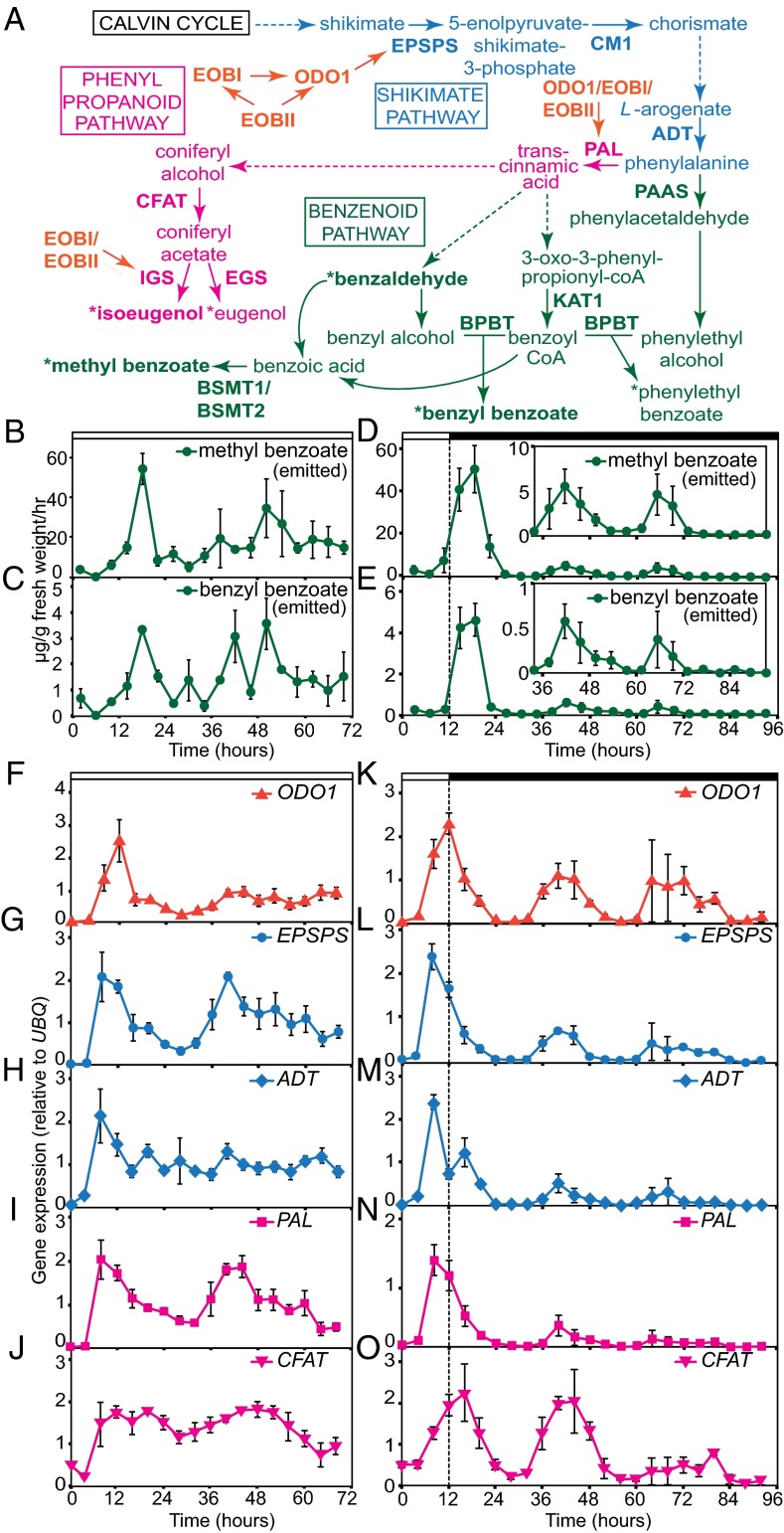
Fig. 1.
Fig. 1.
The floral volatile emission and expression profiles of the genes in the FVBP pathway. (A) An overview of selected parts of the FVBP pathway. Different colors indicate steps and products that are categorized in shikimate, benzenoid, and phenyl propanoid pathways. Arrows with dashed lines in the pathway are representative of multiple steps between products. Volatile products are presented with asterisks. We analyzed expression patterns of enzyme genes and products in bold. Transcription factors are in orange, and enzymes shown are EPSPS, CM1, ADT, phenylacetaldehyde synthase (PAAS), BPBT, KAT1, S-adenosyl-l-methionine:benzoic acid/salicylic acid carboxyl methyltransferase (BSMT) 1, BSMT2, PAL, CFAT, IGS, and eugenol synthase 1 (EGS). (BE) Volatile emission data of methyl benzoate (B and D) and benzyl benzoate (C and E) in Petunia in continuous light (B and C) and dark (D and E). (Insets, D and E) Graphs with enlarged y-axes showing the same 32–96 time point results. (FO) Gene expression patterns of transcription factors and enzymes associated with the FVBP pathway in Petunia in continuous light (FJ) and dark (KO). The line and symbol color of the graphs corresponds to its placement within the FVBP pathway shown in A. Values are relative to UBIQUITIN (UBQ), and normalized by the average expression values of hours 0–12. Results represent means ± SEM from three biological replicates. White and black bars at the top indicate periods of light and dark, respectively.
Fig. 2.
Fig. 2.
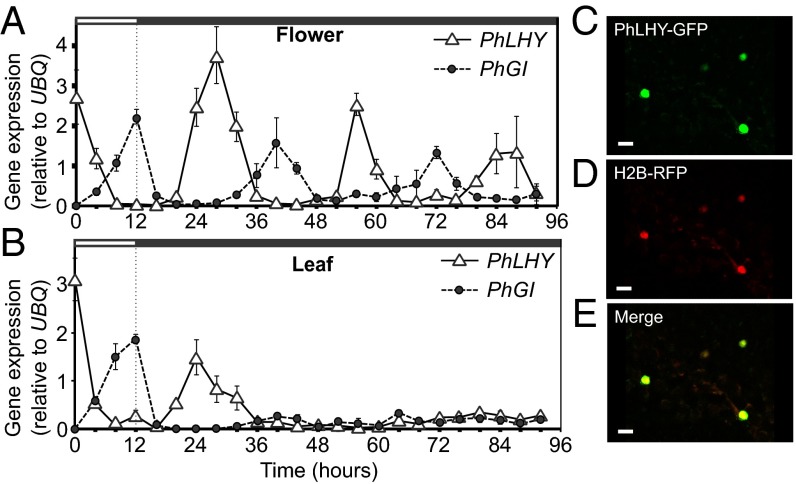
Circadian expression pattern of PhLHY and intracellular localization of PhLHY protein. (A and B) Expression profiles of PhLHY and PhGI in continuous dark over 92 h in Petunia petals (A) and leaves (B). Results represent means ± SEM from three biological replicates. (CE) PhLHY-GFP is a nuclear localized protein. PhLHY-GFP protein (C) and H2B-RFP protein (reference for nuclei) (D) were expressed in epidermal cells of Petunia petals. (E) Merged image of C and D. (Scale bar: 10 μm.)
Fig. 3.
Fig. 3.
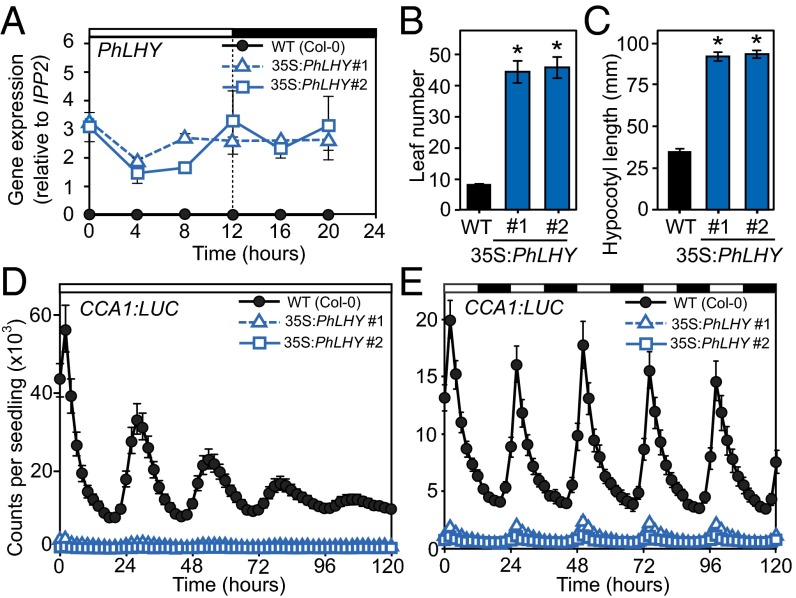
PhLHY functionally resembles CCA1/LHY in Arabidopsis. (A) Expression of PhLHY in 35S:PhLHY plants under light/dark conditions. (B) Flowering time of 35S:PhLHY lines and WT plants is shown. (*Significant difference vs. WT at P < 0.05, Student t test; n = 16.) (C) Hypocotyl length of 35S:PhLHY lines and WT plants (*P < 0.05; n = 30). (D and E) CCA1:LUC activity as measured by luminescence counts per seedling over 5 d of continuous light (D) and light/dark (E) conditions in a comparison between 35S:PhLHY lines and WT. Results represent means ± SEM (n = 16).
Fig. 4.
Fig. 4.
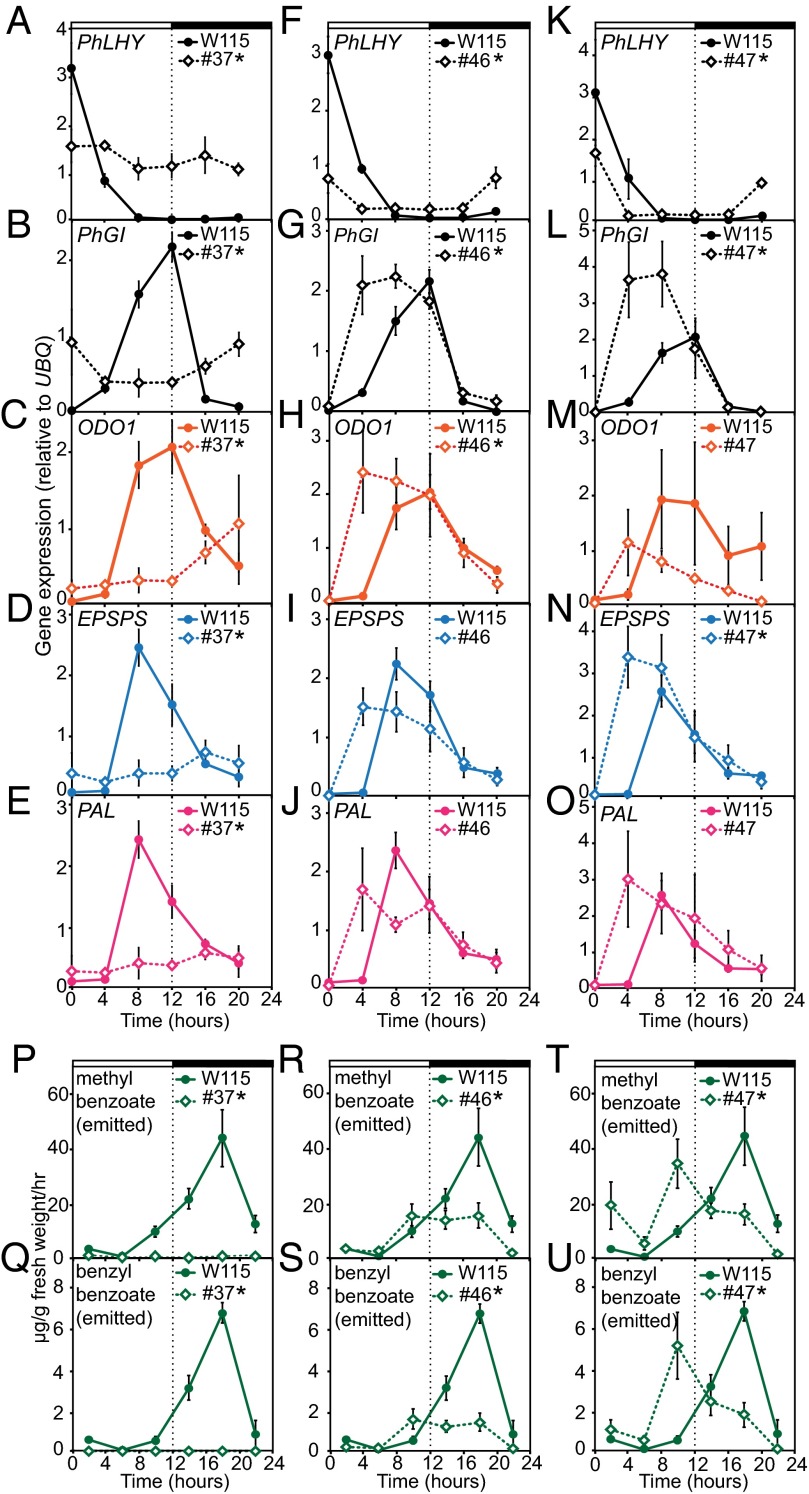
PhLHY regulates daily timing of gene expression and volatile emission in the FVBP pathway. (AO) Daily expression patterns of clock genes and genes encoding proteins in the FVBP pathway in the transgenic line (line 37) with constitutive PhLHY expression (AE) and in the transgenic lines (lines 46 and 47) with altered PhLHY expression (FO). Gene expression values were normalized by the average expression values of hours 0–12. (PU) Daily scent emission patterns of methyl benzoate (P, R, and T) and benzyl benzoate (Q, S, and U) in transgenic line 37 (P and Q) and in transgenic lines 46 and 47 (RU). Results represent means ± SEM from three biological replicates. The line color of the graphs corresponds to its placement within the FVBP pathway (Fig. 1A; *P < 0.05, daily expression and scent emission patterns of transgenic lines differ significantly from WT Petunia; two-way ANOVA).
Fig. 5.
Fig. 5.
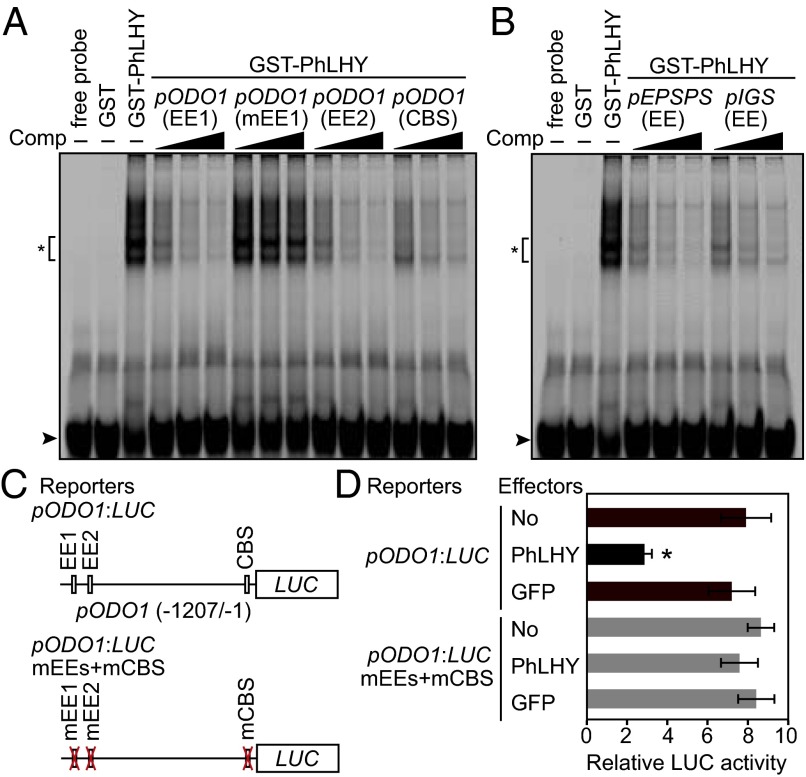
PhLHY binds to EEs. (A) An EMSA shows direct interaction of GST-PhLHY with EEs in the ODO1 promoter. The EE1 in the ODO1 promoter (pODO1) was used as a labeled probe. Competition with different concentrations of unlabeled EE1, EE2, and CBS fragments and the mutated EE1 are shown along the top. (B) EMSA of GST-PhLHY with EEs in the EPSPS (pEPSPS) and IGS (pIGS) promoters. For A and B, GST served as a negative control. Asterisks and arrowheads indicate GST-PhLHY/DNA complexes and free probes, respectively. (C) Schematic of reporters used in transient assay. (D) The effect of PhLHY protein on the ODO1 promoter activities. The activities of firefly LUC were normalized by the activities of 35S:Renilla LUC. Results represent means ± SEM of nine independent samples (*P < 0.01 vs. no effector, Student t test).

References

    1. Harmer SL. The circadian system in higher plants. Annu Rev Plant Biol. 2009;60:357–377. - PubMed
    1. Covington MF, Maloof JN, Straume M, Kay SA, Harmer SL. Global transcriptome analysis reveals circadian regulation of key pathways in plant growth and development. Genome Biol. 2008;9(8):R130. - PMC - PubMed
    1. Dodd AN, et al. Plant circadian clocks increase photosynthesis, growth, survival, and competitive advantage. Science. 2005;309(5734):630–633. - PubMed
    1. Kinmonth-Schultz HA, Golembeski GS, Imaizumi T. Circadian clock-regulated physiological outputs: Dynamic responses in nature. Semin Cell Dev Biol. 2013;24(5):407–413. - PMC - PubMed
    1. Muhlemann JK, Klempien A, Dudareva N. Floral volatiles: From biosynthesis to function. Plant Cell Environ. 2014;37(8):1936–1949. - PubMed

Publication types

MeSH terms

Associated data