Review
. 2015 Jun 12:6:437.
doi: 10.3389/fpls.2015.00437. eCollection 2015.

Circadian rhythms and post-transcriptional regulation in higher plants

Affiliations
Review

Circadian rhythms and post-transcriptional regulation in higher plants

Andrés Romanowski et al. Front Plant Sci. .

Abstract

The circadian clock of plants allows them to cope with daily changes in their environment. This is accomplished by the rhythmic regulation of gene expression, in a process that involves many regulatory steps. One of the key steps involved at the RNA level is post-transcriptional regulation, which ensures a correct control on the different amounts and types of mRNA that will ultimately define the current physiological state of the plant cell. Recent advances in the study of the processes of regulation of pre-mRNA processing, RNA turn-over and surveillance, regulation of translation, function of lncRNAs, biogenesis and function of small RNAs, and the development of bioinformatics tools have helped to vastly expand our understanding of how this regulatory step performs its role. In this work we review the current progress in circadian regulation at the post-transcriptional level research in plants. It is the continuous interaction of all the information flow control post-transcriptional processes that allow a plant to precisely time and predict daily environmental changes.

Keywords: Arabidopsis thaliana; RNA turnover; alternative splicing; circadian rhythms; mRNA nuclear export; polyadenilation; post-transcriptional regulation; regulation of translation.


Figures
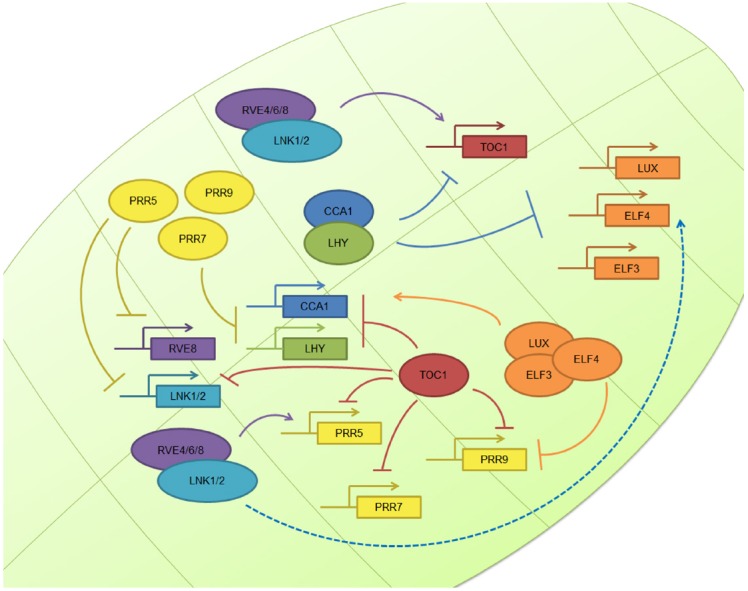
FIGURE 1
FIGURE 1
The plant circadian clock. The plant molecular clock is based on a TTFL mechanism. The image shows the simplified molecular clockwork mechanism of Arabidopsis thaliana: the central loop composed by TOC1, CCA1, and LHY; the morning loop, composed by PRR5, PRR7, and PRR9; the evening complex, composed by ELF3, ELF4, and LUX; and the newly described positive elements, the RVE and LNK family. Other plant clocks are very similar in nature, although there some differences.
FIGURE 2
FIGURE 2
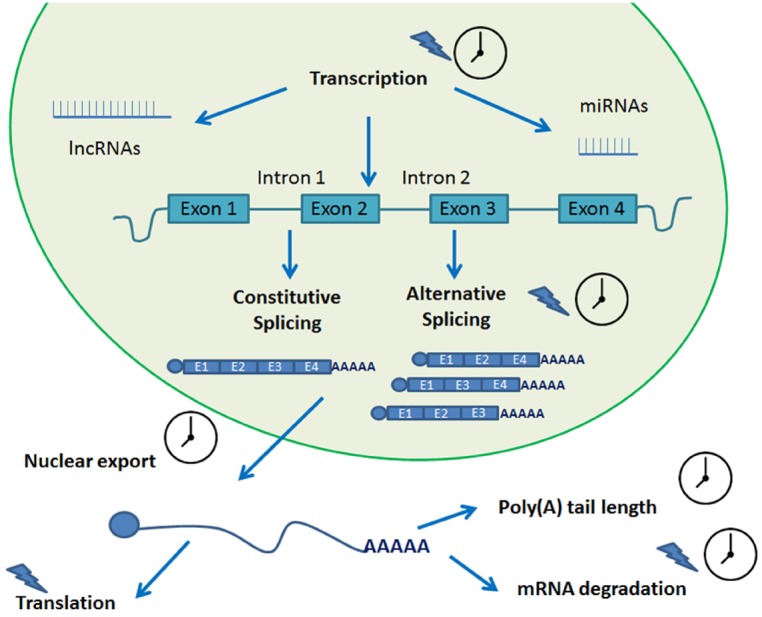
Post-transcriptional processes involved in circadian biology. A transcript undergoes several steps of post-transcriptional processing in its journey from transcription to translation. Many of these steps are circadian regulated and help fine tune the circadian rhythms of the plant. A clock indicates that the process is circadian regulated. A blue lightning indicates light regulation.
FIGURE 3
FIGURE 3
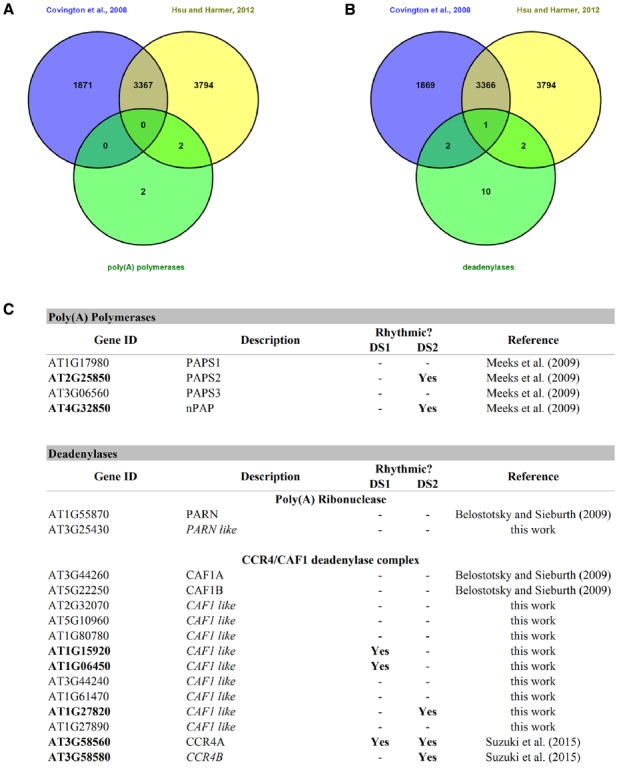
Rhythmic poly(A) polymerases and deadenylases in A. thaliana. (A) A Venn diagram between the two circadian datasets and the list of poly(A) polymerases. (B) A Venn diagram between two circadian datasets and the list of known deadenylases and others found by BlastP homology searches. (C) This table shows the rhythmic and arrhythmic poly(A) polymerases and deadenylases of A. thaliana. DS1 = Covington + Edwards dataset from Covington et al. (2008); DS2 = circadian dataset from Hsu and Harmer (2012).

References

    1. Addepalli B., Meeks L. R., Forbes K. P., Hunt A. G. (2004). Novel alternative splicing of mRNAs encoding poly(A) polymerases in Arabidopsis. Biochim. Biophys. Acta 1679, 117–128. 10.1016/j.bbaexp.2004.06.001 - DOI - PubMed
    1. Beckwith E. J., Yanovsky M. J. (2014). Circadian regulation of gene expression: at the crossroads of transcriptional and post-transcriptional regulatory networks. Curr. Opin. Genet. Dev. 27, 35–42. 10.1016/j.gde.2014.03.007 - DOI - PubMed
    1. Belostotsky D. A., Sieburth L. E. (2009). Kill the messenger: mRNA decay and plant development. Curr. Opin. Plant Biol. 12, 96–102. 10.1016/j.pbi.2008.09.003 - DOI - PubMed
    1. Brown S. A., Kowalska E., Dallmann R. (2012). (Re)inventing the circadian feedback loop. Dev. Cell 22, 477–487. 10.1016/j.devcel.2012.02.007 - DOI - PubMed
    1. Calixto C. P., Waugh R., Brown J. W. (2015). Evolutionary relationships among barley and Arabidopsis core circadian clock and clock-associated genes. J. Mol. Evol. 80, 108–119. 10.1007/s00239-015-9665-0 - DOI - PMC - PubMed

LinkOut - more resources