. 2015 Jul 1:8:35.
doi: 10.1186/s12920-015-0109-x.

Biomarker discovery: quantification of microRNAs and other small non-coding RNAs using next generation sequencing

Affiliations

Biomarker discovery: quantification of microRNAs and other small non-coding RNAs using next generation sequencing

Juan Pablo Lopez et al. BMC Med Genomics. .

Abstract

Background: Small ncRNAs (sncRNAs) offer great hope as biomarkers of disease and response to treatment. This has been highlighted in the context of several medical conditions such as cancer, liver disease, cardiovascular disease, and central nervous system disorders, among many others. Here we assessed several steps involved in the development of an ncRNA biomarker discovery pipeline, ranging from sample preparation to bioinformatic processing of small RNA sequencing data.

Methods: A total of 45 biological samples were included in the present study. All libraries were prepared using the Illumina TruSeq Small RNA protocol and sequenced using the HiSeq2500 or MiSeq Illumina sequencers. Small RNA sequencing data was validated using qRT-PCR. At each stage, we evaluated the pros and cons of different techniques that may be suitable for different experimental designs. Evaluation methods included quality of data output in relation to hands-on laboratory time, cost, and efficiency of processing.

Results: Our results show that good quality sequencing libraries can be prepared from small amounts of total RNA and that varying degradation levels in the samples do not have a significant effect on the overall quantification of sncRNAs via NGS. In addition, we describe the strengths and limitations of three commercially available library preparation methods: (1) Novex TBE PAGE gel; (2) Pippin Prep automated gel system; and (3) AMPure XP beads. We describe our bioinformatics pipeline, provide recommendations for sequencing coverage, and describe in detail the expression and distribution of all sncRNAs in four human tissues: whole-blood, brain, heart and liver.

Conclusions: Ultimately this study provides tools and outcome metrics that will aid researchers and clinicians in choosing an appropriate and effective high-throughput sequencing quantification method for various study designs, and overall generating valuable information that can contribute to our understanding of small ncRNAs as potential biomarkers and mediators of biological functions and disease.


Figures
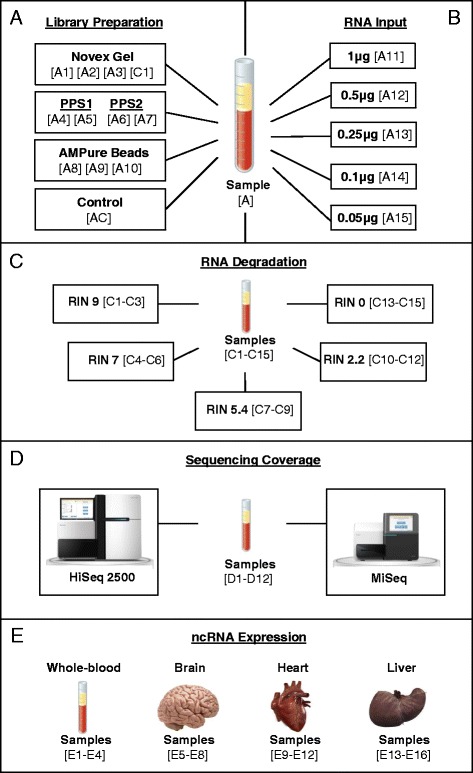
Fig. 1
Fig. 1
Illustration of study design and samples. Human biological samples (N = 45) were included in the present study. a Peripheral blood from a single individual was split into 11 aliquots (technical replicates) to test three different small RNA library purification methods: Novex TBE PAGE gel (N = 3), Pippin Prep automated gel system (PPS) (N = 4), and AMPure XP beads ((N = 3). Sample C1 (control-human brain) (N = 1), sample AC (control-no purification method) (N = 1). b Peripheral blood from a single individual was split into 5 aliquots (technical replicates) to test optimal amounts of RNA input: (1 μg), (0.5 μg), (0.25 μg), (0.1 μg), and (0.05 μg). All libraries were purified using the PPS system. c Peripheral blood samples from 15 healthy volunteers (biological replicates) to test the effects of RNA integrity. Samples were split into 5 groups (N = 3) with average RIN values of 9, 7, 5.4, 2.2 and 0. All libraries were purified using AMPure XP beads. d Peripheral blood samples from 12 healthy volunteers (biological replicates) to test effects of sequencing coverage. Samples sequenced on both a HiSeq2500 (N = 12) and MiSeq (N = 12) Illumina sequencers. All libraries were purified using AMPure XP beads. e Human whole-blood (N = 4), brain (N = 4), heart (N = 4) and liver (N = 4) tissues to test expression and tissue specificity of small ncRNAs. All libraries were purified using AMPure XP beads
Fig. 2
Fig. 2
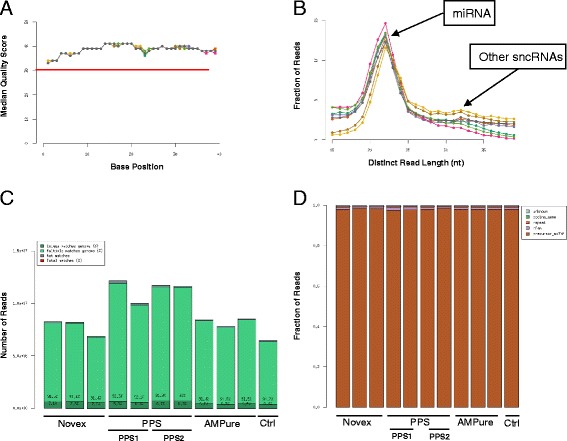
Quality control (QC) data (A1-A10). a Mean quality value scores over 40nts. b Distribution of reads based on length (19–25 nt, microRNAs) (30–35 nt, other sncRNAs). c-d Total number of reads, mapping percentages, and fraction of reads mapping RNA species
Fig. 3
Fig. 3
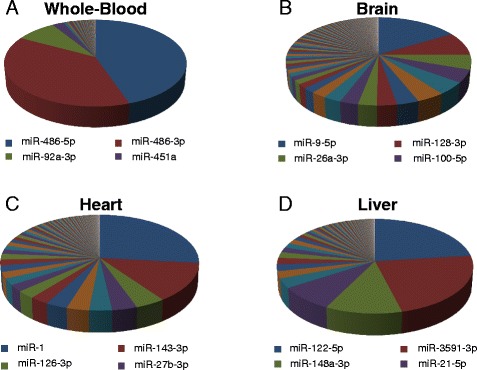
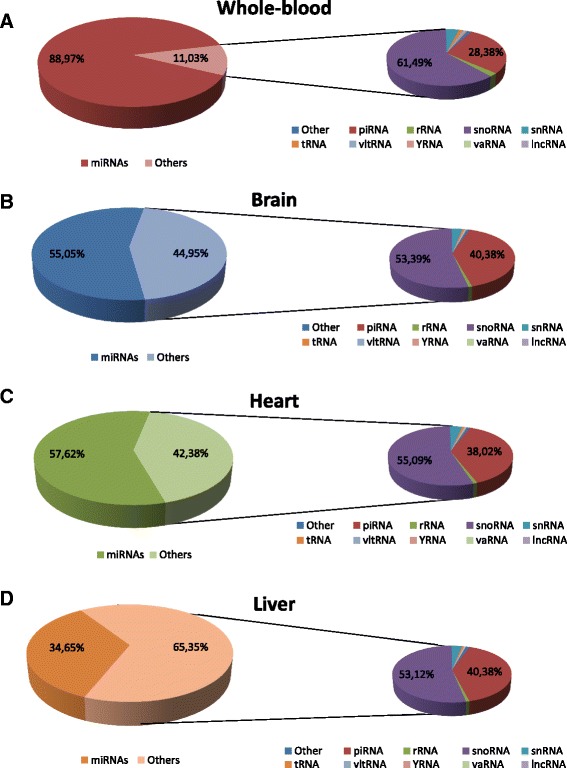
Expression of miRNAs in four human samples. Pie graph showing: a Whole-blood. b Brain. c Heart. d Liver
Fig. 4
Fig. 4
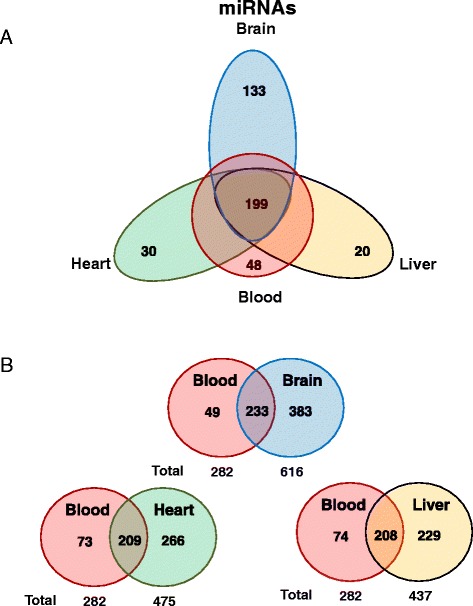
Tissue-specific patterns of expression of mi RNAs in human samples. Venn diagram showing: a Whole-blood vs. Brain vs. Heart vs. Liver. b Co-expression levels of miRNAs between whole-blood and other tissues
Fig. 5
Fig. 5
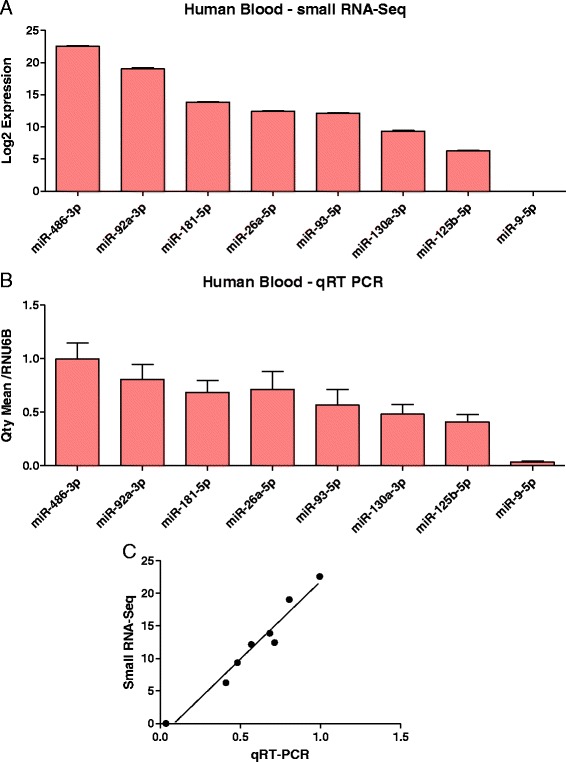
MicroRNA expression. a Bar graph showing small RNA sequencing Log2 expression of eight miRNAs in human whole-blood. b qRT-PCR validation. c Correlation of small RNA sequencing and qRT-PCR expression levels
Fig. 6
Fig. 6
Expression and distribution of other small non-coding RNAs in four human samples. Pie graph showing: a Whole-blood. b Brain. c Heart. d Liver
Fig. 7
Fig. 7
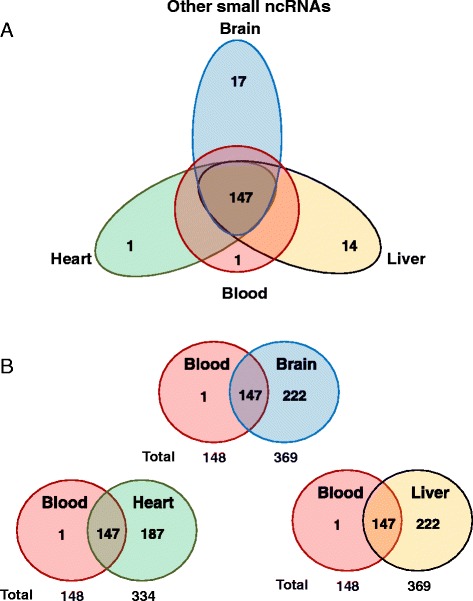
Tissue-specific patterns of expression of other small non-coding RNAs in human samples. Venn diagram showing: a Whole-blood vs. Brain vs. Heart vs. Liver. b Co-expression levels of miRNAs between whole-blood and other tissues

References

    1. Hampel H, Frank R, Broich K, Teipel SJ, Katz RG, Hardy J, et al. Biomarkers for Alzheimer’s disease: academic, industry and regulatory perspectives. Nat Rev Drug Discov. 2010;9(7):560–74. doi: 10.1038/nrd3115. - DOI - PubMed
    1. Shaw LM, Korecka M, Clark CM, Lee VM, Trojanowski JQ. Biomarkers of neurodegeneration for diagnosis and monitoring therapeutics. Nat Rev Drug Discov. 2007;6(4):295–303. doi: 10.1038/nrd2176. - DOI - PubMed
    1. Davis J, Maes M, Andreazza A, McGrath JJ, Tye SJ, Berk M. Towards a classification of biomarkers of neuropsychiatric disease: from encompass to compass. Mol Psychiatry. 2014 - PubMed
    1. Strimbu K, Tavel JA. What are biomarkers? Curr Opin HIV AIDS. 2010;5(6):463–6. doi: 10.1097/COH.0b013e32833ed177. - DOI - PMC - PubMed
    1. Liu Z, Que S, Xu J, Peng T. Alanine aminotransferase-old biomarker and new concept: a review. Int J Med Sci. 2014;11(9):925–35. doi: 10.7150/ijms.8951. - DOI - PMC - PubMed

Publication types