


CD4:CD8 ratio as a frontier marker for clinical outcome, immune dysfunction and viral reservoir size in virologically suppressed HIV-positive patients
- PMID: 26130226
- PMCID: PMC4486418
- DOI: 10.7448/IAS.18.1.20052
CD4:CD8 ratio as a frontier marker for clinical outcome, immune dysfunction and viral reservoir size in virologically suppressed HIV-positive patients
Abstract
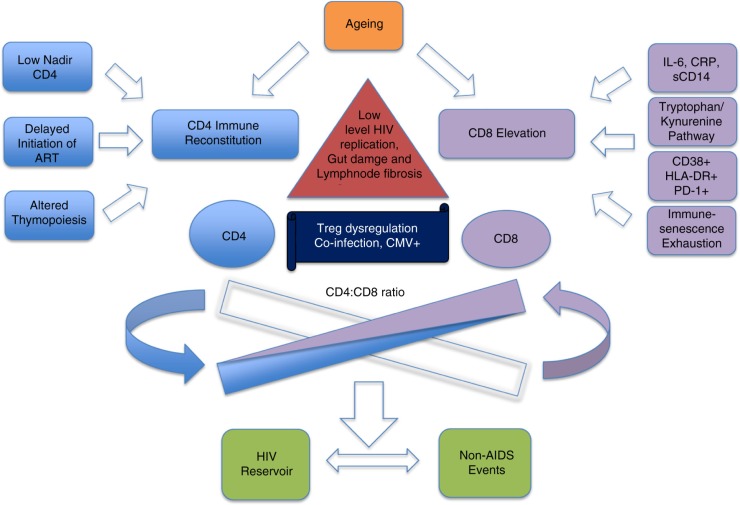
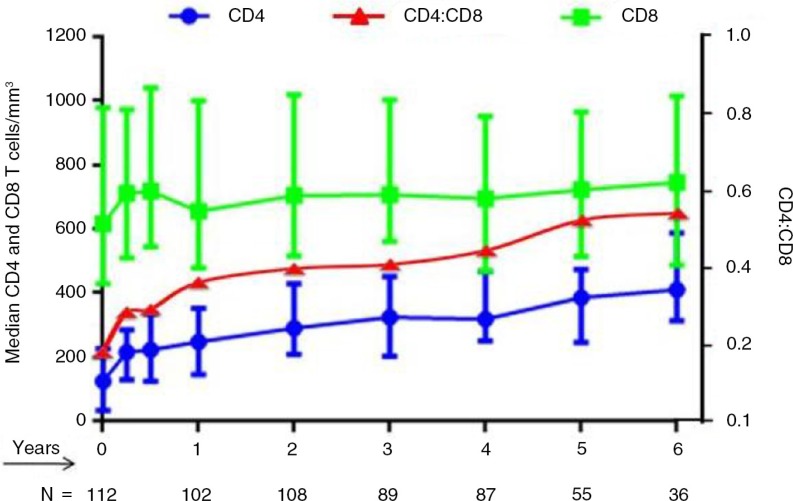
Introduction: Absolute CD4 T cell count and plasma viral load have been established as predictors of HIV disease progression, and CD4 T cell count is used as an indicator for initiation of antiretroviral therapy. Following long-term therapy, patients generally present with significant CD4 T cell recovery contrasting with persistently elevated CD8 T cell counts, which leads to a partial restoration of CD4:CD8 ratio. This review focuses on the relevance of the CD4:CD8 ratio on clinical outcomes, immune dysfunction and HIV reservoir size in long-term treated patients.
Method: We conducted a comprehensive literature review of publications in English language using major electronic databases. Our search was focused on factors contributing to CD4:CD8 T cell ratio and clinical outcome in adult HIV-positive patients in the context of treated infection.
Discussion: Low CD4:CD8 ratio has been linked to ageing and acts as a predictor of mortality in the general population. This ratio may represent the combined effects of inflammation and immunological changes called "inflammaging." Although the mechanisms underlying partial correction of the CD4:CD8 ratio and persistently elevated CD8 T cell count in long-term treated patients remain poorly understood, it has been recently indicated that patients with optimal CD4 T cell recovery and low CD4:CD8 ratio still harbour increased immune activation, an immune senescent phenotype and have a higher risk of non-AIDS morbidity and mortality. This review reconsiders CD4:CD8 ratio in the light of advances in the understanding of immune dysfunction and examines its pathophysiological features and implications on clinical outcome and HIV reservoir size in long-term treated HIV-positive adults.
Conclusion: The CD4:CD8 ratio can contribute to the immunological evaluation of treated patients in a long-term follow-up and may be applied for monitoring both immune dysfunction and viral reservoir size in immune-based clinical trials.
Keywords: CD4:CD8 ratio; HIV infection; immune dysfunction; inflammation; viral reservoir.
Figures
References
-
- Frazer IH, Mackay IR, Crapper RM, Jones B, Gust ID, Sarngadharan MG, et al. Immunological abnormalities in asymptomatic homosexual men: correlation with antibody to HTLV-III and sequential changes over two years. Q J Med. 1986;61(234):921–33. - PubMed
Publication types
MeSH terms
Substances
Grants and funding
LinkOut - more resources
Full Text Sources
Other Literature Sources
Medical
Research Materials
