


Haploidentical transplant with posttransplant cyclophosphamide vs matched unrelated donor transplant for acute myeloid leukemia
- PMID: 26130705
- PMCID: PMC4543223
- DOI: 10.1182/blood-2015-04-639831
Haploidentical transplant with posttransplant cyclophosphamide vs matched unrelated donor transplant for acute myeloid leukemia
Abstract
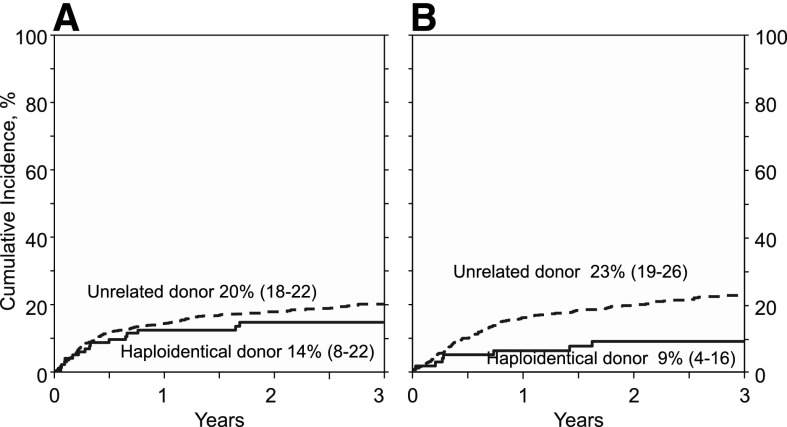
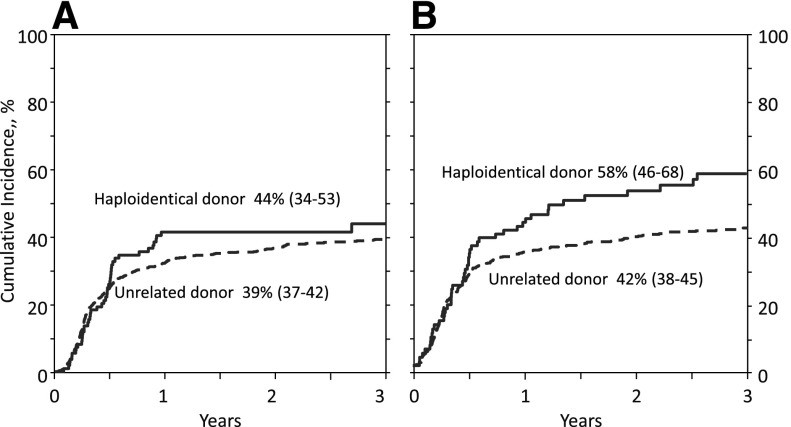
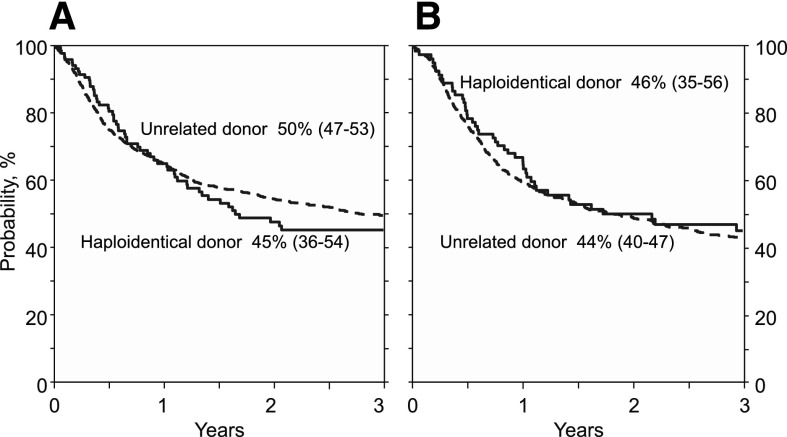
We studied adults with acute myeloid leukemia (AML) after haploidentical (n = 192) and 8/8 HLA-matched unrelated donor (n = 1982) transplantation. Haploidentical recipients received calcineurin inhibitor (CNI), mycophenolate, and posttransplant cyclophosphamide for graft-versus-host disease (GVHD) prophylaxis; 104 patients received myeloablative and 88 received reduced intensity conditioning regimens. Matched unrelated donor transplant recipients received CNI with mycophenolate or methotrexate for GVHD prophylaxis; 1245 patients received myeloablative and 737 received reduced intensity conditioning regimens. In the myeloablative setting, day 30 neutrophil recovery was lower after haploidentical compared with matched unrelated donor transplants (90% vs 97%, P = .02). Corresponding rates after reduced intensity conditioning transplants were 93% and 96% (P = .25). In the myeloablative setting, 3-month acute grade 2-4 (16% vs 33%, P < .0001) and 3-year chronic GVHD (30% vs 53%, P < .0001) were lower after haploidentical compared with matched unrelated donor transplants. Similar differences were observed after reduced intensity conditioning transplants, 19% vs 28% (P = .05) and 34% vs 52% (P = .002). Among patients receiving myeloablative regimens, 3-year probabilities of overall survival were 45% (95% CI, 36-54) and 50% (95% CI, 47-53) after haploidentical and matched unrelated donor transplants (P = .38). Corresponding rates after reduced intensity conditioning transplants were 46% (95% CI, 35-56) and 44% (95% CI, 0.40-47) (P = .71). Although statistical power is limited, these data suggests that survival for patients with AML after haploidentical transplantation with posttransplant cyclophosphamide is comparable with matched unrelated donor transplantation.
Figures
References
-
- Appelbaum FR. Hematology Am Soc Hematol Educ Program. 2008. Allogeneic hematopoietic cell transplantation for acute myeloid leukemia when a matched related donor is not available. pp. 2008:412–417. - PubMed
-
- Petersdorf EW, Anasetti C, Martin PJ, et al. Limits of HLA mismatching in unrelated hematopoietic cell transplantation. Blood. 2004;104(9):2976–2980. - PubMed
Publication types
MeSH terms
Substances
Grants and funding
LinkOut - more resources
Full Text Sources
Other Literature Sources
Medical
Research Materials
