


Anti-mullerian hormon level and polycystic ovarian syndrome diagnosis
- PMID: 26131012
- PMCID: PMC4475772
Anti-mullerian hormon level and polycystic ovarian syndrome diagnosis
Abstract
Background: Polycystic ovarian syndrome (PCOS) is a common endocrinopathy that accompanied with long term complications. The early diagnosis of this syndrome can prevent it.
Objective: The aim was to determine the role of anti-mullerian hormon (AMH) in PCOS diagnosis and to find cut off level of it.
Materials and methods: In this cross sectional study, 117 women between 20-40 years old were participated in two groups: 60 PCOS women (based on Rotterdam criteria consensus) as the case group and 57 normal ovulatory women as the control group. In day 2-4 of cycle, transvaginal sonography was performed and serum hormonal level of AMH, luteinizing hormone (LH), follicle stimulating hormone (FSH), estradiol (E2), testosterone, fasting blood sugar (FBS), thyroid stimulating hormone (TSH), and prolactin (PRL) were measured in all of participants. For all of them score of hirsutism (base on Freeman-Galloway scoring) was determined.
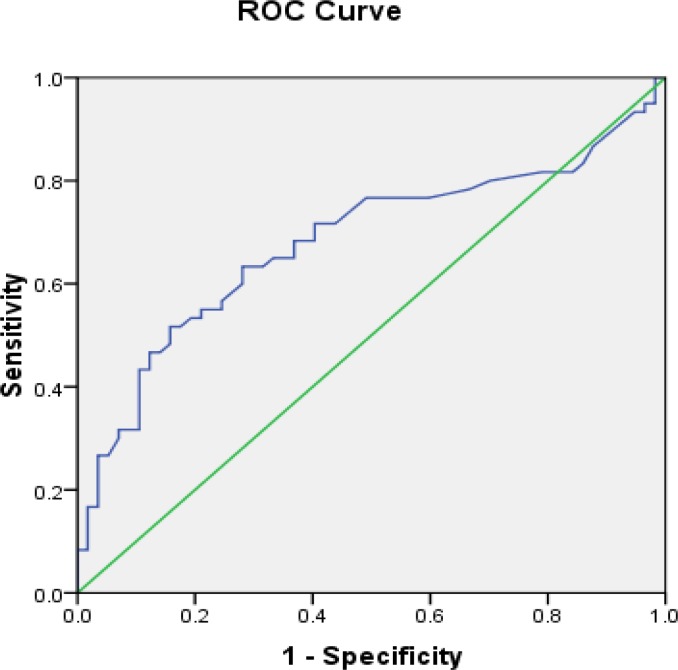
Results: There were statistically significant in irregular pattern of menstruation, AMH and FSH level, and presence of hirsutism between two groups. But regarding mean of age, body mass index, plasma level of PRL, TSH, LH, Testosterone, FBS, and E2 differences were not significant. Construction by ROC curve present 3.15 ng/ml as AMH cut off with 70.37% sensitivity and 77.36% specificity in order to PCOS diagnosis.
Conclusion: AMH with cut off level of 3.15 ng/ml with sensitivity 70.37% and specificity 77.36% could use for early diagnosis of PCOS patients.
Keywords: Anti-mullerian hormon; Hirsutism; Polycystic ovarian syndrome; Rotterdam criteria.
Figures
References
-
- Norman RJ, Dewailly D, Legro RS, Hickey TE. Polycystic ovary syndrome. Lancet. 2007;370:685–697. - PubMed
-
- Welt CK, Gudmundsson JA, Arason G, Adams J, Palsdottir H, Gudlaugsdottir G, et al. Characterizing discrete subsets of polycystic ovary syndrome as defined by the Rotterdam criteria: the impact of weight on phenotype and metabolic features. J Clin Endocrinol Metab. 2006;91:4842–4848. - PubMed
-
- Azziz R, Carmina E, Dewailly D, Diamanti-Kandarakis E, Escobar-Morreale HF, Futterweit W, et al. Position statement: criteria for defining polycystic ovary syndrome as a predominantly hyperandrogenic syndrome: an Androgen Excess Society guideline. J Clin Endocrinol Metab. 2006;91:4237–4245. - PubMed
-
- Weenen C, Laven JS, Von Bergh AR, Cranfield M, Groome NP, Visser JA, et al. Anti-Mullerian hormone expression pattern in the human ovary: potential implications for initial and cyclic follicle recruitment. Mol Hum Reprod. 2004;10:77–83. - PubMed
-
- Pigny P, Merlen E, Robert Y, Cortet-Rudelli C, Decanter C, Jonard S, et al. Elevated serum level of anti-Mullerian hormone in patients with polycystic ovary syndrome: relationship to the ovarian follicle excess and to the follicular arrest. J Clin Endocrinol Metab. 2003;88:5957–5962. - PubMed
LinkOut - more resources
Full Text Sources