


Do Children and Adolescents with Anorexia Nervosa Display an Inefficient Cognitive Processing Style?
- PMID: 26133552
- PMCID: PMC4489794
- DOI: 10.1371/journal.pone.0131724
Do Children and Adolescents with Anorexia Nervosa Display an Inefficient Cognitive Processing Style?
Abstract
Objective: This study aimed to examine neuropsychological processing in children and adolescents with Anorexia Nervosa (AN). The relationship of clinical and demographic variables to neuropsychological functioning within the AN group was also explored.
Method: The performance of 41 children and adolescents with a diagnosis of AN were compared to 43 healthy control (HC) participants on a number of neuropsychological measures.
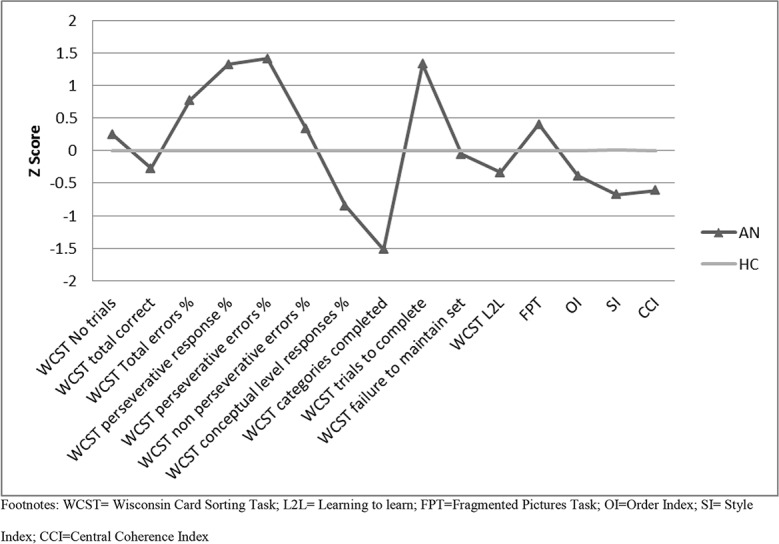
Results: There were no differences in IQ between AN and HC groups. However, children and adolescents with AN displayed significantly more perseverative errors on the Wisconsin Card Sorting Test, and lower Style and Central Coherence scores on the Rey Osterrieth Complex Figure Test relative to HCs.
Conclusion: Inefficient cognitive processing in the AN group was independent of clinical and demographic variables, suggesting it might represent an underlying trait for AN. The implications of these findings are discussed.
Conflict of interest statement
Figures
References
-
- Hay P, Chinn D, Forbes D, Madden S, Newton R, Sugenor L, et al. Royal Australian and New Zealand College of Psychiatrists clinical practice guidelines for the treatment of eating disorders. Australian and New Zealand Journal of Psychiatry. 2014;48(11):977–1008. 10.1177/0004867414555814 - DOI - PubMed
-
- Lezak MD, Howieson DB, Bigler ED, Tranel D. Neuropsychological Assessment: OUP; USA; 2012.
Publication types
MeSH terms
LinkOut - more resources
Full Text Sources
Other Literature Sources
