


Planning and reporting of quality-of-life outcomes in cancer trials
- PMID: 26133966
- PMCID: PMC4551161
- DOI: 10.1093/annonc/mdv283
Planning and reporting of quality-of-life outcomes in cancer trials
Erratum in
-
Planning and reporting of quality-of-life outcomes in cancer trials.Ann Oncol. 2016 Jan;27(1):209. doi: 10.1093/annonc/mdv559. Epub 2015 Nov 25. Ann Oncol. 2016. PMID: 26612098 Free PMC article. No abstract available.
Abstract
Background: Information about the impact of cancer treatments on patients' quality of life (QoL) is of paramount importance to patients and treating oncologists. Cancer trials that do not specify QoL as an outcome or fail to report collected QoL data, omit crucial information for decision making. To estimate the magnitude of these problems, we investigated how frequently QoL outcomes were specified in protocols of cancer trials and subsequently reported.
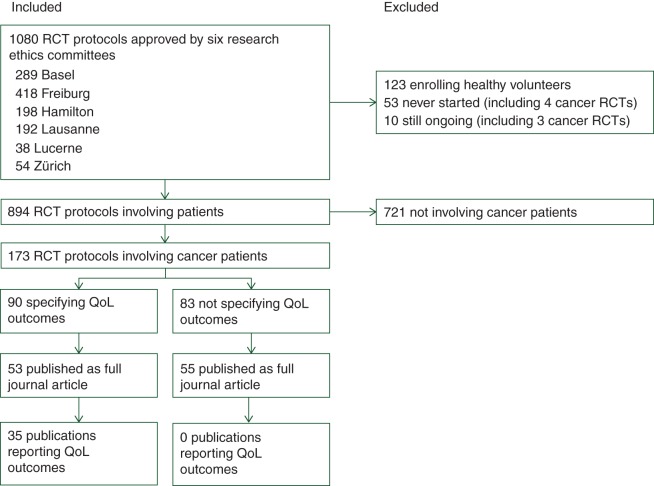
Design: Retrospective cohort study of RCT protocols approved by six research ethics committees in Switzerland, Germany, and Canada between 2000 and 2003. We compared protocols to corresponding publications, which were identified through literature searches and investigator surveys.
Results: Of the 173 cancer trials, 90 (52%) specified QoL outcomes in their protocol, 2 (1%) as primary and 88 (51%) as secondary outcome. Of the 173 trials, 35 (20%) reported QoL outcomes in a corresponding publication (4 modified from the protocol), 18 (10%) were published but failed to report QoL outcomes in the primary or a secondary publication, and 37 (21%) were not published at all. Of the 83 (48%) trials that did not specify QoL outcomes in their protocol, none subsequently reported QoL outcomes. Failure to report pre-specified QoL outcomes was not associated with industry sponsorship (versus non-industry), sample size, and multicentre (versus single centre) status but possibly with trial discontinuation.
Conclusions: About half of cancer trials specified QoL outcomes in their protocols. However, only 20% reported any QoL data in associated publications. Highly relevant information for decision making is often unavailable to patients, oncologists, and health policymakers.
Keywords: cohort studies; ethics committees; neoplasms; publication bias; quality of life; randomized controlled trials as topic.
© The Author 2015. Published by Oxford University Press on behalf of the European Society for Medical Oncology. All rights reserved. For permissions, please email: journals.permissions@oup.com.
Figures
References
-
- Basch E, Abernethy AP, Mullins CD et al. . Recommendations for incorporating patient-reported outcomes into clinical comparative effectiveness research in adult oncology. J Clin Oncol 2012; 30(34): 4249–4255. - PubMed
-
- Lipscomb J, Gotay CC, Snyder CF. Patient-reported outcomes in cancer: a review of recent research and policy initiatives. CA Cancer J Clin 2007; 57(5): 278–300. - PubMed
-
- Luckett T, King MT, Butow PN et al. . Choosing between the EORTC QLQ-C30 and FACT-G for measuring health-related quality of life in cancer clinical research: issues, evidence and recommendations. Ann Oncol 2011; 22(10): 2179–2190. - PubMed
-
- King MT, Bell ML, Costa D et al. . The Quality of Life Questionnaire Core 30 (QLQ-C30) and Functional Assessment of Cancer-General (FACT-G) differ in responsiveness, relative efficiency, and therefore required sample size. J Clin Epidemiol 2014; 67(1): 100–107. - PubMed
-
- Conter HJMD, Ruchira Sengupta MAS, Devidas Menon PD et al. . Current use of health-related quality of life outcomes in advanced-stage lung cancer clinical trials. Univ Tor Med J 2011; 88(2): 91–98.
Publication types
MeSH terms
LinkOut - more resources
Full Text Sources
Other Literature Sources
