


Evidence of a Causal Association Between Insulinemia and Endometrial Cancer: A Mendelian Randomization Analysis
- PMID: 26134033
- PMCID: PMC4572886
- DOI: 10.1093/jnci/djv178
Evidence of a Causal Association Between Insulinemia and Endometrial Cancer: A Mendelian Randomization Analysis
Abstract
Background: Insulinemia and type 2 diabetes (T2D) have been associated with endometrial cancer risk in numerous observational studies. However, the causality of these associations is uncertain. Here we use a Mendelian randomization (MR) approach to assess whether insulinemia and T2D are causally associated with endometrial cancer.
Methods: We used single nucleotide polymorphisms (SNPs) associated with T2D (49 variants), fasting glucose (36 variants), fasting insulin (18 variants), early insulin secretion (17 variants), and body mass index (BMI) (32 variants) as instrumental variables in MR analyses. We calculated MR estimates for each risk factor with endometrial cancer using an inverse-variance weighted method with SNP-endometrial cancer associations from 1287 case patients and 8273 control participants.
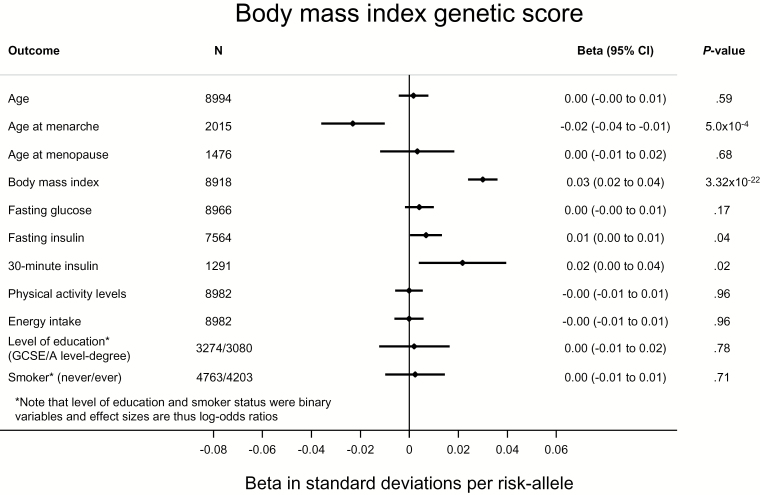
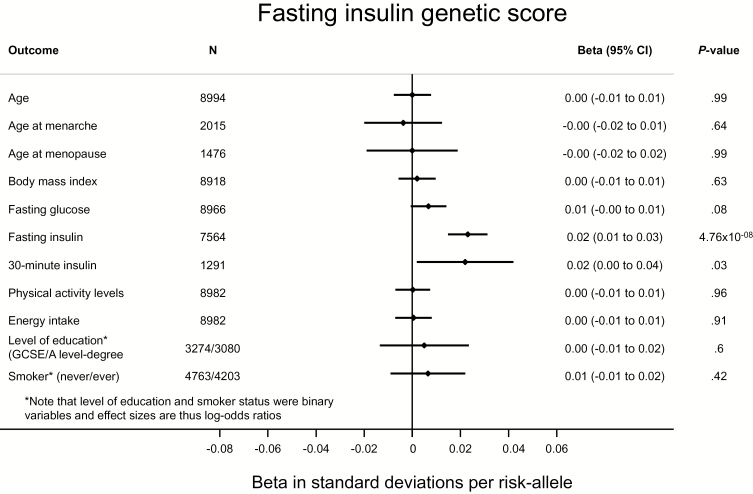
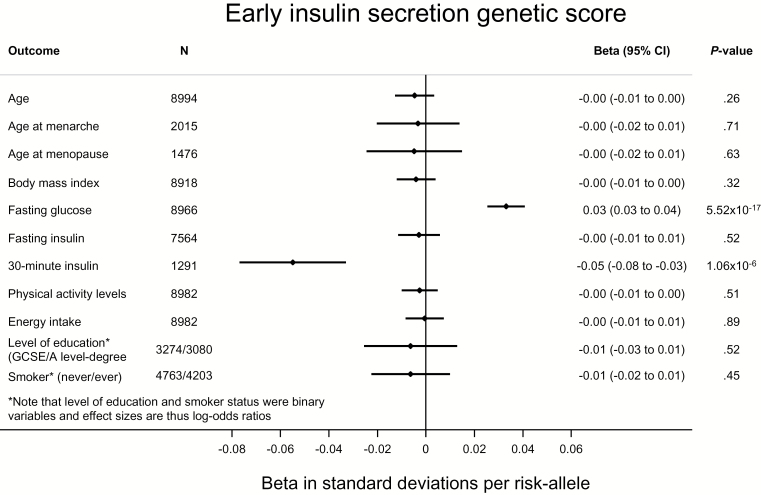
Results: Genetically predicted higher fasting insulin levels were associated with greater risk of endometrial cancer (odds ratio [OR] per standard deviation = 2.34, 95% confidence internal [CI] = 1.06 to 5.14, P = .03). Consistently, genetically predicted higher 30-minute postchallenge insulin levels were also associated with endometrial cancer risk (OR = 1.40, 95% CI = 1.12 to 1.76, P = .003). We observed no associations between genetic risk of type 2 diabetes (OR = 0.91, 95% CI = 0.79 to 1.04, P = .16) or higher fasting glucose (OR = 1.00, 95% CI = 0.67 to 1.50, P = .99) and endometrial cancer. In contrast, endometrial cancer risk was higher in individuals with genetically predicted higher BMI (OR = 3.86, 95% CI = 2.24 to 6.64, P = 1.2x10(-6)).
Conclusion: This study provides evidence to support a causal association of higher insulin levels, independently of BMI, with endometrial cancer risk.
© The Author 2015. Published by Oxford University Press.
Figures
Comment in
-
Progress in Vulvar and Endometrial Cancers: Exploiting Anatomy and Biology and Improving Systemic Therapy.Int J Radiat Oncol Biol Phys. 2016 Sep 1;96(1):1-5. doi: 10.1016/j.ijrobp.2016.02.048. Int J Radiat Oncol Biol Phys. 2016. PMID: 27511840 No abstract available.
References
-
- Zimmet P, Alberti KG, Shaw J. Global and societal implications of the diabetes epidemic. Nature. 2001;414 (6865):782–787. - PubMed
-
- Chen L, Magliano DJ, Zimmet PZ. The worldwide epidemiology of type 2 diabetes mellitus--present and future perspectives. Nat Rev Endocrinol. 2012;8 (4):228–236. - PubMed
-
- Kaaks R, Lukanova A. Energy balance and cancer: the role of insulin and insulin-like growth factor-I. Proc Nutr Soc. 2001;60 (1):91–106. - PubMed
Publication types
MeSH terms
Substances
Grants and funding
- G0000934/MRC_/Medical Research Council/United Kingdom
- 068545/Z/02/WT_/Wellcome Trust/United Kingdom
- 16565/CRUK_/Cancer Research UK/United Kingdom
- MC_U106179471/MRC_/Medical Research Council/United Kingdom
- MC_U106179472/MRC_/Medical Research Council/United Kingdom
- 16563/CRUK_/Cancer Research UK/United Kingdom
- 100574/WT_/Wellcome Trust/United Kingdom
- MC_UU_12015/1/MRC_/Medical Research Council/United Kingdom
- C490/A10124/CRUK_/Cancer Research UK/United Kingdom
- MC_UU_12015/2/MRC_/Medical Research Council/United Kingdom
- 098498/WT_/Wellcome Trust/United Kingdom
- 085475/WT_/Wellcome Trust/United Kingdom
- 10119/CRUK_/Cancer Research UK/United Kingdom
- 16561/CRUK_/Cancer Research UK/United Kingdom
- 10124/CRUK_/Cancer Research UK/United Kingdom
LinkOut - more resources
Full Text Sources
Other Literature Sources
Medical
