. 2015 Jul 1;35(26):9568-79.
doi: 10.1523/JNEUROSCI.5061-14.2015.

Explicit and Implicit Processes Constitute the Fast and Slow Processes of Sensorimotor Learning

Affiliations

Explicit and Implicit Processes Constitute the Fast and Slow Processes of Sensorimotor Learning

Samuel D McDougle et al. J Neurosci. .

Abstract

A popular model of human sensorimotor learning suggests that a fast process and a slow process work in parallel to produce the canonical learning curve (Smith et al., 2006). Recent evidence supports the subdivision of sensorimotor learning into explicit and implicit processes that simultaneously subserve task performance (Taylor et al., 2014). We set out to test whether these two accounts of learning processes are homologous. Using a recently developed method to assay explicit and implicit learning directly in a sensorimotor task, along with a computational modeling analysis, we show that the fast process closely resembles explicit learning and the slow process approximates implicit learning. In addition, we provide evidence for a subdivision of the slow/implicit process into distinct manifestations of motor memory. We conclude that the two-state model of motor learning is a close approximation of sensorimotor learning, but it is unable to describe adequately the various implicit learning operations that forge the learning curve. Our results suggest that a wider net be cast in the search for the putative psychological mechanisms and neural substrates underlying the multiplicity of processes involved in motor learning.

Keywords: adaptation; cerebellum; explicit learning; motor control; motor learning; reaching.


Figures

Figure 1.
Figure 1.
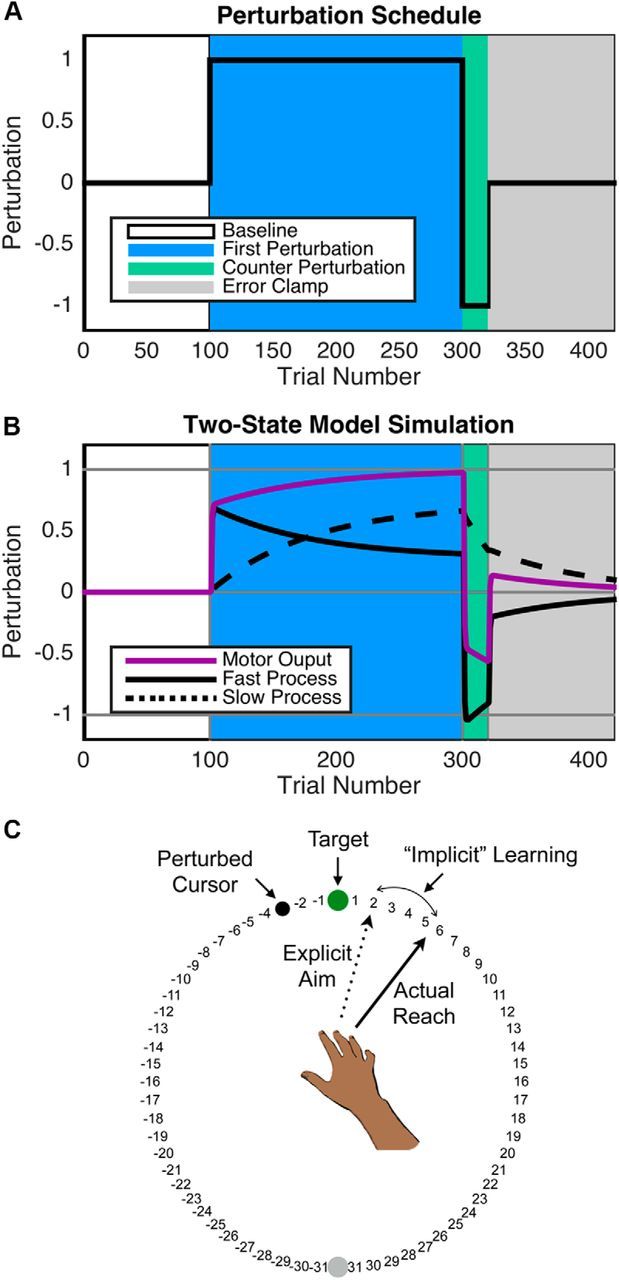
A, Perturbation schedule for all experiments, similar to Smith et al. (2006). Perturbations are normalized at 1/−1 for illustrative purposes. There were no perturbations in the baseline block (white), clockwise perturbations in the R1/F1 block (blue), counterclockwise perturbations in the R2/F2 block (green), and error clamp in the EC block (gray). B, Simulations of the two-state model of sensorimotor learning. Note that the fast process (solid black line) learns at a fast rate but has low retention and the slow process (dashed black line) learns at a slow rate but has high retention. Motor output was defined as the combination of the fast and slow process (purple line). C, Task display. In the Report conditions, participants verbally report, before each movement, where they planned to aim to make the cursor land on the target. In the Report condition of Experiment 1, the numbers are displayed in a 180° arc. In all experiments, participant's vision of their hand was occluded.
Figure 2.
Figure 2.
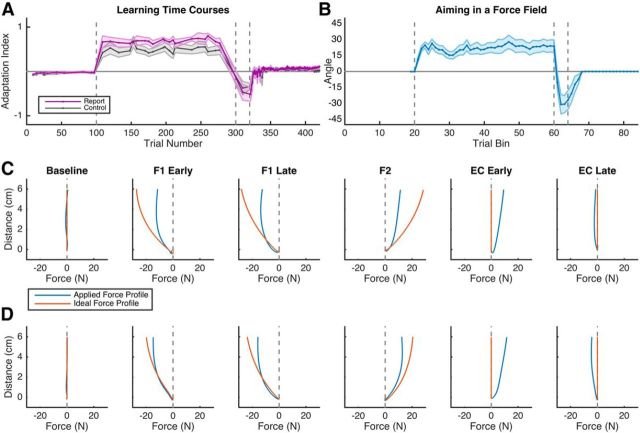
Experiment 1 behavioral results. A, Adaptation index for the error clamp trials. Note that participants rapidly flip the sign of their applied force during F2 and show rebound of forces appropriate for F1 during the EC epochs. B, Participants in the Report condition report aiming directions that are appropriate to the applied forces in both the F1 and F2 epochs and quickly decay to 0° of aiming in the EC epoch. C, D, Averaged participant force profiles (blue) and ideal force profiles (red) for both the Control (C) and Report (D) conditions during selected error-clamp trials throughout the blocks of the task. The ideal force profile for a trial was computed by taking the participant's reach velocity at each time point and calculating the ideal force needed to counter perfectly the perturbation given that velocity. Shading represents SEM.
Figure 3.
Figure 3.
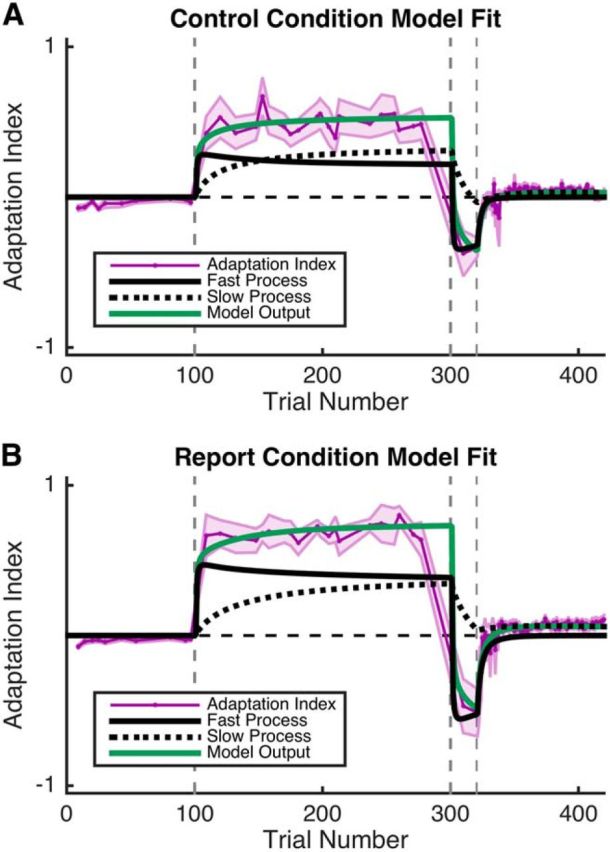
Experiment 1 model fitting. The two-state model was fit to each participant in both the Control (A) and Report (B) conditions. The output of the model (green line) was fit to each participant's adaptation index data (purple). Also depicted are the fast (solid black line) and slow (dashed black line) processes implied by the fits. Shading represents SEM.
Figure 4.
Figure 4.
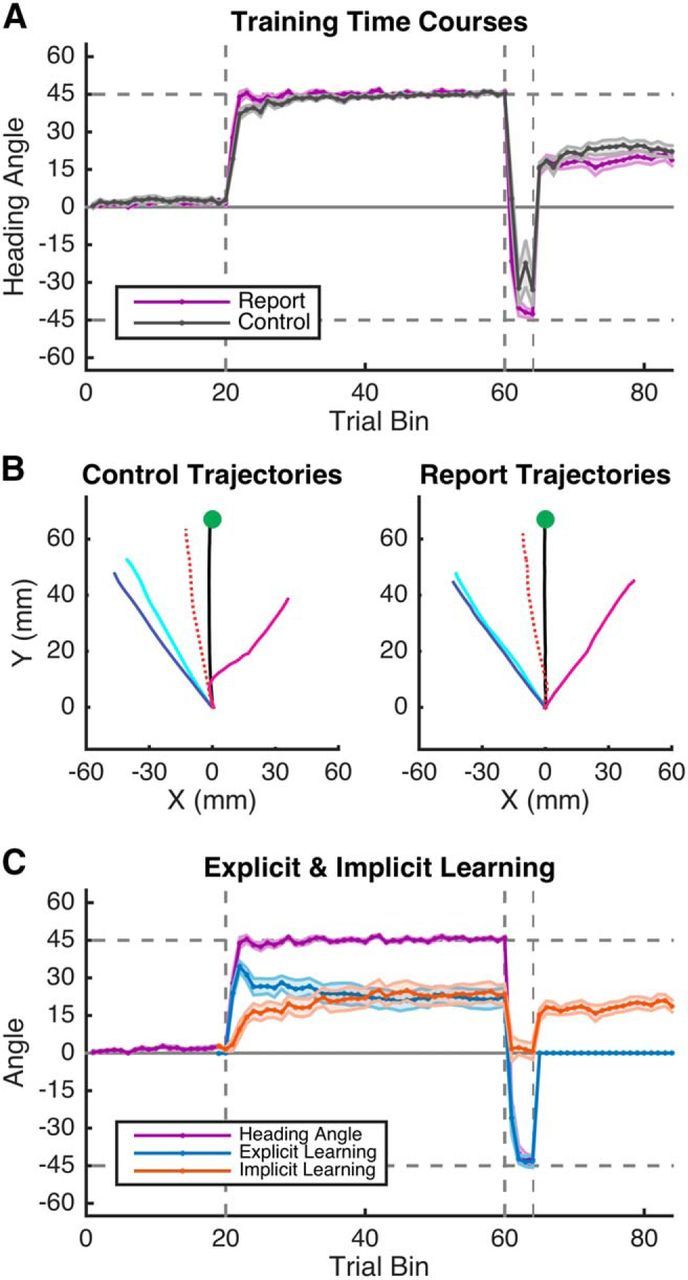
Experiment 2 behavioral results. A, Averaged hand heading angles for both groups binned by five trials. Participants in both the Report (purple) and Control (black) conditions learn the first 45° clockwise rotation (R1), then the 45° counterclockwise rotation (R2), and subsequently show rebound back to the first rotation during the error-clamp block (EC). B, Reach trajectories during interspersed error clamps. Participants in both conditions show accurate baseline performance (BL, black), robust early R1 learning (ER1, cyan), late R1 learning (LR1, blue), R2 learning (R2, magenta), and early EC epoch rebound (EC, red dashed). C, Explicit aiming and implicit learning in the Report condition. Participants showed both explicit (blue) and implicit (red) learning components of measured heading angles (purple). Implicit learning is estimated through a subtraction of aiming direction from heading angle. Participants are instructed to aim directly to the target for the EC epoch. Note that heading angle (purple) and implicit learning (red) are equivalent in the EC epoch. Shading represents SEM.
Figure 5.
Figure 5.
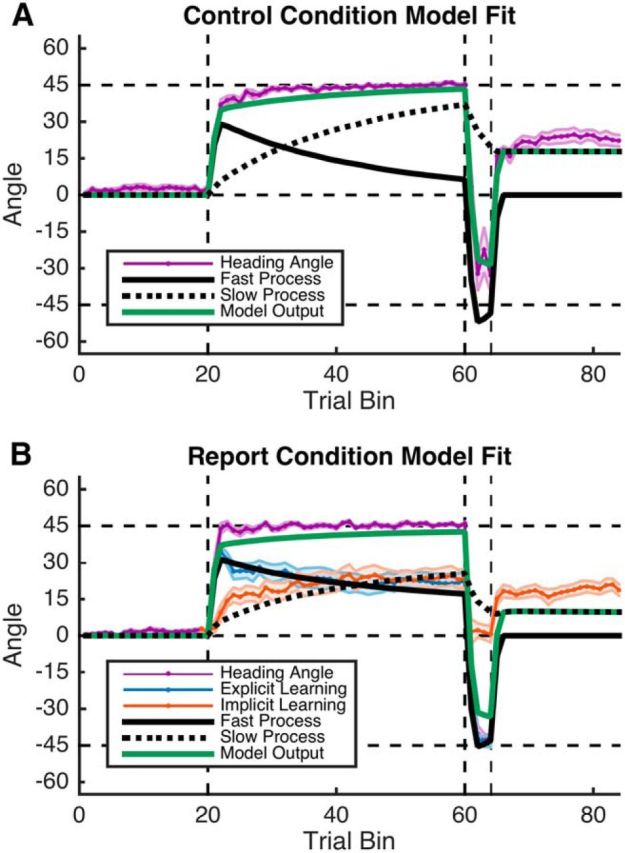
Experiment 2 model fitting. The two-state model (see Materials and Methods) was fit to both conditions. A, In the Control condition, the total model output (green line) was fit to participant's mean heading angle data (purple). Implied fast (solid black line) and slow processes (dashed black line) of the model fit are also depicted. B, In the Report condition, the fast and slow processes of the model were fit individually to each participant's respective explicit (blue) and implicit (red) learning data. Here, the model captures R1 behavior but fails to capture all implicit learning in the R2 epoch and undershoots the rebound in the EC epoch. Shading represents SEM.
Figure 6.
Figure 6.
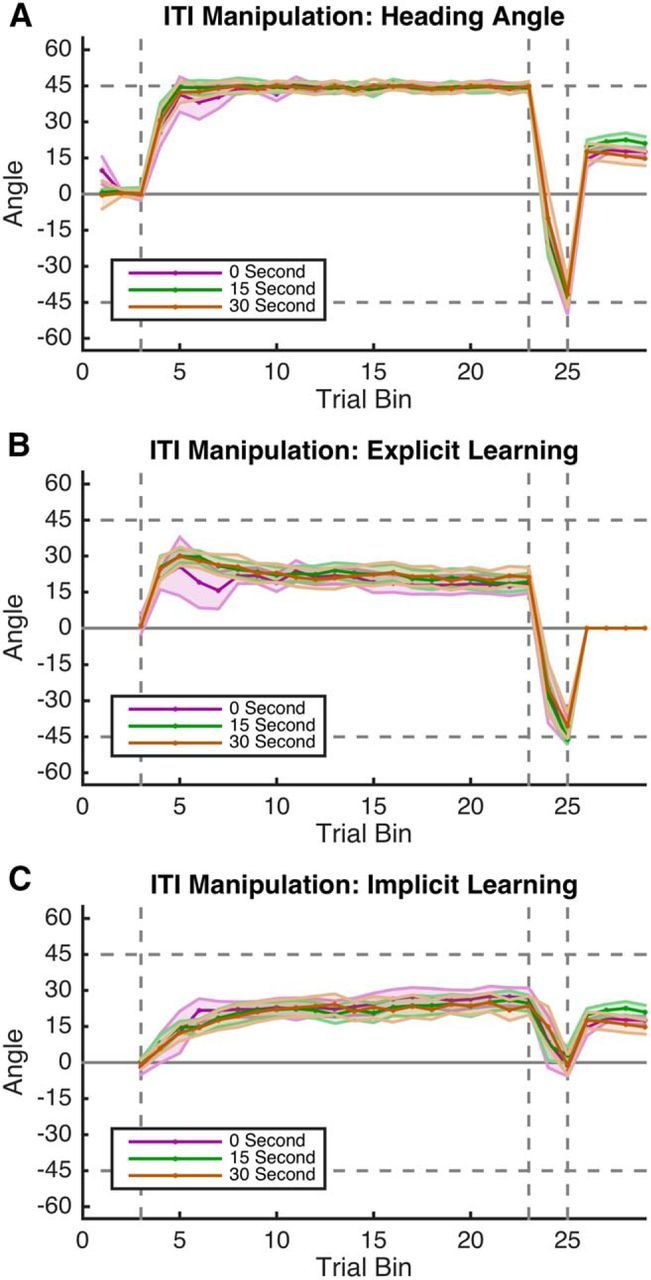
Experiment 3 behavior. A, Averaged hand heading angles, B, C, Explicit aiming (blue; B) and implicit learning (red; C) for the three conditions of Experiment 3. All three ITI conditions show remarkably similar learning. Shading represents SEM.
Figure 7.
Figure 7.
Experiment 4 behavior and model fitting. A, In the Full condition, implicit learning (red) was low relative to the Partial condition, but rebound was continuous with R2 learning. The fast and slow processes of the model were fit individually to explicit (blue) and implicit (red) learning data. B, In the Partial condition, implicit learning (red) echoed that of the various single-target groups of Experiments 2 and 3, with a higher rebound than predicted by a single monotonic implicit learning process. The fast and slow processes of the model were fit individually to explicit (blue) and implicit (red) learning data. C, Superimposed implicit learning curves from the Partial (green) and Full (brown) conditions. Shading represents SEM.

References

    1. Albert MV, Catz N, Thier P, Kording K. Saccadic gain adaptation is predicted by the statistics of natural fluctuations in oculomotor function. Front Comput Neurosci. 2012;6:96. - PMC - PubMed
    1. Ashby FG, Maddox WT. Human category learning. Annu Rev Psychol. 2005;56:149–178. doi: 10.1146/annurev.psych.56.091103.070217. - DOI - PubMed
    1. Berniker M, Kording KP. Estimating the relevance of world disturbances to explain savings, interference and long-term motor adaptation effects. PLoS Comput Biol. 2011;7:e1002210. doi: 10.1371/journal.pcbi.1002210. - DOI - PMC - PubMed
    1. Bond KM, Taylor JA. Flexible explicit but rigid implicit learning in a visuomotor adaptation task. J Neurophysiol. 2015 In press. - PMC - PubMed
    1. Brennan AE, Wu HG, Smith MA. Translational and Computational Motor Control, 2012. New Orleans: 2012. The identification of a rapidly-decaying, high-precision proprioceptive sensory memory and its effects on motor adaptation.

Publication types

LinkOut - more resources