


Assessment of Allergy to Milk, Egg, Cod, and Wheat in Swedish Schoolchildren: A Population Based Cohort Study
- PMID: 26134827
- PMCID: PMC4489866
- DOI: 10.1371/journal.pone.0131804
Assessment of Allergy to Milk, Egg, Cod, and Wheat in Swedish Schoolchildren: A Population Based Cohort Study
Abstract
Objectives: Knowledge about the prevalence of allergies to foods in childhood and adolescence is incomplete. The purpose of this study was to investigate the prevalence of allergies to milk, egg, cod, and wheat using reported data, clinical examinations, and double-blind placebo-controlled food challenges, and to describe the phenotypes of reported food hypersensitivity in a cohort of Swedish schoolchildren.
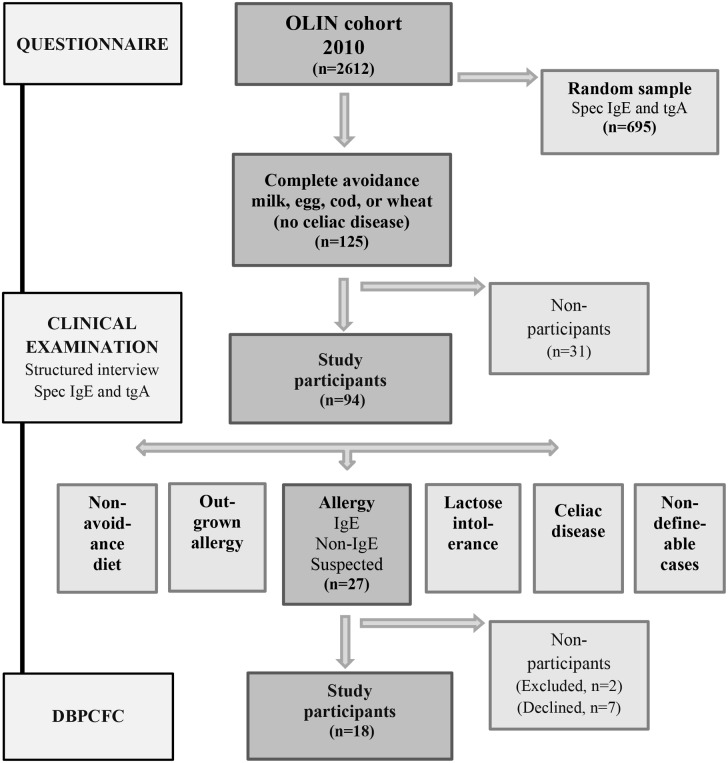
Methods: In a population-based cohort of 12-year-old children, the parents of 2612 (96% of invited) completed a questionnaire. Specific IgE antibodies to foods were analyzed in a random sample (n=695). Children reporting complete avoidance of milk, egg, cod, or wheat due to perceived hypersensitivity and without physician-diagnosed celiac disease were invited to undergo clinical examination that included specific IgE testing, a celiac screening test, and categorization into phenotypes of food hypersensitivity according to preset criteria. Children with possible food allergy were further evaluated with double-blind challenges.
Results: In this cohort, the prevalence of reported food allergy to milk, egg, cod, or wheat was 4.8%. Food allergy was diagnosed in 1.4% of the children after clinical evaluation and in 0.6% following double-blind placebo-controlled food challenge. After clinical examination, children who completely avoided one or more essential foods due to perceived food hypersensitivity were categorized with the following phenotypes: allergy (29%), outgrown allergy (19%), lactose intolerance (40%), and unclear (12%).
Conclusions: There was a high discrepancy in the prevalence of allergy to milk, egg, cod and wheat as assessed by reported data, clinical evaluation, and double-blind food challenges. Food hypersensitivity phenotyping according to preset criteria was helpful for identifying children with food allergy.
Conflict of interest statement
References
-
- Roehr CC, Edenharter G, Reimann S, Ehlers I, Worm M, Zuberbier T, et al. Food allergy and non-allergic food hypersensitivity in children and adolescents. Clin Exp Allergy 2004;34:1534–41. - PubMed
-
- Venter C, Pereira B, Voigt K, Grundy J, Clayton CB, Higgins B, et al. Prevalence and cumulative incidence of food hypersensitivity in the first 3 years of life. Allergy. 2008;63(3):354–9. - PubMed
Publication types
MeSH terms
Substances
LinkOut - more resources
Full Text Sources
Other Literature Sources
Medical
