


Risk factors and outcomes of carbapenem-resistant Klebsiella pneumoniae infections in liver transplant recipients
- PMID: 26136397
- PMCID: PMC4896355
- DOI: 10.1002/lt.24207
Risk factors and outcomes of carbapenem-resistant Klebsiella pneumoniae infections in liver transplant recipients
Abstract
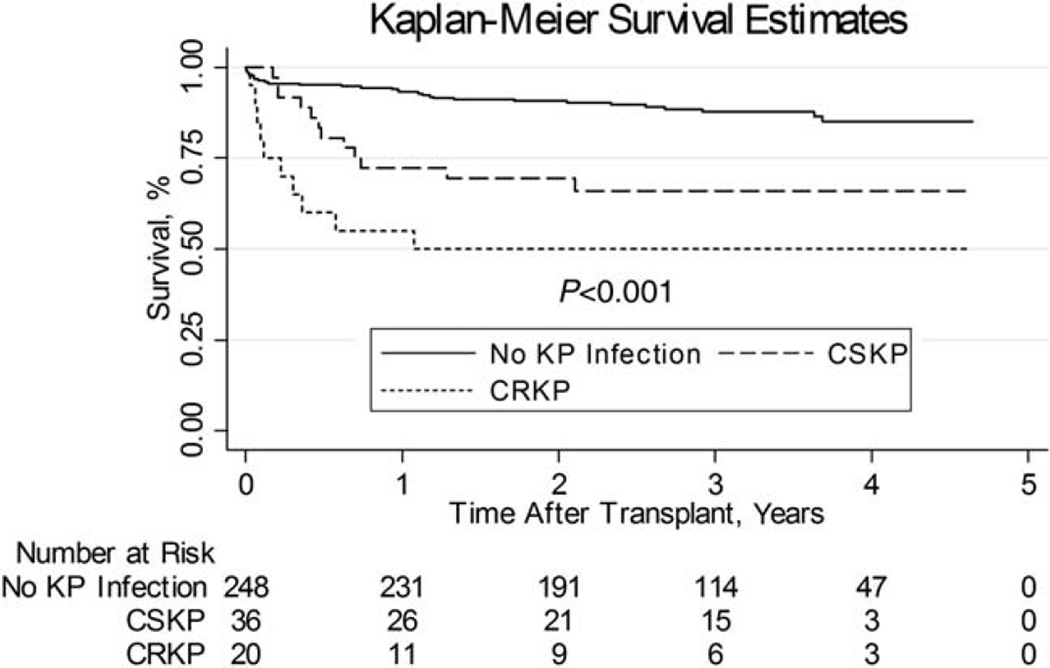
Carbapenem-resistant Klebsiella pneumoniae (CRKP) infection is increasing in incidence and is associated with increased mortality in liver transplantation (LT) recipients. We performed a retrospective cohort study of all patients transplanted between January 2010 and January 2013 to identify the incidence and risk factors for post-LT CRKP infection and evaluate the impact of this infection on outcomes in a CRKP-endemic area. We studied 304 recipients, of whom 20 (6.6%) developed CRKP and 36 (11.8%) carbapenem-susceptible Klebsiella pneumoniae (CSKP) infections in the year following LT. Among the 20 recipients with post-LT CRKP infection, 8 (40%) were infected in ≥ 2 sites; 13 (65%) had surgical site-intra-abdominal infections; 12 (60%) had pneumonia; and 3 (15%) had a urinary tract infection. There were 6 patients with a CRKP infection before LT, 5 of whom developed a CRKP infection after LT. Significant risk factors for post-LT CRKP infection in multivariate analysis included laboratory Model for End-Stage Liver Disease at LT (odds ratio [OR], 1.07; P = 0.001), hepatocellular carcinoma (OR, 3.19; P = 0.02), Roux-en-Y biliary choledochojejunostomy (OR, 3.15; P = 0.04), and bile leak (OR, 5.89; P = 0.001). One-year estimated patient survival was 55% (95% confidence interval, 31%-73%), 72% (55%-84%), and 93% (89%-96%), for patients with CRKP, CSKP, and no Klebsiella pneumoniae infection, respectively. In multivariate analysis, CRKP (hazard ratio [HR], 6.92; P < 0.001) and CSKP infections (CSKP, HR, 3.84; P < 0.001), as well as bile leak (HR, 2.10; P = 0.03) were the strongest predictors of post-LT mortality. In an endemic area, post-LT CRKP infection is common, occurring in 6.6% of recipients, and is strongly associated with post-LT mortality. Improved strategies for screening and prevention of CRKP infection are urgently needed.
© 2015 American Association for the Study of Liver Diseases.
Conflict of interest statement
Potential conflict of interest: Nothing to report.
Figures
Comment in
-
Risk factors and outcomes of carbapenem-resistant Klebsiella pneumoniae infections in liver transplant recipients.Liver Transpl. 2016 Jan;22(1):130. doi: 10.1002/lt.24327. Epub 2015 Oct 29. Liver Transpl. 2016. PMID: 26335447 No abstract available.
-
Reply.Liver Transpl. 2016 Jan;22(1):131. doi: 10.1002/lt.24337. Liver Transpl. 2016. PMID: 26360320 No abstract available.
-
Risk factors and outcomes of carbapenem-resistant Klebsiella pneumoniae infections in liver transplant recipients.Liver Transpl. 2016 May;22(5):698-9. doi: 10.1002/lt.24413. Liver Transpl. 2016. PMID: 26849961 No abstract available.
References
-
- Blair JE, Kusne S. Bacterial, mycobacterial, and protozoal infections after liver transplantation--part I. Liver Transpl. 2005;11:1452–1459. - PubMed
-
- Singh N, Gayowski T, Wagener M, Yu VL. Infectious complications in liver transplant recipients on tacrolimus. Prospective analysis of 88 consecutive liver transplants. Transplantation. 1994;58:774–778. - PubMed
-
- Wagener MM, Yu VL. Bacteremia in transplant recipients: a prospective study of demographics, etiologic agents, risk factors, and outcomes. Am J Infect Control. 1992;20:239–247. - PubMed
-
- Bert F, Larroque B, Paugam-Burtz C, Janny S, Durand F, Dondero F, et al. Microbial epidemiology and outcome of bloodstream infections in liver transplant recipients: an analysis of 259 episodes. Liver Transpl. 2010;16:393–401. - PubMed
-
- Singh N, Wagener MM, Obman A, Cacciarelli TV, de Vera ME, Gayowski T. Bacteremias in liver transplant recipients: shift toward gram-negative bacteria as predominant pathogens. Liver Transpl. 2004;10:844–849. - PubMed
MeSH terms
Substances
Grants and funding
LinkOut - more resources
Full Text Sources
Other Literature Sources
Medical
Research Materials