. 2015:2015:868031.
doi: 10.1155/2015/868031. Epub 2015 Jun 2.

Automated Feature Extraction in Brain Tumor by Magnetic Resonance Imaging Using Gaussian Mixture Models

Affiliations

Automated Feature Extraction in Brain Tumor by Magnetic Resonance Imaging Using Gaussian Mixture Models

Ahmad Chaddad. Int J Biomed Imaging. 2015.

Erratum in

Abstract

This paper presents a novel method for Glioblastoma (GBM) feature extraction based on Gaussian mixture model (GMM) features using MRI. We addressed the task of the new features to identify GBM using T1 and T2 weighted images (T1-WI, T2-WI) and Fluid-Attenuated Inversion Recovery (FLAIR) MR images. A pathologic area was detected using multithresholding segmentation with morphological operations of MR images. Multiclassifier techniques were considered to evaluate the performance of the feature based scheme in terms of its capability to discriminate GBM and normal tissue. GMM features demonstrated the best performance by the comparative study using principal component analysis (PCA) and wavelet based features. For the T1-WI, the accuracy performance was 97.05% (AUC = 92.73%) with 0.00% missed detection and 2.95% false alarm. In the T2-WI, the same accuracy (97.05%, AUC = 91.70%) value was achieved with 2.95% missed detection and 0.00% false alarm. In FLAIR mode the accuracy decreased to 94.11% (AUC = 95.85%) with 0.00% missed detection and 5.89% false alarm. These experimental results are promising to enhance the characteristics of heterogeneity and hence early treatment of GBM.


Figures
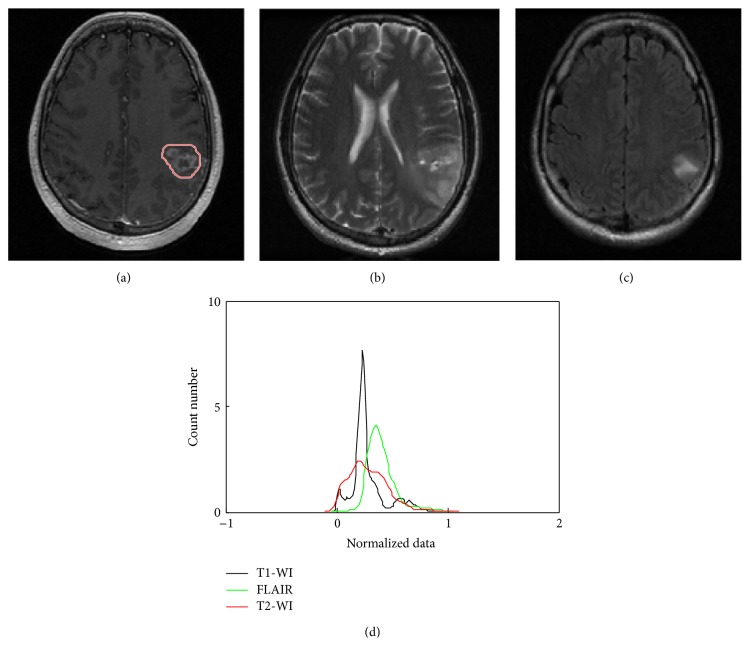
Figure 1
Figure 1
Analysis of GBM schema: (a) brain tumor image on axial T1-WI, (b) axial T2-WI, (c) axial FLAIR sequence, and (d) GBM data fitting in three MR sequences.
Figure 2
Figure 2
Schematic diagram of the proposed method for automatic feature extraction.
Figure 3
Figure 3
Principal components based on higher variance of GBM and normal areas: (black curve) variance magnitude of 17 normal areas from T1-WI, T2-WI, and FLAIR, (blue curve) variance magnitude of 17 GBMs chosen from T1-WI, (red curve) variance magnitude of 17 GBMs chosen from T2-WI, and (green curve) variance magnitude of 17 chosen GBMs chosen from FLAIR mode of MRI.
Figure 4
Figure 4
GBM detection by segmentation and morphology operations: (a) T1-MR image, (b) image segmented by four levels, (c) range of GBM gray level conserve, (d) filtering of (c), (e) raw GBM data detected, and (f) GBM located on the brain image.
Figure 5
Figure 5
GMM curve fitting: example of GBM based GMM features.
Figure 6
Figure 6
Heat map with correlation coefficients between GMM features: w, μ, and v are the weight, average, and variance, respectively; N and T are the index of normal and tumor (GBM) areas, respectively.
Figure 7
Figure 7
ROC curves of GBM and normal area discrimination based on T1-WI, T2-WI, FLAIR, and entire MR mode (T1-WI, T2-WI, and FLAIR, 51 images): (a) GMM features, (b) PCA features, and (c) Daubechies (db1) and Coiflets (coif1) wavelet features.

References

    1. Chen C.-C., Wan Y.-L., Wai Y.-Y., Liu H.-L. Quality assurance of clinical MRI scanners using ACR MRI phantom: preliminary results. Journal of Digital Imaging. 2004;17(4):279–284. doi: 10.1007/s10278-004-1023-5. - DOI - PMC - PubMed
    1. Sachdeva J., Kumar V., Gupta I., Khandelwal N., Ahuja C. K. Segmentation, feature extraction, and multiclass brain tumor classification. Journal of Digital Imaging. 2013;26(6):1141–1150. doi: 10.1007/s10278-013-9600-0. - DOI - PMC - PubMed
    1. Patriarche J. W., Erickson B. J. Part 1. Automated change detection and characterization in serial MR studies of brain-tumor patients. Journal of Digital Imaging. 2007;20(3):203–222. doi: 10.1007/s10278-006-1038-1. - DOI - PMC - PubMed
    1. Likar B., Viergever M. A., Pernuš F. Retrospective correction of MR intensity inhomogeneity by information minimization. IEEE Transactions on Medical Imaging. 2001;20(12):1398–1410. doi: 10.1109/42.974934. - DOI - PubMed
    1. Yang F., Thomas M. A., Dehdashti F., Grigsby P. W. Temporal analysis of intratumoral metabolic heterogeneity characterized by textural features in cervical cancer. European Journal of Nuclear Medicine and Molecular Imaging. 2013;40(5):716–727. doi: 10.1007/s00259-012-2332-4. - DOI - PMC - PubMed
