Review
. 2015:2015:508409.
doi: 10.1155/2015/508409. Epub 2015 Jun 2.

Mechanisms Linking Inflammation to Insulin Resistance

Affiliations
Review

Mechanisms Linking Inflammation to Insulin Resistance

Li Chen et al. Int J Endocrinol. 2015.

Abstract

Obesity is now widespread around the world. Obesity-associated chronic low-grade inflammation is responsible for the decrease of insulin sensitivity, which makes obesity a major risk factor for insulin resistance and related diseases such as type 2 diabetes mellitus and metabolic syndromes. The state of low-grade inflammation is caused by overnutrition which leads to lipid accumulation in adipocytes. Obesity might increase the expression of some inflammatory cytokines and activate several signaling pathways, both of which are involved in the pathogenesis of insulin resistance by interfering with insulin signaling and action. It has been suggested that specific factors and signaling pathways are often correlated with each other; therefore, both of the fluctuation of cytokines and the status of relevant signaling pathways should be considered during studies analyzing inflammation-related insulin resistance. In this paper, we discuss how these factors and signaling pathways contribute to insulin resistance and the therapeutic promise targeting inflammation in insulin resistance based on the latest experimental studies.


Figures
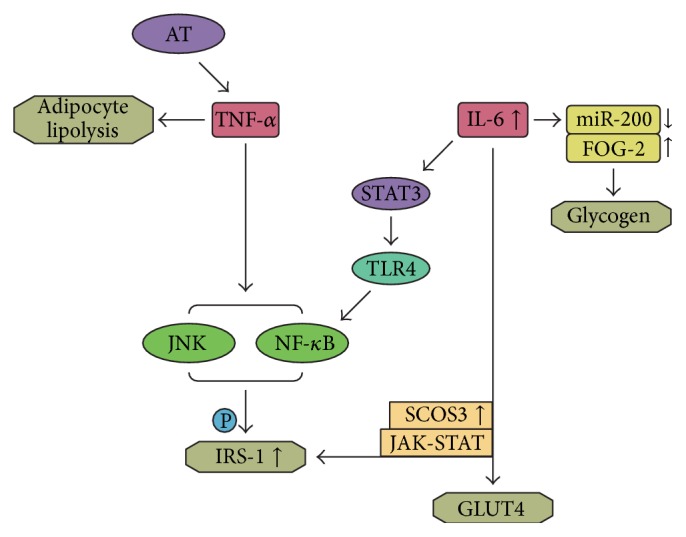
Figure 1
Figure 1
Influence of the inflammatory cytokines on the status of insulin resistance. TNF-α causes insulin resistance by enhancing adipocyte lipolysis stimulating JNK and IKKβ/NF-κB pathway which may increase serine/threonine phosphorylation of IRS1. IL-6 induces IR by reducing the expression of GLUT4 and IRS-1 by activating the JAK-STAT signaling pathway and increasing SOCS3 expression, and IL-6 can also lead to IR in skeletal muscle by inducing TLR-4 gene expression through activation of STAT3; besides, TLR4 is suggested to be major upstream molecules in the activation of NF-κB. Besides, IL-6 is also found to induce IR by impairing the synthesis of glycogen through downregulating the expression of miR-200s and upregulating that of FOG-2.
Figure 2
Figure 2
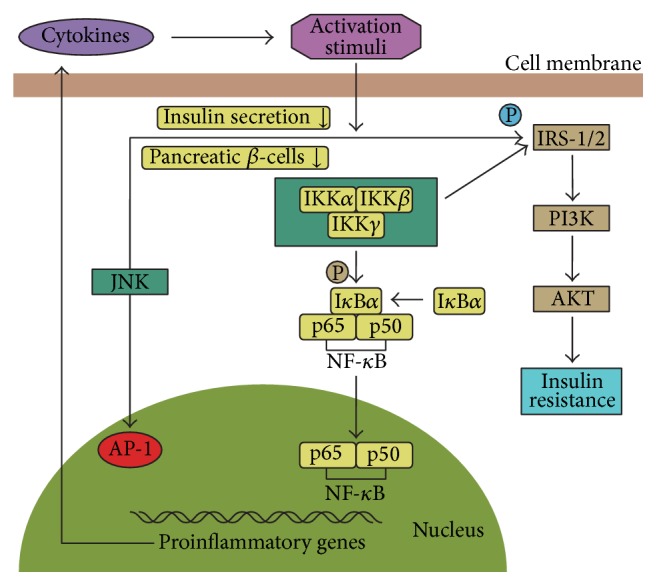
Inflammatory pathways linking inflammation to insulin resistance. Activation of JNK and NF-κB pathways causes serine kinase phosphorylation of IRS-1 or IRS-2, which may block insulin signaling and finally lead to the occurrence of IR. In addition, JNK and NF-κB pathways are involved in the production of proinflammatory cytokines which may in turn become activation stimuli of the pathways.
Figure 3
Figure 3
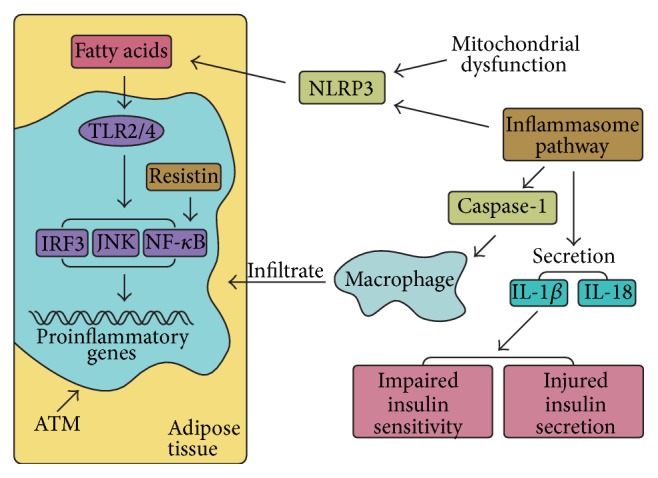
Inflammasome pathway and macrophages are involved in development of insulin resistance. The secretion of IL-β and IL-18 can be regulated by inflammasome pathway. Inflammasome consists of a large group of cytosolic protein complexes including NLRP3 and caspase-1. NLRP3 can be activated by mitochondrial dysfunction through causing ROS accumulation, and NLRP3 is also a novel molecular link between saturated FFA and chronic inflammation. Caspase-1 mediates macrophages that infiltrate into adipose tissues. Dietary saturated fatty acids lead to activation of TLR2 and TLR4 in ATMs, giving rise to the activation of IRF3, JNK, and NF-κB.

References

    1. Chawla A., Nguyen K. D., Goh Y. P. S. Macrophage-mediated inflammation in metabolic disease. Nature Reviews Immunology. 2011;11(11):738–749. doi: 10.1038/nri3071. - DOI - PMC - PubMed
    1. Liang F. X., Koya D. Acupuncture: is it effective for treatment of Insulin resistance? Diabetes, Obesity and Metabolism. 2010;12(7):555–569. doi: 10.1111/j.1463-1326.2009.01192.x. - DOI - PubMed
    1. Laakso M., Kuusisto J. Insulin resistance and hyperglycaemia in cardiovascular disease development. Nature Reviews Endocrinology. 2014;10(5):293–302. doi: 10.1038/nrendo.2014.29. - DOI - PubMed
    1. Mavrogiannaki A. N., Migdalis I. N. Nonalcoholic fatty liver disease, diabetes mellitus and cardiovascular disease: newer data. International Journal of Endocrinology. 2013;2013:8. doi: 10.1155/2013/450639.450639 - DOI - PMC - PubMed
    1. Gaggini M., Morelli M., Buzzigoli E., DeFronzo R. A., Bugianesi E., Gastaldelli A. Non-alcoholic fatty liver disease (NAFLD) and its connection with insulin resistance, dyslipidemia, atherosclerosis and coronary heart disease. Nutrients. 2013;5(5):1544–1560. doi: 10.3390/nu5051544. - DOI - PMC - PubMed