. 2015 Jun 21:5:33.
doi: 10.1186/s13578-015-0027-9. eCollection 2015.

Application of CRISPR/Cas9 for biomedical discoveries

Affiliations

Application of CRISPR/Cas9 for biomedical discoveries

Sean M Riordan et al. Cell Biosci. .

Abstract

The Clustered Regions of Interspersed Palindromic Repeats-Cas9 (CRISPR/Cas9), a viral defense system found in bacteria and archaea, has emerged as a tour de force genome editing tool. The CRISPR/Cas9 system is much easier to customize and optimize because the site selection for DNA cleavage is guided by a short sequence of RNA rather than an engineered protein as in the systems of zinc finger nucleases (ZFN), transcription activator-like effector nucleases (TALEN), and meganucleases. Although it still suffers from some off-target effects, the CRISPR/Cas9 system has been broadly and successfully applied for biomedical discoveries in a number of areas. In this review, we present a brief history and development of the CRISPR system and focus on the application of this genome editing technology for biomedical discoveries. We then present concise concluding remarks and future directions for this fast moving field.

Keywords: Animal model; CRISPR; Cas9; Genome editing.


Figures
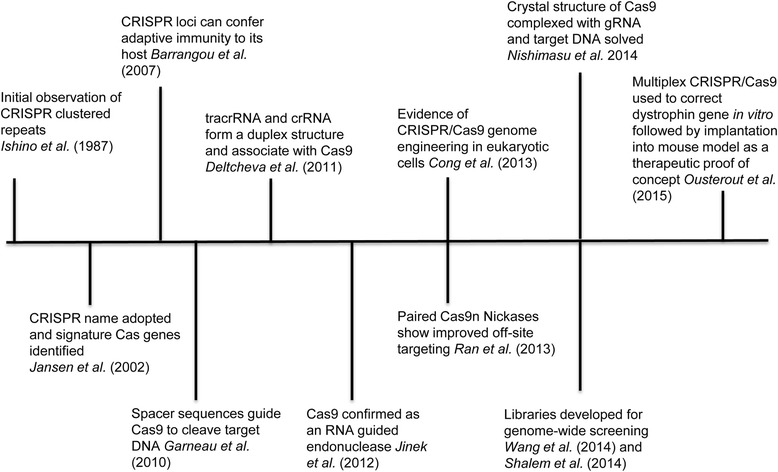
Fig. 1
Fig. 1
History of CRISPR/Cas development. A useful understanding of the potential and capabilities of the CRISPR/Cas system took many years to develop. Only recently has there been an explosion in the development and application of this system
Fig. 2
Fig. 2
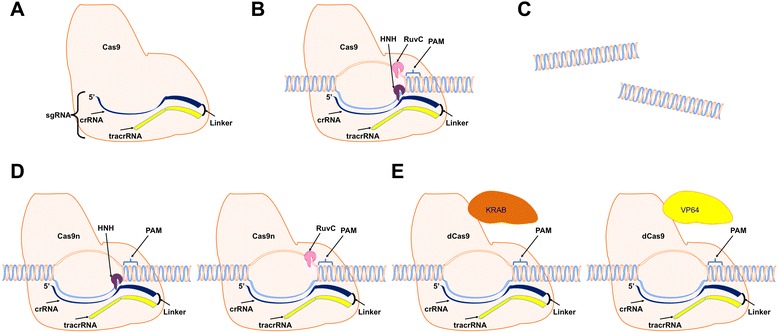
Mechanism of Cas9 action. a The three essential components necessary for CRISPR/Cas activity, using spCas9 as an example, are Cas9, crRNA and tracrRNA. The introduction of the linker region to combine the crRNA and tracrRNA into a single guide RNA (sgRNA) improves overall targeting efficiency. b Recognition of the protospacer region by the sgRNA in conjunction with Cas9 recognition of the appropriate PAM sequence initiates cleavage. c Cleaved DNA fragments. d Mutated forms of Cas9 can contain a single active domain to act as a Cas9n “nickase” where only one strand of the DNA is cleaved. e Alternatively both catalytic domains can be mutated to form a dCas9 “dead” nuclease that can then be tethered to effector molecules to target repression or activation, KRAB and VP64 respectively, for example. Images adapted from motifolio.com

References

    1. Bibikova M, Carroll D, Segal DJ, Trautman JK, Smith J, Kim YG, et al. Stimulation of homologous recombination through targeted cleavage by chimeric nucleases. Mol Cell Biol. 2001;21(1):289–97. - PMC - PubMed
    1. Urnov FD, Miller JC, Lee YL, Beausejour CM, Rock JM, Augustus S, et al. Highly efficient endogenous human gene correction using designed zinc-finger nucleases. Nature. 2005;435(7042):646–51. - PubMed
    1. Durai S, Mani M, Kandavelou K, Wu J, Porteus MH, Chandrasegaran S. Zinc finger nucleases: custom-designed molecular scissors for genome engineering of plant and mammalian cells. Nucleic Acids Res. 2005;33(18):5978–90. - PMC - PubMed
    1. Kim YG, Cha J, Chandrasegaran S. Hybrid restriction enzymes: zinc finger fusions to Fok I cleavage domain. Proc Natl Acad Sci. 1996;93(3):1156–60. - PMC - PubMed
    1. Rouet P, Smih F, Jasin M. Introduction of double-strand breaks into the genome of mouse cells by expression of a rare-cutting endonuclease. Mol Cell Biol. 1994;14(12):8096–106. - PMC - PubMed