


How Long Do We Need to Follow-Up Our Hernia Patients to Find the Real Recurrence Rate?
- PMID: 26137464
- PMCID: PMC4468742
- DOI: 10.3389/fsurg.2015.00024
How Long Do We Need to Follow-Up Our Hernia Patients to Find the Real Recurrence Rate?
Abstract
Introduction: It is known that recurrences continue to occur after the follow-up period of 1-5 years usually used in most hernia studies. By reviewing the data in the Herniamed Hernia Registry documenting the time interval between the recurrent operation and previous inguinal hernia repair, the present study identifies the temporal course of onset of recurrence.
Patients and methods: Prospective data were recorded in the Herniamed Registry between 1 September 2009 and 4 May 2015 on a total of 145,590 patients with 171,143 inguinal hernia operations. These included 18,774 operations due to an inguinal hernia recurrence (10.94%). During the same period, prospective data were collected on 24,385 incisional hernia operations. The latter cases included 5,328 patients with a recurrent incisional hernia (21.85%).
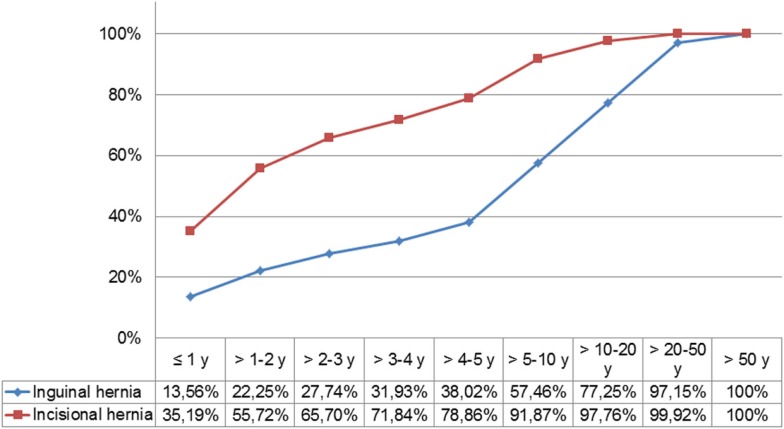
Results: Only 57.46% of all inguinal hernia recurrences occurred within 10 years of the previous inguinal hernia operation. Some of the remaining 42.54% of all recurrences occurred only much later, even after more than 50 years. The course of onset of recurrence is markedly different for incisional hernia. About 91.87% of such recurrences occur already within 10 years of the last operation.
Conclusion: Ascertainment of the actual recurrence rate after hernia repair calls for a follow-up of 10 years for incisional hernia and of 50 years for inguinal hernia. The data collected can be used to give an approximate estimate with a shorter follow-up.
Keywords: follow-up; incisional hernia; inguinal hernia; recurrence; reoperation.
Figures
References
-
- Sarosi GA, Jr, Ben-David K. Recurrent Inguinal and Femoral Hernia. UpToDate; (2014). Available from: www.uptodate.com/contents/recurrent-inguinal-and-femoral-hernia
LinkOut - more resources
Full Text Sources
Other Literature Sources
