


SIRT3 regulates progression and development of diseases of aging
- PMID: 26138757
- PMCID: PMC4558250
- DOI: 10.1016/j.tem.2015.06.001
SIRT3 regulates progression and development of diseases of aging
Abstract
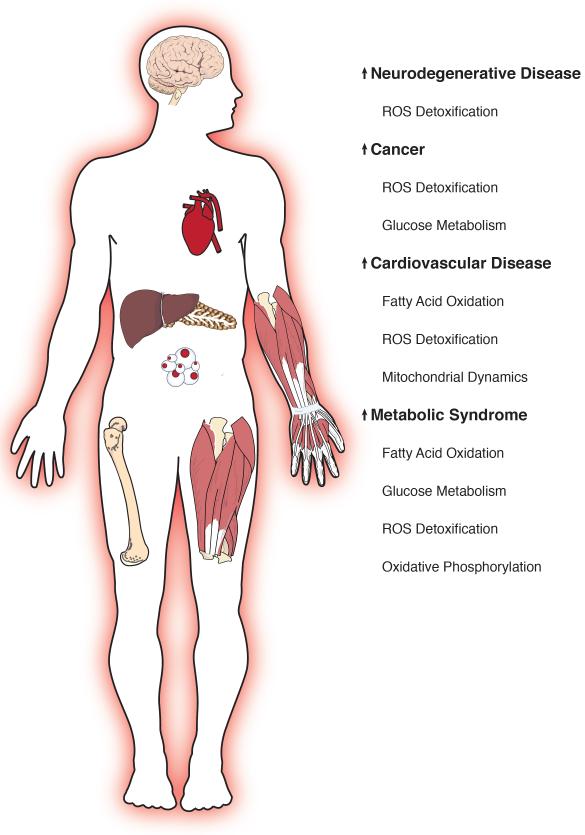
The mitochondrial sirtuin SIRT3 is a protein deacylase that influences almost every major aspect of mitochondrial biology, including nutrient oxidation, ATP generation, reactive oxygen species (ROS) detoxification, mitochondrial dynamics, and the mitochondrial unfolded protein response (UPR). Interestingly, mice lacking SIRT3 (SIRT3KO), either spontaneously or when crossed with mouse models of disease, develop several diseases of aging at an accelerated pace, such as cancer, metabolic syndrome, cardiovascular disease, and neurodegenerative diseases, and, thus, might be a valuable model of accelerated aging. In this review, we discuss functions of SIRT3 in pathways involved in diseases of aging and how the lack of SIRT3 might accelerate the aging process. We also suggest that further studies on SIRT3 will help uncover important new pathways driving the aging process.
Keywords: SIRT3; aging; disease; mitochondria; sirtuins.
Copyright © 2015 Elsevier Ltd. All rights reserved.
Figures
References
-
- Frye RA. Characterization of five human cDNAs with homology to the yeast SIR2 gene: Sir2-like proteins (sirtuins) metabolize NAD and may have protein ADP-ribosyltransferase activity. Biochem Biophys Res Commun. 1999;260(1):273–9. - PubMed
-
- Lin SJ, Defossez PA, Guarente L. Requirement of NAD and SIR2 for life span extension by calorie restriction in Saccharomyces cerevisiae. Science. 2000;289(5487):2126–8. - PubMed
Publication types
MeSH terms
Substances
Grants and funding
- P30AG028716-01/AG/NIA NIH HHS/United States
- T32 GM007184/GM/NIGMS NIH HHS/United States
- T32 CA059365/CA/NCI NIH HHS/United States
- R01AG045351/AG/NIA NIH HHS/United States
- R24 DK085610/DK/NIDDK NIH HHS/United States
- R01AA022146/AA/NIAAA NIH HHS/United States
- R24DK085610-05/DK/NIDDK NIH HHS/United States
- R01 AG045351/AG/NIA NIH HHS/United States
- P30 AG028716/AG/NIA NIH HHS/United States
- 5T32GM007105-40/GM/NIGMS NIH HHS/United States
- R01 AA022146/AA/NIAAA NIH HHS/United States
- T32 GM007105/GM/NIGMS NIH HHS/United States
- 5T32-CA059365/CA/NCI NIH HHS/United States
LinkOut - more resources
Full Text Sources
Other Literature Sources
Medical
