


Malaria situation in India with special reference to tribal areas
- PMID: 26139770
- PMCID: PMC4510751
- DOI: 10.4103/0971-5916.159510
Malaria situation in India with special reference to tribal areas
Abstract
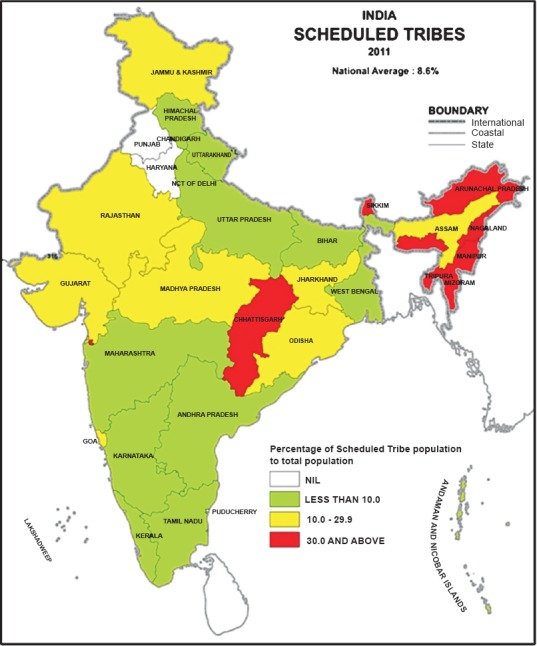
Background & objectives: In India, malaria is a major public health problem in States having predominantly tribal population. The objective of this analysis was to find out the incidence of malaria in various States/districts having varied proportions of tribal population using National Vector Borne Disease Control Programme (NVBDCP) data.
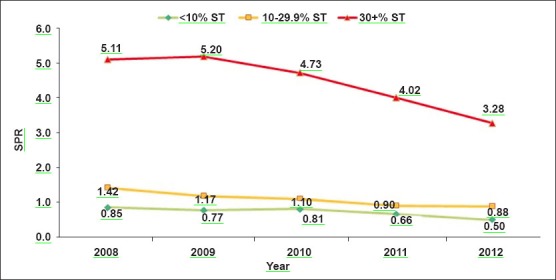
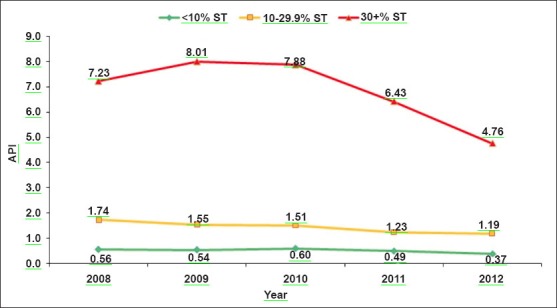
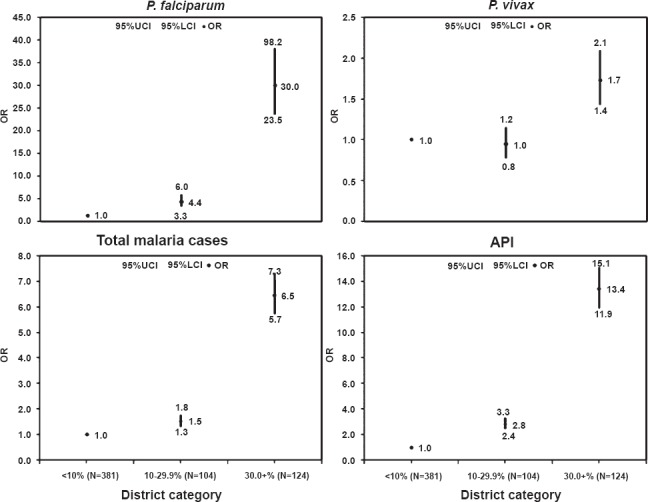
Methods: States and districts were classified into three categories based on proportions of Scheduled Tribes (ST) population as <10, 10-29.9 and 30 per cent + ST population. Five year average (2008-2012) of all important malaria indicators collected by NVBDCP was taken to normalize the effect of annual fluctuations in malaria incidence.
Results: State level analysis revealed that ten States/UTs with 30 per cent or more tribal population comprising only three per cent of total population, contributed 14 per cent of total malaria, 21 per cent Plasmodium falciparum and 29 per cent of deaths due to malaria. Similarly, district level analysis showed that districts with 30 per cent or more tribal population comprising about eight per cent country's population contributed to 46 per cent of total malaria cases, 70 per cent P. falciparum and 47 per cent malarial deaths in the country.
Interpretation & conclusions: Our analysis showed that the neglect of the ethnic communities in tribal areas would be detrimental to the overall reduction of morbidity and mortality due to malaria. The fight against the increasing burden of malaria in tribal belt requires adoption of multiple approaches and socio-economic development of the tribal communities.
Figures
References
-
- World malaria report 2013. Geneva: World Health Organization; 2013. [accessed on March 11, 2014]. WHO. Available from: www.who.int/iris/bitstream/10665/97008/1/9789241564694_eng.pdf .
-
- World malaria report 2011. Geneva: World Health Organization; [accessed on March 11, 2014]. WHO. Available from: http://www.who.int/malaria/world_malaria _report_2011/9789241564403_eng.pdf .
-
- Malaria situation in India. Geneva: World Health Organization; [accessed on March 11, 2014]. National Vector Borne Disease Control Programme, (2010-2014) Available from: http://www.nvbdcp.gov.in/Doc/malaria-situation-March14.pdf .
-
- Singh N, Singh OP, Sharma VP. Dynamics of malaria transmission in forested and deforested region of Mandla district, Central India, Madhya Pradesh. J Am Mosq Cont Assoc. 1996;12:225–34. - PubMed
MeSH terms
LinkOut - more resources
Full Text Sources