


Transforming Ward Rounds Through Rounding-in-Flow
- PMID: 26140131
- PMCID: PMC4477576
- DOI: 10.4300/JGME-D-13-00324.1
Transforming Ward Rounds Through Rounding-in-Flow
Abstract
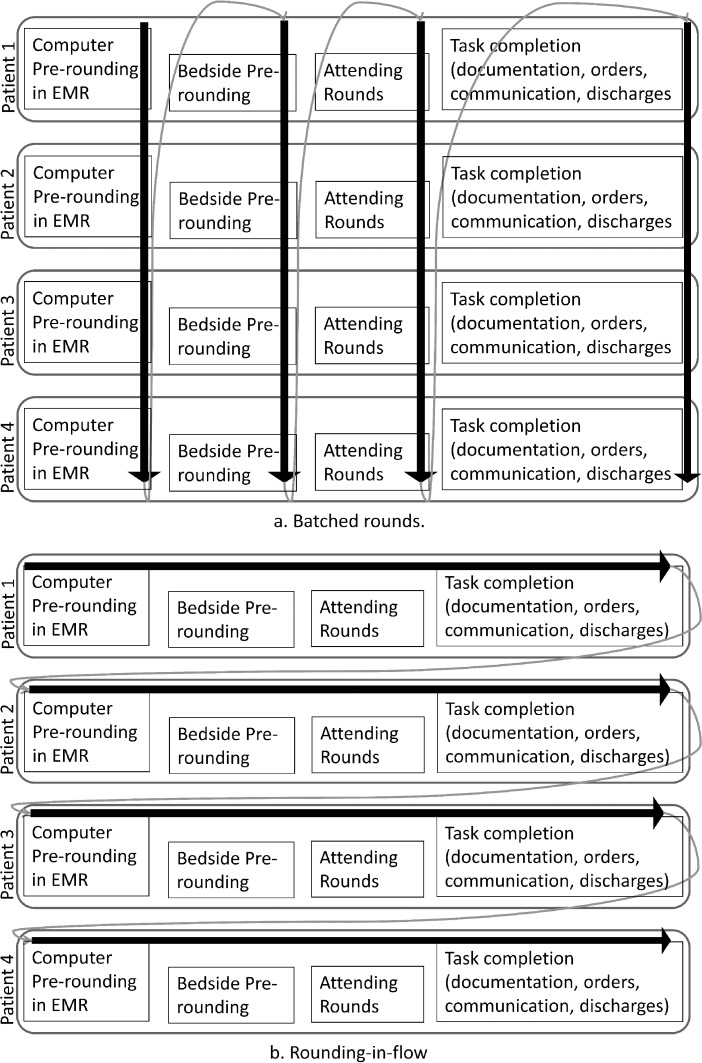
Background: Traditional "batched" bedside clinical care rounds, where rounds for all patients precede clinical tasks, may delay clinical care and reduce resident work efficiency.
Innovation: Using Lean concepts, we developed a novel "Rounding-in-Flow" approach, with the patient care team completing all tasks for a single patient before initiating any tasks for the next patient. Outcome measures included timely patient discharge and intern work hours.
Methods: We performed a retrospective cohort study with historic and contemporaneous control groups, with time series adjustment for underlying temporal trends at a single medical center. Primary outcomes were timely patient discharge orders and resident duty hours. Participants were 17 376 consecutive hospital inpatients between January 1, 2011, and June 30, 2012, and medical ward rounding teams of interns, residents, and attending hospitalists.
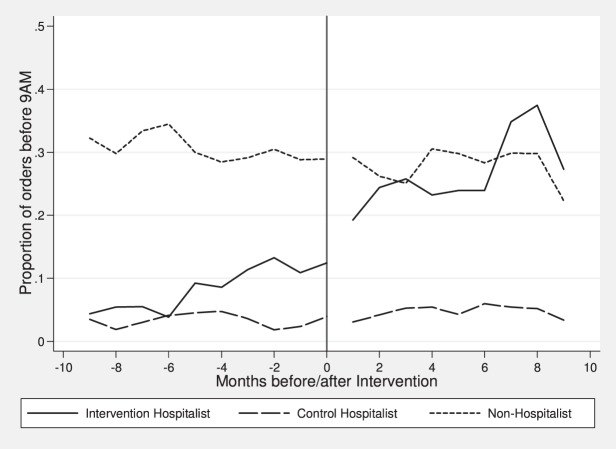
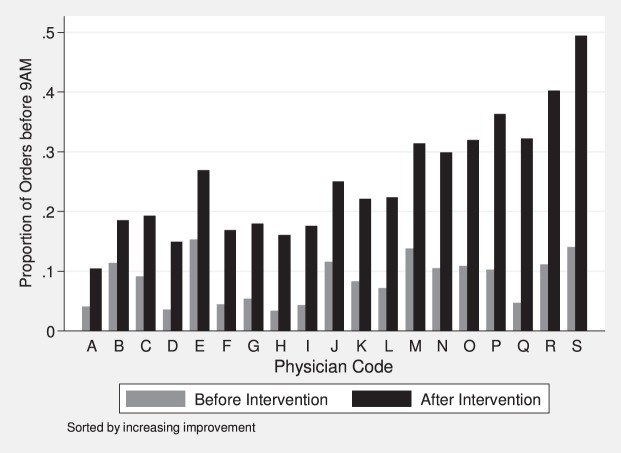
Results: Timely discharge orders, defined as written by 9:00 am, improved from 8.6% to 26.6% (OR, 1.55; 95% CI 1.17-2.06; P = .003). Time of actual patient discharge was unchanged. Resident duty hour violations, defined as less than 10 hours between clinical duties, decreased from 2.96 to 0.98 per intern per rotation (difference, 1.98; 95% CI 1.09-2.87; P < .001). Average daily intern work hours decreased from 12.3 to 11.9 hours (difference, 0.4 hours; 95% CI 0.16-0.69; P = .002).
Conclusions: Compared with batched rounding, Lean Rounding-in-Flow using "1-piece flow" principles was associated with more discharge orders written before 9:00 am and fewer violations in the 10-hour break rule, with minimal changes to intern total work hours and actual patient discharge time.
Figures
References
-
- Bush RW. Reducing waste in US health care systems. JAMA. 2007;297(8):871–874. - PubMed
-
- Kenney C. Transforming Health Care: Virginia Mason Medical Center's Pursuit of the Perfect Patient Experience. New York, NY: Productivity Press–Taylor & Francis Group; 2011.
-
- Kaplan GS. Waste not: the management imperative for healthcare. J Healthc Manag. 2012;57(3):160–166. - PubMed
-
- Ohno T. Toyota Production System: Beyond Large-Scale Production. New York, NY: Productivity Press; 1998.
LinkOut - more resources
Full Text Sources
Other Literature Sources
