


Teaching global health with simulations and case discussions in a medical student selective
- PMID: 26141160
- PMCID: PMC4491235
- DOI: 10.1186/s12992-015-0111-2
Teaching global health with simulations and case discussions in a medical student selective
Abstract
Background: Among US medical schools, demand for Global Health (GH) programs continues to grow. At the same time, cultural competency training has become a priority for medical students who will care for an increasingly diverse US patient population. We describe a pilot period for a new GH Selective designed to introduce medical students to global medicine and enhance culturally-sensitive communication skills.
Methods: As a 4-week clinical clerkship, the GH Selective was offered annually over a three-year period to a total of 33 students. Activities included clinical assignments, cultural competency and clinical skills simulations, patient case discussions in tropical medicine, journal clubs, and lectures. Faculty assessments of student performance and student evaluations of course content were focused on 6 course objectives, adapted from standardized GH objectives.
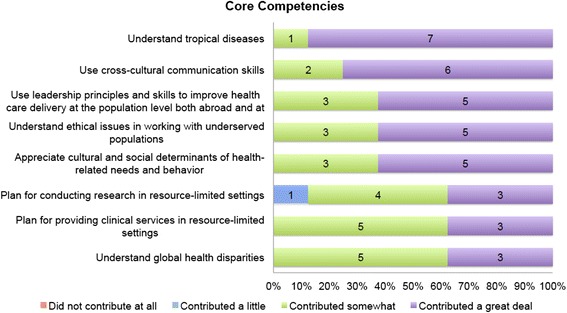
Results: For each offering of the GH Selective, at least 40 faculty members and fellows volunteered over 200 teaching hours from 11 medical school departments. Student feedback was consistently positive through competency-based curricular evaluations. As a result of its successes, the course is now offered on a biannual basis.
Discussion: Experiential, student-centered teaching employed in this course proved successful as an introduction to delivery of evidence-based and culturally sensitive GH. Special emphasis on working with standardized patients in interdisciplinary and cross-cultural simulations provided students with clinical skills applicable for care provided both locally and on international rotations.
Conclusion: With a special emphasis on cross-cultural sensitivity, this pilot elective trained future practitioners in fund of knowledge, clinical skills, and service delivery methods in GH.
Figures

References
-
- New York University and NYU Global Institute of Public Health. Summary Report. Global Colloquium of University Presidents; 2013
-
- Association of American Medical Colleges. Cultural competence education. Available at: (https://www.aamc.org/download/54338/data/). Accessed December 11, 2014.
Publication types
MeSH terms
LinkOut - more resources
Full Text Sources
Other Literature Sources
Medical
Research Materials
